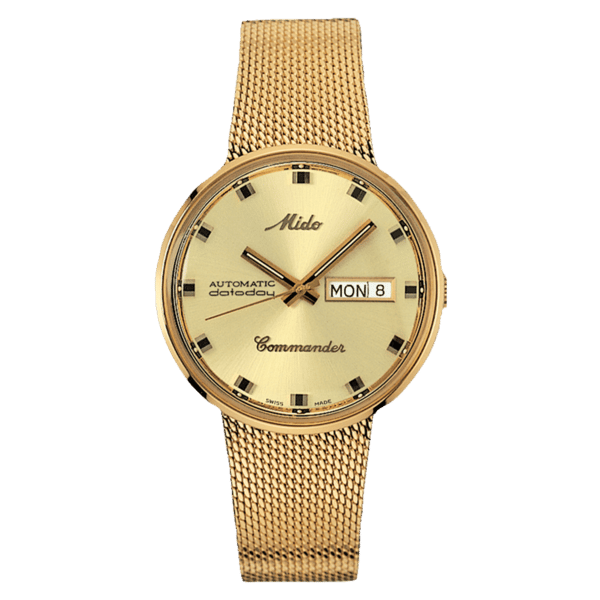
The Architectural Legacy of the Mido Commander
In the pantheon of Swiss watchmaking, there are few models that can claim an uninterrupted production run spanning over sixty years. The Mido Commander is one such rarity. Launched in 1959, the Commander was born during an era of optimism and industrial growth, where the lines of architecture and product design began to blur. Mido’s designers looked toward the Eiffel Tower—not for its ornate lattice, but for its structural integrity and the way it defined the Parisian skyline through iron and geometry. The reference M021.626.11.031.00 is the modern heir to this legacy, a watch that retains the soul of the original while incorporating twenty-first-century mechanical advancements.
Case Construction and Aesthetic Philosophy
The first thing one notices about the Commander Big Date is its 'all-dial' presence. By utilizing an extremely thin bezel, Mido maximizes the visual real estate of the 42mm case. This design choice is a direct nod to the mid-century aesthetic where legibility was paramount. The case itself is crafted from 316L stainless steel, featuring a mixture of satin-brushed surfaces and high-polish accents. The transition between these finishes is sharp, indicating a level of manufacturing precision that punches far above the watch's price point.
The lugs are perhaps the most critical element of the Commander’s architecture. They are short, almost stubby, and integrated into the case in a way that minimizes the lug-to-lug distance to approximately 45mm. This is a masterstroke of ergonomics. It allows a 42mm watch to sit comfortably on a 6.5-inch wrist without the lugs overhanging the wrist's edges. The case back is solid, secured by screws, which aids in maintaining the watch's relatively slim profile of 11.97mm. While 50 meters of water resistance may seem conservative to the modern collector, it is historically accurate for a piece that leans more toward the dress-sport hybrid category than a dedicated tool watch.
The Dial: A Study in Depth and Clarity
The dial of the M021.626.11.031.00 is a sunray-finished silver masterpiece. In direct sunlight, the graining of the dial creates a radial light play that shifts from bright white to a deep, metallic grey. The indices are applied, faceted, and polished, featuring a black lacquer inlay that provides a stark contrast against the silver background. This contrast is further enhanced by the use of Super-LumiNova on both the hands and the outer pips of the hour markers, ensuring that the watch remains functional in low-light environments.
However, the piece de resistance is the Big Date complication at 6 o'clock. Unlike a standard date window, which uses a single disc with numbers 1 through 31, the Big Date (or 'Grande Date') utilizes two independent discs—one for the tens and one for the units. This allows for a significantly larger aperture, making the date legible at a glance. The implementation here is flawless; the two discs are perfectly aligned, and the jump at midnight is crisp. Framing the date window is a polished steel border that anchors the bottom of the dial, providing a visual counterweight to the Mido logo at 12 o'clock.
The Caliber 80: Mechanical Superiority
Under the hood lies the Mido Caliber 80, a movement that has redefined expectations for the entry-to-mid-level luxury segment. Based on the ETA C07.651 (a derivative of the legendary 2824-2), this movement is a testament to the Swatch Group’s industrial might. The primary achievement of the Caliber 80 is its eponymous 80-hour power reserve. This was achieved by reducing the frequency from the standard 4Hz (28,800 vph) to 3Hz (21,600 vph) and utilizing a high-performance Nivaflex NM mainspring.
From a technical standpoint, the reduction in frequency is a calculated trade-off. While a higher beat rate offers a smoother sweep of the seconds hand, the 3Hz rate allows for significantly less friction and wear on the escapement, contributing to longer service intervals. Furthermore, the movement features a friction-reduced escapement and a laser-regulated balance wheel. By removing the traditional regulator index, Mido (via ETA) has created a more stable, shock-resistant platform that maintains its accuracy over the entire duration of the power reserve. The finishing on the movement—though hidden behind a solid caseback in this reference—is of the Elaboré grade, meaning it is decorated with perlage and Geneva stripes on the rotor, and adjusted in three positions for better accuracy.
The Bracelet: Engineering Comfort
The bracelet of the Commander Big Date is a three-link design that echoes the robustness of the case. The links are primarily brushed, with polished flanks that catch the light as the wrist moves. What sets this bracelet apart is its flexibility. The individual links are small enough to contour around the wrist, avoiding the 'stiff' feeling often associated with lower-cost steel bracelets. The folding clasp is secure and features a dual-push-button release, though it lacks a micro-adjustment system, which is perhaps the only minor grievance in an otherwise stellar package.
Market Positioning and the Value Proposition
In the context of the Swatch Group's hierarchy, Mido sits comfortably between Tissot and Longines. However, the Commander Big Date often feels like it is punching into Longines territory. When compared to other 'Big Date' watches on the market—many of which come from high-end Glashütte manufactures—the Mido offers a staggering 90% of the experience for 10% of the price. It is a watch for the collector who appreciates the history of the 'Ocean Star' line (of which the Commander was originally a part) and who wants a movement that won't require constant winding if left off the wrist for a weekend.
Final Thoughts on the Reference M021.626.11.031.00
The Mido Commander Big Date is a rare example of a watch that honors its past without being a slave to it. It takes the architectural spirit of 1959 and reinforces it with modern metallurgical and mechanical standards. For the young professional or the seasoned collector looking for a reliable, historically significant daily wearer, this reference is nearly impossible to fault. It is precise, technically interesting due to its dual-disc date, and aesthetically timeless. In an industry often obsessed with the next 'big thing,' the Commander reminds us that sometimes, the best designs are the ones that never left.