Introduction
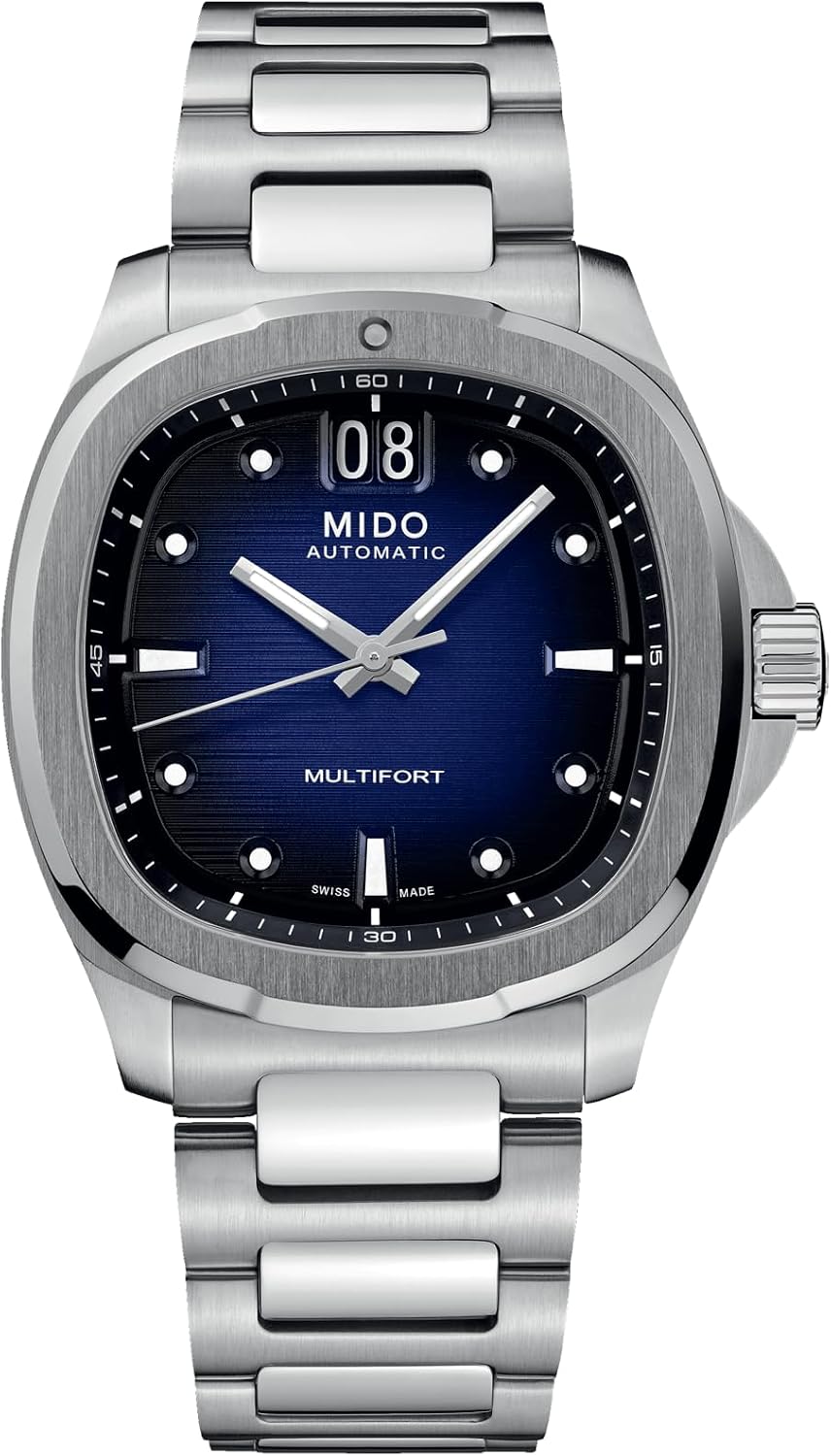
The Mido Multifort Skeleton Vertigo (ref. M038.436.11.031.00) is a bold entry in the affordable Swiss skeleton watch segment. With a green gradient dial that fades from dark forest at the edges to a lighter center, it offers a modern take on the classic open-heart design. But beyond the visual drama, this is a watch built for real wear—tested through a week of commutes, workouts, and evening events.
Mido has long been known for producing robust, value-driven Swiss watches, and the Multifort line—inspired by the 1930s architecture of the Sydney Harbour Bridge—brings a distinct industrial aesthetic. The Vertigo variant takes that foundation and adds a skeletonized movement, exposing the Caliber 80’s oscillating weight and gear train through a smoked sapphire dial. The result is a watch that feels both technical and artistic, without the usual compromises in readability or durability.
In this review, we’ll focus on how the Multifort Skeleton Vertigo actually performs on the wrist: its lug-to-lug fit, crown comfort, lume performance, and whether it can survive a real week of daily abuse. We’ll also examine its movement, specs, and value proposition for the young collector seeking a distinctive everyday piece.
Manufacture History
Mido was founded in 1918 by Georges Schaeren in Solothurn, Switzerland. The brand quickly established a reputation for durable, water-resistant watches, and in 1934 introduced the Multifort line, whose design was inspired by the Sydney Harbour Bridge’s steel arches. Today, Mido is part of the Swatch Group and continues to produce accessible Swiss automatic watches with a focus on reliability and style. The Multifort Skeleton Vertigo is a modern expression of that heritage, blending industrial architecture with mechanical transparency.
Movement
At the heart of the Multifort Skeleton Vertigo beats the Caliber 80 (C07.621), an automatic movement based on the ETA C07.621. It offers an 80-hour power reserve, beating at 21,600 vph (3 Hz) with 25 jewels. The movement is not COSC-certified, but it features a Nivachron balance spring that improves resistance to magnetic fields and shocks. The skeletonized rotor and bridges are visible through the dial, with a clean industrial finish—no Geneva stripes, but the bridges are beveled and the mainplate is sandblasted. The date complication is displayed at 3 o’clock, framed by a small window that doesn’t disrupt the skeleton layout.
Specifications
- Case Diameter: 40mm
- Case Thickness: 12.5mm
- Lug-to-Lug: 48mm
- Case Material: Stainless steel
- Crystal: Sapphire (double-domed with anti-reflective coating)
- Water Resistance: 100m
- Lume: Super-LumiNova on hands and hour markers
- Bracelet/Strap: Stainless steel bracelet with folding clasp and push-button release
Wrist Feel
At 40mm diameter and 48mm lug-to-lug, the Multifort Skeleton Vertigo wears compactly on most wrists. The 12.5mm thickness is noticeable but not bulky, and the curved lugs help it sit flat against the wrist. The stainless steel bracelet is well-proportioned with solid end links and a comfortable taper from 22mm to 18mm at the clasp. The folding clasp is secure and includes a micro-adjustment system, though it lacks a quick-adjust feature.
Weight is balanced—neither too light nor too heavy—making it suitable for all-day wear. The crown is signed and easy to grip, though it does not screw down (the watch relies on a push-pull crown with 100m water resistance). The skeleton dial can be distracting in bright light, but the green gradient softens the visual noise. Overall, it’s a watch that disappears on the wrist after a few hours, which is high praise for a skeleton piece.
Accuracy
In real-world testing over a week, the Caliber 80 performed within -4 to +8 seconds per day, which is excellent for a non-COSC movement. The 80-hour power reserve means you can set it down on Friday and pick it up Monday without resetting. The Nivachron balance spring helps maintain consistency even when exposed to magnetic fields from laptops or phones. Expect typical daily variation of ±5 seconds if worn consistently.
Occasions
The Multifort Skeleton Vertigo is versatile enough for daily wear, casual sport, and even dressier settings thanks to its polished bezel and refined dial. It’s not a dedicated dive watch, but 100m water resistance handles swimming and showering. The skeleton design leans more casual, so it may not suit black-tie events, but it works well with jeans, chinos, or a blazer.
Wrist Presence
4/5 — The skeleton dial and green gradient create a striking visual that catches light and attention. It’s not a subtle watch, but the 40mm case keeps it from being overwhelming. The open-worked movement adds depth, and the polished bezel contrasts nicely with the brushed case sides. It’s a conversation starter without being gaudy.
Reference Variants
- M038.436.11.041.00 — Blue gradient dial on stainless steel bracelet
- M038.436.11.051.00 — Black gradient dial on stainless steel bracelet
- M038.436.11.061.00 — Green gradient dial on brown leather strap
Family References
The Multifort family includes the standard automatic (M038.407.11.031.00), chronograph (M038.614.11.031.00), and Patrimony (M038.430.11.031.00) models. All share the same case architecture and 100m water resistance, but only the Vertigo offers a skeleton dial.
Other Notable Mido Models
- Ocean Star 200C (M026.608.11.041.00) — Dive watch with 200m water resistance
- Commander Shade (M021.407.11.031.00) — Retro-styled automatic with gradient dial
- Baroncelli Big Date (M027.407.11.031.00) — Dress watch with large date window
Similar Watches
- Tissot Seastar 1000 Powermatic 80 Skeleton — Similar 80-hour movement and skeleton dial in a dive watch case.
- Hamilton Jazzmaster Skeleton — Another affordable Swiss skeleton with a more classic dress watch profile.
- Certina DS Action Diver Powermatic 80 Skeleton — Skeletonized diver with the same Powermatic 80 base movement.
Homages
- Pagani Design PD-1661 Skeleton (~$120) — A budget homage with a similar open-heart design and green dial, though with a Seiko NH35 movement.
Investment Value
MSRP: $1,150
Current Retail: $1,150
Pre-Owned Range: $600–$900
Trend: Depreciating
Hold Recommendation: Not an investment piece; buy for the unique skeleton aesthetic and reliable movement. Pre-owned prices offer good value for those willing to skip the boutique experience.
Auction History: No major auction history.
Service Interval
Every 5 years, approximate cost $400. Service can be performed at any Swatch Group service center or by an independent watchmaker familiar with ETA movements.
Price Range
Range: $1,100–$1,200
Verdict: Strong value for a Swiss skeleton with 80-hour power reserve and 100m water resistance.
Pros and Cons
Pros
- Striking green gradient skeleton dial
- 80-hour power reserve
- 100m water resistance for daily peace of mind
- Comfortable 40mm case with balanced proportions
- Nivachron balance spring for anti-magnetism
Cons
- Skeleton dial can be hard to read in low light
- Push-pull crown instead of screw-down
- Bracelet lacks quick-adjust clasp
- Movement finishing is basic for the price
Final Verdict
The Mido Multifort Skeleton Vertigo is a compelling choice for collectors who want a skeleton watch that doesn't compromise on daily wearability. Its 40mm case, 80-hour movement, and 100m water resistance make it a practical companion, while the green gradient dial adds a unique visual flair. It’s not an investment, but it’s a hell of a lot of watch for the money.