The Intersection of Architecture and Horology
For over a century, Mido has maintained a philosophy that timekeeping should not exist in a vacuum, but rather as an extension of the built environment. This ethos, 'Inspired by Architecture,' has seen the brand translate the curves of the Eiffel Tower and the arches of the Colosseum into wrist-bound instruments. The Rainflower collection, however, looks toward the future, drawing its visual identity from the ArtScience Museum in Singapore. Designed by Moshe Safdie, the building is often referred to as 'The Welcoming Hand of Singapore,' with ten 'fingers' or petals extending toward the sky. The Rainflower captures this essence not through literal imitation, but through the sophisticated use of geometry and texture.
In a market saturated with derivative designs, the Rainflower offers a refreshing take on the feminine timepiece. It avoids the 'shrink it and pink it' trope that plagues many manufacturers. Instead, it presents a cohesive technical package that respects the intelligence of the collector. From the subtle fluting on the case sides to the intricate dial patterns, every element feels intentional, serving the broader narrative of organic modernism.
Movement Architecture: The Caliber 80 Deep Dive
At the heart of the Rainflower beats the Mido Caliber 80, a movement that represents a significant evolution of the ubiquitous ETA 2824-2. To understand the Caliber 80 (part of the ETA C07 family), one must look at the technical trade-offs made to achieve its namesake 80-hour power reserve. Standard movements in this category typically offer 38 to 42 hours. Mido achieves nearly double this by lowering the oscillation frequency from 4Hz (28,800 vph) to 3Hz (21,600 vph).
While purists might argue that a 4Hz sweep is smoother, the practical benefits of a 3Hz frequency in the Caliber 80 are undeniable. The reduced beat rate lowers the energy consumption of the escapement, while a high-tech Nivaflex NM mainspring—housed in a barrel with a reduced-diameter arbor—allows for a longer, thinner spring that stores more potential energy. Furthermore, the movement features a friction-reducing escapement made of high-performance materials, ensuring that the torque delivery remains consistent throughout the power curve. This results in a watch that can be set aside on a Friday evening and remain perfectly synchronized on Monday morning—a luxury typically reserved for much higher price points.
Case Finishing and Dial Texture
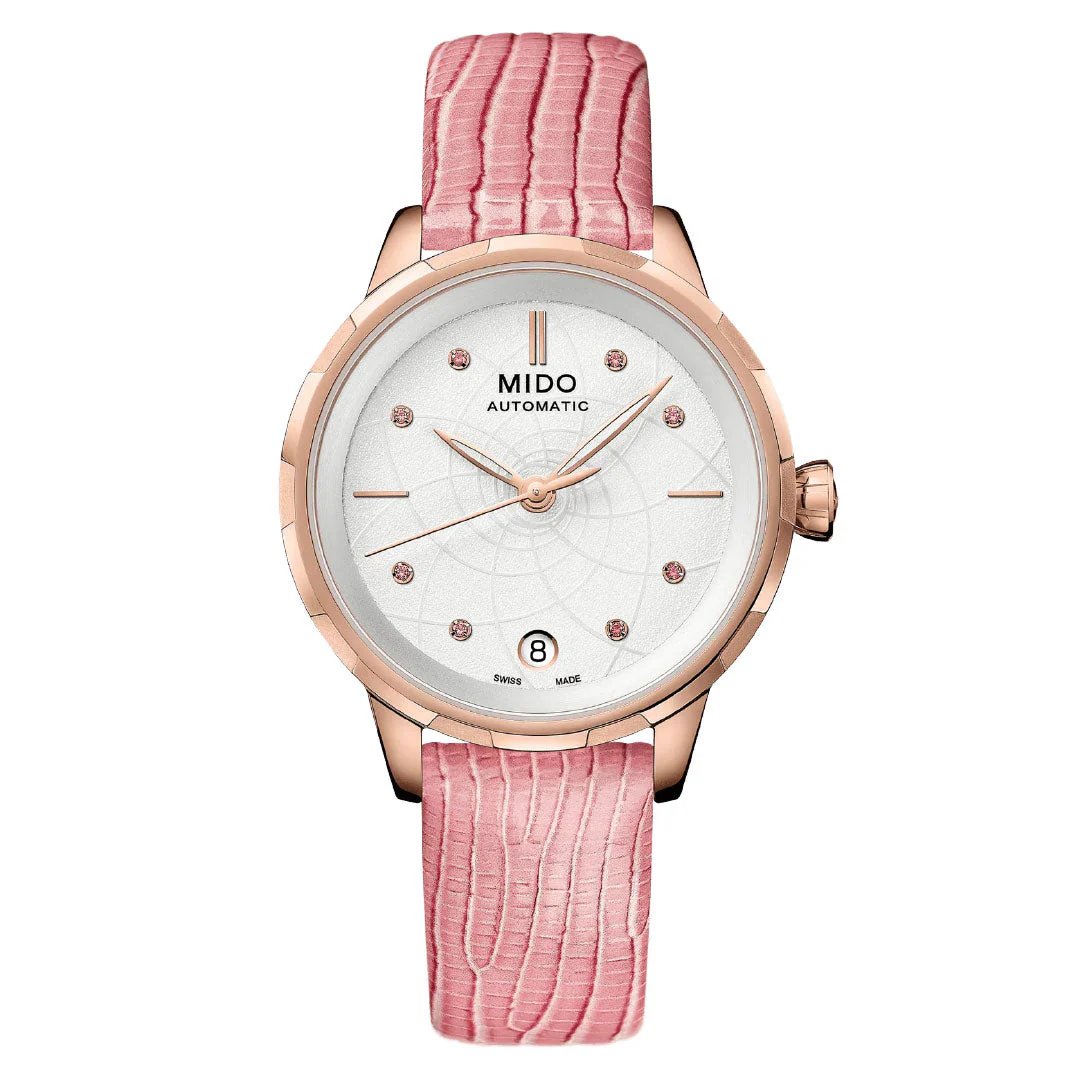
The case of the Rainflower is a masterclass in PVD (Physical Vapor Deposition) application. The rose gold hue is deep and consistent, lacking the brassy undertones found in cheaper plating methods. The case sides feature a distinctive fluted texture that mimics the 'petals' of the ArtScience Museum. This is not merely an aesthetic choice; the vertical grooves provide a tactile quality and help to break up the polished surfaces, making the watch appear even slimmer than its 9.8mm measurement suggests.
The dial is where Mido’s attention to detail truly shines. In the mother-of-pearl variants, the material is selected for its iridescent consistency. The indexes, often set with Top Wesselton diamonds, are applied with precision, catching the light without creating excessive glare. The hands are diamond-polished and faceted, ensuring legibility even in the absence of luminous material. The date window at 6 o'clock is framed in a way that balances the dial, avoiding the 'off-center' look that often occurs when movements are placed in larger cases.
The Swatch Group Advantage
It is impossible to discuss Mido without acknowledging the vertical integration provided by the Swatch Group. Because Mido has access to ETA’s manufacturing prowess, they can offer components—like the Nivachron hairspring or the Elinchron II hairspring—that independent brands simply cannot match at this price. The Rainflower benefits from this industrial scale, offering a level of reliability and serviceability that is paramount for a young collector building a foundational wardrobe.
The sapphire crystal is treated with an anti-reflective coating on both sides, a feature often omitted by competitors to save costs. This treatment is crucial for the Rainflower, as it allows the intricate dial textures—whether they be the grained finish or the mother-of-pearl—to be viewed with absolute clarity. The exhibition caseback reveals the movement, which, while industrially finished, features perlage on the plates and heat-blued screws that add a touch of traditional horological flair.
Ergonomics and Real-World Wear
On the wrist, the Rainflower is a study in balance. The 34mm case diameter is the 'Goldilocks' size for contemporary feminine watches—neither too dainty to be unreadable nor too large to be cumbersome. The lug-to-lug distance of 40mm ensures that the watch does not overhang the wrist, providing a secure and comfortable fit. The leather straps provided by Mido are of high quality, featuring a soft lining that requires minimal break-in time.
The deployant clasp is a double-push-button butterfly style. It operates with a satisfying mechanical click, providing security and extending the life of the leather strap by preventing the creasing associated with standard pin buckles. For the collector who values the 'set it and forget it' nature of a reliable automatic, the Rainflower’s ergonomics make it an effortless daily companion.
Comparative Analysis: Mido vs. The World
When compared to the Tissot Le Locle, the Rainflower feels more contemporary and specialized. While Tissot leans into a classical, almost conservative aesthetic, Mido’s architectural focus gives the Rainflower a more intellectual appeal. Compared to the Longines PrimaLuna, the Rainflower offers a superior power reserve (80 hours vs. 40-45 hours) at a significantly lower price point, although it lacks the brand prestige and heritage-tier finishing of Longines.
For the collector, the choice often comes down to the value proposition. The Rainflower provides a Swiss-made, high-autonomy mechanical movement in a uniquely designed case for roughly $1,000. In an era where many 'fashion' brands sell quartz movements in generic cases for half that price, the Rainflower stands as a testament to the enduring value of genuine horological engineering.
Final Verdict
The Mido Rainflower is more than a tribute to a building; it is a tribute to the idea that entry-level luxury should not compromise on technical specifications. By housing the Caliber 80 within a case of such distinct architectural merit, Mido has created a watch that appeals to both the eye and the mind. It is a precise, technical, and ultimately reverent piece of horology that deserves a place in any sophisticated collection.