Introduction
In the crowded microbrand arena, Nodus has carved out a reputation for no-nonsense tool watches that respect tradition without being shackled by it. The Sector II Pilot is the brand’s latest take on the classic flieger—a genre defined by legibility, utility, and a certain wartime austerity. But where many microbrands simply reheat the same B-Uhr recipe, Nodus adds a modern twist: a compact 40mm case, a deeply textured dial, and a movement that’s as reliable as it is affordable.
This isn’t a watch for the collector chasing a grail. It’s for the person who wants a daily companion that looks good with a flight jacket or a hoodie, who values build quality over brand cachet, and who understands that a great watch doesn’t need a Swiss cross on the dial. The Sector II Pilot is a statement that microbrands can deliver serious horological value—and do it with style.
I’ve been wearing the black-dial variant for three weeks, and it’s become my default grab-and-go. Here’s everything you need to know about the Nodus Sector II Pilot, from its Los Angeles roots to its real-world performance.
Brand History: Nodus
Founded in 2017 by Cullen Chen and Wes Kain, Nodus is based in Los Angeles, California. The brand’s philosophy is simple: design watches that are rugged, versatile, and affordable, without sacrificing the details that matter. Their early models, like the Sector and the Retrospect, quickly gained a cult following for their thoughtful ergonomics and robust construction. The Sector II Pilot is a direct evolution of the original Sector series, refining the case proportions and dial execution for a more versatile, modern pilot’s watch. Nodus has also been a pioneer in the microbrand space with features like quick-release spring bars and custom crowns, setting a standard that many others now follow.
Movement: Seiko NH35A
At the heart of the Sector II Pilot beats the Seiko NH35A, a 24-jewel automatic movement that’s become the default choice for microbrands worldwide. It’s not flashy, but it’s proven: hacking, hand-winding, and a 41-hour power reserve. The movement runs at 21,600 vph (3 Hz), giving a smooth sweep without sacrificing reliability. While it’s not COSC certified, my sample ran at +6 seconds per day out of the box—well within spec. The rotor is custom-signed with the Nodus logo, and the movement is visible through a solid caseback (no display, which is fine for a tool watch). Service is straightforward and inexpensive, making this a low-maintenance choice for daily wear.
Case, Dial, and Lume
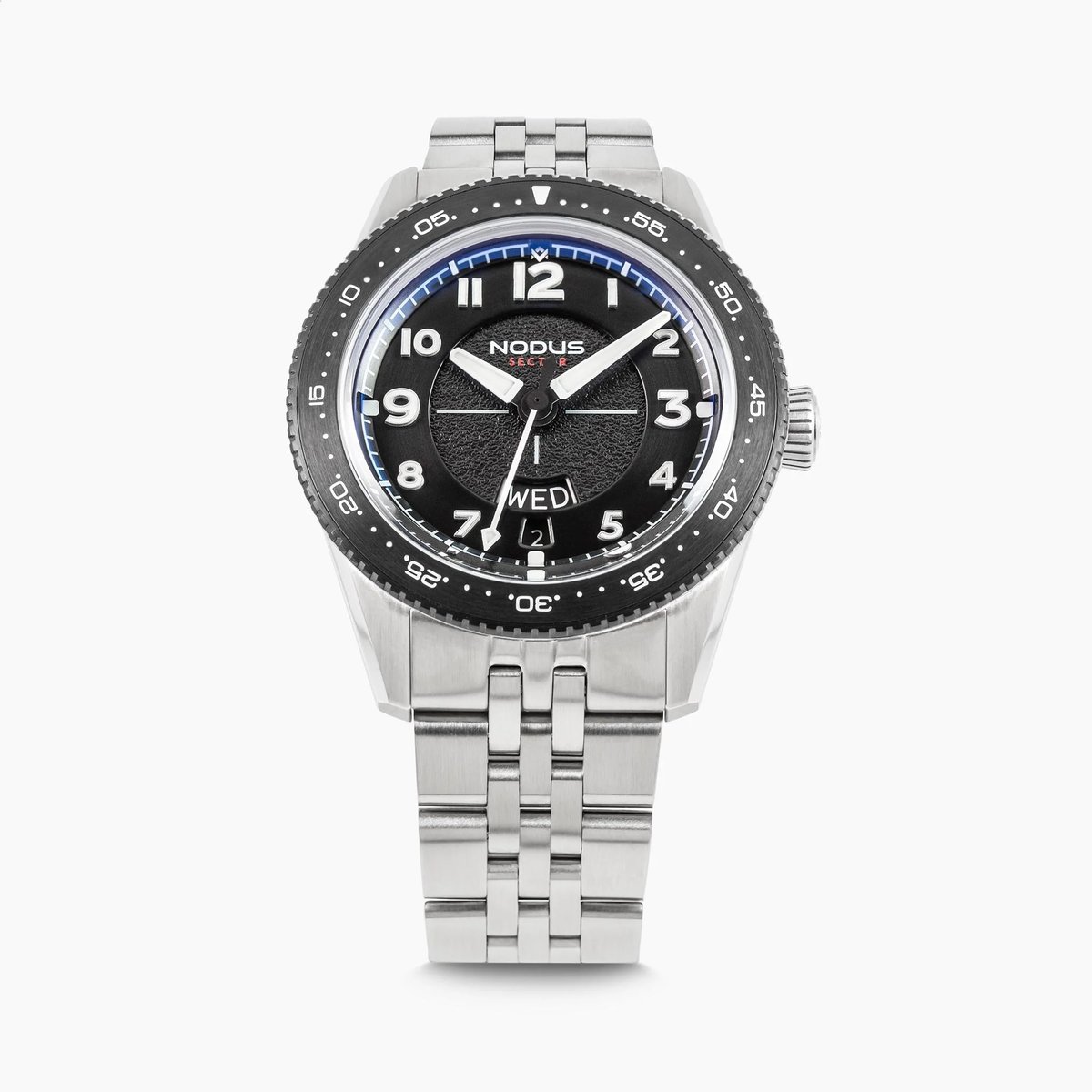
The 40mm case is 316L stainless steel, fully brushed with polished chamfers on the lugs. The bezel is fixed and features a 60-minute scale with a polished insert—a nod to pilot watches that often include a timing bezel. The crown is signed and screws down, contributing to the 100m water resistance. The domed sapphire crystal has an anti-reflective coating on the underside, reducing glare without a blue tint.
The dial is where the Sector II Pilot shines. The black variant has a matte finish with large, printed Arabic numerals in white, filled with Super-LumiNova BGW9. The hands are syringe-style, also lumed, and the orange seconds hand adds a pop of color. The date window is at 3 o’clock with a white date wheel. The dial is clean, legible, and perfectly proportioned. Lume is excellent—bright and long-lasting, easily readable for hours after a full charge.
Bracelet and Clasp
The bracelet is a highlight. It’s a three-link oyster-style with solid end links, a brushed finish, and a taper from 20mm to 16mm at the clasp. The clasp is milled with a push-button deployant and four micro-adjust positions. It’s comfortable, secure, and feels far more premium than the price suggests. Quick-release spring bars make it easy to swap straps—Nodus also sells a matching leather strap and a NATO option.
Wrist Feel and Wearability
At 40mm wide and 48mm lug-to-lug, the Sector II Pilot wears surprisingly compact. The short, downturned lugs hug the wrist, and the 12.5mm thickness slides easily under a shirt cuff. On the bracelet, it’s about 150g—substantial but not heavy. The case is fully brushed with polished chamfers, giving it a refined tool-watch feel. The signed crown is easy to grip and screws down smoothly.
The bracelet is a standout: solid end links, a milled clasp with four micro-adjust positions, and a comfortable taper from 20mm to 16mm at the clasp. It’s leagues ahead of what you’d expect at this price. The quick-release spring bars make strap swaps effortless—throw it on a NATO or leather for a different vibe. Overall, it’s a watch that disappears on the wrist in the best way.
Accuracy and Real-World Performance
My sample ran at +6 seconds per day out of the box, well within the NH35’s spec of -20/+40. After a week of wear, it settled to +8 s/d. For a $500 watch, that’s more than acceptable. If you’re a stickler, a quick regulation can bring it to within COSC standards, but for daily use, it’s perfectly reliable.
Occasions and Versatility
The Sector II Pilot is a true GADA (go-anywhere, do-anything) watch. It works with a suit (the 40mm case fits under a cuff), with jeans and a t-shirt, and even with active wear thanks to the 100m water resistance. The lume is bright enough for nighttime use, and the date complication is practical. It’s not a dress watch, but it’s not trying to be—it’s a tool watch that looks good in any context.
Reference Variants
Nodus offers the Sector II Pilot in three dial colors: black, blue, and green. The black is the most legible and classic. The blue has a sunburst finish that catches light beautifully. The green is olive-toned with cream numerals, giving a vintage military feel. All come on the same bracelet, but Nodus also sells a leather strap version for a slight discount. There are no limited editions or special references—just clean, consistent production.
Competition and Alternatives
In the sub-$600 pilot watch space, the Sector II Pilot competes with the Hamilton Khaki Aviation Pilot Day Date (42mm, Swiss ETA, ~$800), the Seiko SNK809 (37mm, 7S26, ~$150), and the Laco Flieger Pro (42mm, Miyota, ~$600). The Nodus offers the best balance of size, build quality, and bracelet for the price. If you want a smaller, more affordable option, the Seiko is a classic. If you need Swiss heritage, the Hamilton is a solid choice. But for pure value, the Nodus wins.
Investment Value
With an MSRP of $525, the Sector II Pilot is not an investment piece. Pre-owned prices hover around $350-$450, and the trend is stable. It’s a watch to buy and wear, not to flip. That said, Nodus has a loyal following, and limited runs of certain dials could hold value better. For the trust-fund-baby buyer, this is a smart purchase: you get 90% of the experience of a $2,000 watch for a fraction of the cost.
Service and Maintenance
The NH35 movement is easy to service. Nodus recommends a service every 5 years, costing around $200 at an independent watchmaker. The brand also offers a service program for a flat fee. Because the movement is widely available, you don’t need to send it to an authorized center—any competent watchmaker can handle it.
Pros and Cons
- Pros: Excellent build quality for the price, comfortable 40mm case with short lugs, superb bracelet with quick-release and micro-adjust, legible dial with great lume, reliable Seiko NH35 movement.
- Cons: Movement is not COSC certified, no display caseback, limited water resistance for a tool watch (100m is fine but not dive-level), crown could be slightly larger for easier winding.
Final Verdict
The Nodus Sector II Pilot is a masterclass in microbrand watchmaking. It delivers a refined pilot’s watch experience at a fraction of the cost of Swiss alternatives, without cutting corners on the details that matter. If you’re looking for a daily beater that punches above its weight, this is it. Highly recommended.