The Anti-Hype Argument
There is a specific fatigue that sets in around year three of collecting. You have watched a stainless-steel chronograph double in value because a celebrity wore it to a beach party. You have watched the same watch halve eighteen months later. You have sat on a waitlist that turned out to be a vibes-based lottery run by a boutique manager with a spreadsheet. Somewhere in there, you started wondering whether any of this was actually about watches.
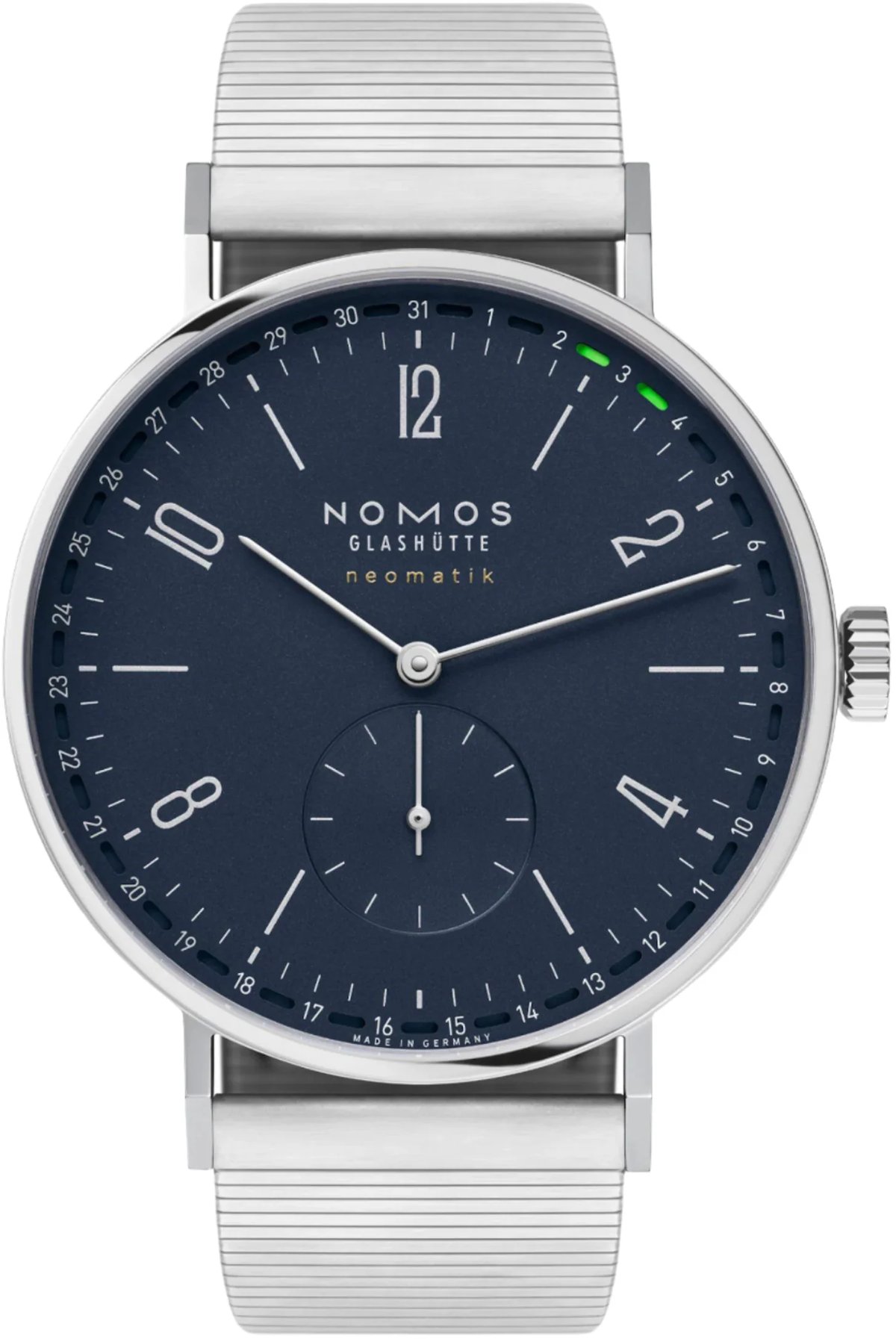
The Nomos Glashütte Tangente neomatik 41 Update, reference 180, is what you buy when you are finished with that. It is not a hype watch. It has never been a hype watch. It will, in all likelihood, never become one. What it is: a 40.5mm stainless-steel automatic with a fully in-house movement, a date display that solves a problem you did not know you had, and a Bauhaus dial that has been quietly outlasting trends since the Weimar Republic.
And here is the part that matters for anyone with a portfolio mindset. It costs roughly what a used Datejust costs, and it will lose money. That is not a design flaw. That is the entire proposition.
Glashütte's Outsider
Nomos was founded in Glashütte in 1990, the year after the Berlin Wall came down. The town had been a watchmaking centre since the nineteenth century, and the brand took over part of that historic infrastructure and built something deliberately modern on top of it. Under Roland Schwertner, Nomos committed to three things and has largely stuck to them for three decades: strict Bauhaus design, fully in-house movements, and prices that undercut comparable Swiss watchmaking by a wide margin.
The Tangente is the founding shape of the brand — a flat round case, a bezel so thin it barely qualifies as one, stick hands, and a dial that is essentially a grid of numerals and indices with nothing decorative added. It has been in continuous production since the early 1990s and has survived every trend cycle since without a single meaningful redesign. That kind of consistency is usually a marketing line. Here it is simply true.
The neomatik line arrived in 2014 with the DUW 3001, Nomos's first automatic movement thin enough to sit under a Tangente case without turning the watch into a hockey puck. The Update variant followed in 2018, pairing that thin automatic architecture with a date. Reference 180 is the core configuration: white silver-plated dial, black Horween shell cordovan strap.
The Movement: DUW 6101 and the Update Date
The DUW 6101 is the reason this watch exists. It is a fully in-house automatic with date, running at 21,600 vibrations per hour with 42 hours of power reserve, hacking seconds, and Nomos's own swing-system escapement — a component most brands at this price point buy from a supplier rather than build themselves. The rotor winds bidirectionally, which keeps the winding action efficient on a watch that is not going to be worn during a gym session.
Finishing is what you would expect from Glashütte and then some at this price. The bridges carry ribbing, the screws are tempered blue, and the rotor is skeletonised and signed. It is not Lange finishing, and nobody is claiming it is. But it is real, visible, through the sapphire caseback, and it costs a fraction of what the Swiss charge for a movement with less to look at.
The Update date is the genuinely interesting part. Instead of cutting a window into the dial, Nomos prints the date numerals on a ring that runs around the perimeter of the dial, with a small marker indicating the current date. It is patented, it keeps the dial surface uninterrupted, and — critically — it can be set both forwards and backwards with the crown. Anyone who has owned a conventional quick-set date and overshot by three days knows exactly why that matters. It is a small piece of engineering that quietly removes a daily annoyance.
Case, Dial and the Design Argument
The case is stainless steel at 40.5mm, with sapphire crystal front and back and 50 metres of water resistance. There is no lume, which is a deliberate choice rather than an oversight: this is a watch designed to be read in a boardroom or at dinner, not in a cave. The strap is Horween shell cordovan leather on a pin buckle, and it is the correct pairing — a bracelet would fight the design language entirely.
The dial is white silver-plated, with the date ring printed around the edge in a typeface that matches the rest of the printing exactly. Blued steel hands. Applied indices are absent; everything is printed. The whole thing is a study in restraint, and restraint is much harder to execute well than complexity. Get the proportions wrong by a fraction of a millimetre and a Bauhaus dial looks cheap. Nomos has been getting them right for thirty years.
What you are buying here, ultimately, is a design argument that has already won. The Tangente shape has been copied by dozens of microbrands and will be copied by dozens more. None of them will have the movement.
On the Wrist
The Tangente neomatik 41 Update wears like a watch designed by people who studied wrists rather than mood boards. The case is flat, the bezel is negligible, and almost the entire surface area is dial. That means it reads larger than its measurement suggests, and it also means it slides under a shirt cuff without a fight. Weight is minimal. This is not a watch you notice on the arm, which is precisely what a dress watch should be.
The caveat is the lugs. Nomos uses straight, relatively long lugs that do not curve down to meet the wrist, so the watch anchors rather than hugs. On a wrist below roughly 6.5 inches it can overhang, and no amount of strap adjustment fixes geometry. Try before you buy. On a 7-inch wrist and above, it is close to ideal — balanced, low-slung and comfortable through a full working day.
The shell cordovan strap is stiff and slightly glossy when new and takes several weeks to break in. Once it does, it develops a depth of colour that calf leather simply does not. Budget for a replacement every couple of years if you wear it daily.
Accuracy and Daily Life
Nomos regulates the DUW 6101 in multiple positions at the factory, and real-world examples typically land within a few seconds per day — most owners report something in the range of -2 to +8 seconds, with occasional outliers in either direction. This is not a COSC-certified movement and Nomos does not market it as a chronometer, so treat single-digit daily deviation as a win rather than an entitlement.
The 3 Hz beat rate is slower than the 4 Hz Swiss standard, which shows in a slightly lazier sweep. In exchange you get the 42-hour reserve and a movement that is genuinely thin. The hacking seconds make setting precise, and the bidirectional date means correcting the calendar after a weekend on the shelf takes seconds rather than a minute of careful crown work.
Day to day, the practical limitations are the 50 metres of water resistance and the absence of lume. Wash your hands in it, get caught in the rain in it, but do not swim in it and do not take it hiking after dark. This is a watch with a narrow brief, executed exceptionally well within that brief.
When You Would Wear It
Formal and dress occasions are the obvious answer, and it handles a suit better than almost anything at the price. But the Tangente is more versatile than its reputation suggests. On the shell cordovan strap it works with a blazer and jeans, with a knit and chinos, with the smart-casual uniform that most people under forty actually wear to the office. It is not a sports watch and it does not pretend to be. If you need one watch to do everything, this is not it. If you need the dress half of a two-watch collection, it is very hard to beat.
The Lineup and the Family
Reference 180 is the core Tangente neomatik 41 Update: white silver-plated dial, black Horween shell cordovan strap, pin buckle. Nomos has offered the same model over its production run with alternative dial finishes and strap materials under separate references, but the white-on-black combination remains the definitive expression of the design and the easiest to live with long term.
Within the wider Tangente family, the obvious siblings are the Tangente 38 Datum for smaller wrists and a lower price, the Tangente neomatik 39 for a thinner automatic without the date complication, the Tangente 35 and Tangente 33 for genuinely compact cases, and the Tangente Sport neomatik 42 Datum for anyone who wants the same design language with actual water resistance and lume. Elsewhere in the Nomos catalogue, the Orion, Ludwig, Metro and Zürich all share the same design DNA with different case shapes, and the Club Campus is the entry point for younger buyers.
Alternatives and Homages
The most direct alternative is the Junghans Max Bill Automatic — the other canonical German Bauhaus dress watch. It is cheaper and charming, but it runs a modified Swiss-derived movement and the finishing is a clear tier below. The Stowa Antea Classic 390 offers Bauhaus-adjacent design with a small seconds layout at a lower entry price, though the movement story is far less interesting.
Step up and you are looking at the Jaeger-LeCoultre Master Ultra Thin Date, which delivers an in-house automatic, a conventional date window and considerably more decorated movement architecture for roughly three times the money. Grand Seiko's Elegance Collection dress models offer superior case finishing and dial work, but a very different design language and a much weaker resale curve outside Japan.
At the bottom of the market, the look is everywhere. Sternglas builds the Naos in Hamburg for around $259 and borrows the Bauhaus playbook wholesale. Tisell's Bauhaus 38 comes in around $210 with an automatic movement. Rodina sells a Bauhaus Automatic for around $120. All three get the silhouette roughly right and none of them get anywhere near the movement, the finishing or the dial printing. They are fine as beaters and irrelevant as substitutes.
The Money Question: Resale, Hold vs Flip
Let us be blunt, because this is the section most reviews soften. Nomos does not hold value the way Rolex does. A Tangente neomatik 41 Update bought at retail and sold two years later typically fetches somewhere between $2,400 and $3,200 on the secondary market, which represents a 25 to 35 percent haircut from a current retail figure north of $4,000. If you are buying this watch as a store of value, you are making a mistake.
What the numbers do not capture is the shape of the curve. Nomos depreciation is front-loaded. Take the initial hit and the watch flattens out dramatically — a five-year-old example and a ten-year-old example trade within a few hundred dollars of each other, because the brand has been steadily raising retail prices and the design has not changed. There is also no hype cycle to ride down. Nobody is going to dump a Tangente neomatik 41 Update on the market because a rapper stopped wearing one.
The rational play, if you want one, is to buy used. At $2,400 to $3,200 you are getting an in-house automatic with a patented date mechanism and genuine German finishing for less than the price of a Swiss watch with a bought-in movement. Hold it for a decade, service it once, and the total cost of ownership is genuinely low. There is no auction history to speak of — Nomos simply does not appear at Phillips or Christie's — so do not build a thesis around it becoming collectible. Build a thesis around it being good.
Service and Ownership
Nomos services through its Glashütte atelier and a network of authorised partners in major markets, and the brand advises servicing based on actual running behaviour rather than a fixed calendar interval. Independent watchmakers familiar with the neomatik architecture can handle routine regulation and strap work, but parts availability pushes most owners back to authorised channels for anything involving the movement. Budget for a service at some point in the first decade of ownership and treat it as part of the cost of running a mechanical watch properly.
Pros and Cons
Pros: a fully in-house automatic movement with a patented bidirectional date system; genuine Bauhaus design integrity rather than retro pastiche; thin, flat and comfortable under a cuff; sub-$5,000 pricing for German in-house watchmaking; sapphire front and back with visible Glashütte finishing.
Cons: no lume and only 50 metres of water resistance, so it cannot be your only watch; long straight lugs limit it to larger wrists; resale is soft; there is no factory bracelet option; and the peripheral date ring takes a moment longer to read than a conventional window.
Final Verdict
The Tangente neomatik 41 Update is the rare watch that justifies itself on engineering and design rather than scarcity theatre. If your collection is built around hype assets and you want something that will still look correct in twenty years, this is one of the most defensible purchases under $5,000. Buy it used, wear it hard, and stop checking the resale graph. The watch will not reward you financially. It will reward you every time you look at it, which is a better deal than most of what the market is currently offering.