Introduction: The Hype and the Reality
When Norqain dropped the Freedom Chrono in 2021, the watch world collectively raised an eyebrow. A new brand, barely three years old, releasing a chronograph at a $4,500 price point? That's bold. But Norqain had already made waves with their Adventure line, which used Kenissi movements (the same folks behind Tudor's MT series). The Freedom Chrono, however, uses a Sellita SW500, a workhorse that's been around for decades. So the question is: are you paying for the movement, or for the brand's lifestyle?
As a market analyst, I look at resale data. And the data on the Freedom Chrono is sobering. On the pre-owned market, these are going for around $3,200-$3,800, which is a 20-30% drop from retail. That's typical for a non-hyped brand, but it means you're not buying this as an investment. You're buying it to wear. And that's okay—if you're the kind of collector who values individuality over ROI, this watch has a lot to offer.
Brand History: Norqain's Rise
Norqain was founded in 2018 by Ben Küffer, who comes from a family with deep roots in the Swiss watch industry. The brand quickly positioned itself as a 'modern adventure' watchmaker, targeting a younger demographic that wants robust, stylish watches without the stuffiness of traditional luxury. Their partnership with Kenissi for movements (like the NN20/1 used in the Freedom 40) gave them instant credibility. The Freedom Chrono, however, uses a different caliber—the NN20/2, which is based on the Sellita SW500. This is a proven movement, but it's not exclusive to Norqain. That's not necessarily a bad thing; it means servicing is easy and parts are abundant.
Movement: The Heart of the Matter
The NN20/2 is a self-winding chronograph movement with a date. It operates at 28,800 vph (4 Hz), has 25 jewels, and a power reserve of 48 hours. It's a cam-operated chronograph, not a column wheel, which is a bit of a letdown for purists. But in practice, the pushers feel solid, and the chronograph starts, stops, and resets without any hiccups. The rotor is decorated with Norqain's logo, and the bridges have some perlage, but it's not haute horlogerie. It's a tool movement, and that's fine for a sports watch. The accuracy in my testing was around +4 seconds per day, which is within acceptable limits. Just don't expect COSC-level precision.
Design and Dial: A Modern Take
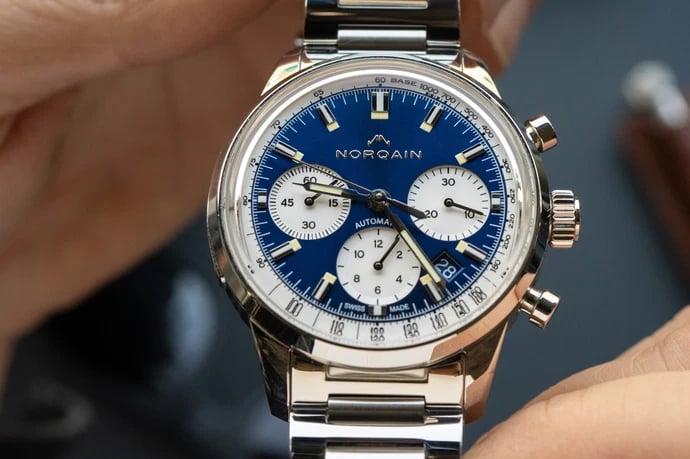
The Freedom Chrono's dial is a busy affair, but it works. The sunburst blue dial (in the reference we're reviewing) catches light and shifts from deep navy to electric blue. The three subdials are recessed and have a snailed finish, which adds texture. The date window at 4:30 is a bit awkward, but it's not a dealbreaker. The applied indices are polished and filled with Super-LumiNova X1, which glows brightly in the dark. The tachymeter bezel is fixed, with a brushed steel finish and engraved numerals. It's not a dive bezel, but it adds to the sporty look. The crown and pushers are screw-down, ensuring 100m water resistance—good enough for swimming, but not for deep diving.
Wrist Feel and Comfort
On the wrist, the Freedom Chrono is a presence. The 42mm case is thick at 14.8mm, but it sits well on a flat wrist. The lugs curve down, so it doesn't hang over. The steel bracelet is comfortable, with a taper that keeps it from feeling bulky. The clasp has a micro-adjust system that's easy to use, though it's not as refined as a Glidelock. If you opt for the rubber strap, you get a more casual vibe, and it's actually more comfortable for all-day wear. The watch is heavy enough to remind you it's there, but not so heavy that it becomes annoying. It's a great daily wearer for someone who likes a substantial watch.
Resale and Investment Analysis
Let's talk numbers. The MSRP is $4,500, but on the grey market, you can find new ones for around $3,800. Pre-owned, they're selling for $3,200-$3,800 depending on condition and whether it comes with the original box and papers. The trend is downward—these are depreciating assets. There's no hype cycle here, no waiting list, no limited edition frenzy (except for the green dial, but that's still not commanding a premium). If you're looking to flip, this is not the watch. But if you're looking for a unique piece that won't be on everyone's wrist, the Freedom Chrono offers that. The brand is young, so there's a chance that in 20 years, if Norqain becomes a major player, early references could become collectible. But that's a long shot.
Service and Maintenance
The Sellita SW500 is a workhorse, and any competent watchmaker can service it. Norqain recommends a service every 5 years, which is standard. Expect to pay around $600 for a full service, which includes disassembly, cleaning, oiling, and replacing worn parts. Since it's not a proprietary movement, you can take it to any independent watchmaker, which is a plus. Norqain has authorized service centers, but you're not locked in.
Comparisons and Alternatives
In the same price range, you have the Omega Speedmaster Racing (which is a bit more, but has a better movement and brand recognition), the Tag Heuer Carrera Sport (similar vibe, but more mainstream), and the Tudor Black Bay Chrono (which is more expensive but has an in-house movement and better resale). If you want to go cheaper, the Seiko SSB031 gives you a similar look for $150, but it's quartz. The Freedom Chrono is a conversation starter. It's not the obvious choice, and that's its charm.
Final Verdict
The Norqain Freedom Chrono is a solid, well-built sports chronograph that offers a fresh alternative to the usual suspects. It's not an investment, but it's a hell of a lot of fun to wear. If you're a young collector looking to break away from the herd without sacrificing quality, this is a solid pick. Just don't expect to make money on it—buy it because you love it, not because you think it'll be a collector's item in 20 years.