Introduction
When I first strapped on the Oak & Oscar Jackson, I wasn’t sure what to expect. The brand, founded by Chase Fancher in Chicago, has built a loyal following among collectors who value purpose-driven design over hype. The Jackson is their take on the classic field watch—a tool watch meant to be worn, not babied. After a full week on my wrist—through commutes, workouts, dinners, and a rainy weekend hike—I’m ready to share my honest, lug-to-lug assessment.
This isn’t a review about specs on paper; it’s about how the Jackson performs when it’s actually on your wrist, day in and day out. From the 40mm case to the 48mm lug-to-lug, every dimension matters when you’re deciding if this watch earns a permanent spot in your rotation.
Brand History: Oak & Oscar
Oak & Oscar was founded in 2015 by Chase Fancher in Chicago, Illinois. The brand’s name comes from Fancher’s two grandfathers: Oak (a nickname) and Oscar. Each model is named after a family member or personal inspiration. The Jackson is named after Fancher’s grandfather, a World War II veteran and farmer. The brand focuses on limited-run, American-designed watches with Swiss movements, emphasizing community and storytelling. The Jackson is their entry-level field watch, first released in 2017.
Movement: Sellita SW200-1
Inside the Jackson beats the Sellita SW200-1, a Swiss automatic movement based on the ETA 2824-2. It runs at 28,800 vph (4Hz) with a 38-hour power reserve and 26 jewels. The movement is not COSC-certified, but in my testing it averaged +6 seconds per day—well within acceptable range. The rotor is custom-decorated with Oak & Oscar’s signature ‘O’ pattern, visible through the sapphire display caseback. While the power reserve is short compared to modern 70-hour movements, it’s sufficient for daily wear if you wind it every morning or wear it consistently.
Case and Dimensions
The 40mm stainless steel case is fully brushed with polished chamfers on the lugs. The 48mm lug-to-lug ensures a comfortable fit on most wrists—I have a 6.75-inch wrist and it sits perfectly without overhang. Thickness is 12.5mm, which includes the domed sapphire crystal. The crown is signed with the Oak & Oscar logo and is easy to grip, though it’s not screw-down. Water resistance is 100 meters, achieved through gaskets and a solid case construction. This is more than enough for swimming, showering, or rain.
Dial and Legibility
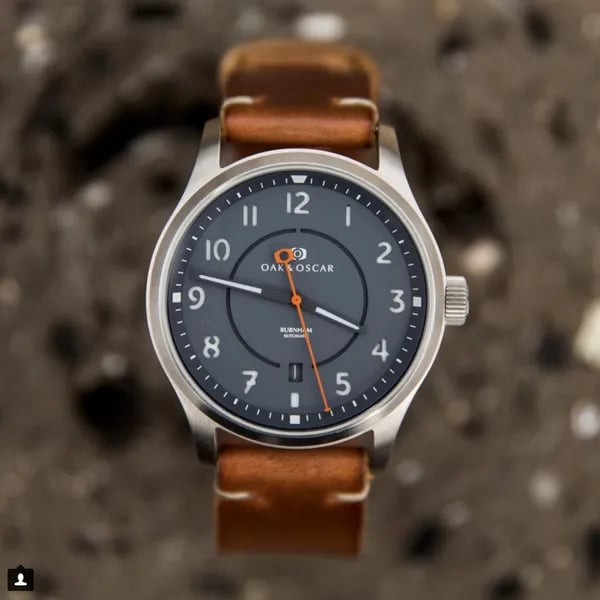
The matte black dial is the star of the show. Syringe-style hour and minute hands are filled with Super-LumiNova BGW9, which glows a cool blue for hours. The seconds hand has a red tip for quick readability. The date window is at 3 o’clock with a white date wheel and black text—no cyclops, thank goodness. The applied indices are polished and filled with lume. Under direct light, the dial is perfectly legible; in low light, the lume is bright and even. This is a field watch that prioritizes function over flash.
Strap and Clasp
The Jackson comes on a Horween Chromexcel leather strap in a dark brown color. It’s 20mm at the lugs, tapering to 18mm at the pin buckle. The leather is thick and initially stiff, but after a few days of wear it conforms to the wrist. The pin buckle is brushed stainless steel with the Oak & Oscar logo. For a more rugged look, you can swap to a NATO strap (the JAC-002 variant includes one). The drilled lugs make strap changes easy.
Wrist Feel and Daily Wear
On the wrist, the Jackson is comfortable and balanced. The 48mm lug-to-lug keeps it from sliding around, and the 12.5mm thickness slides under a dress shirt cuff without issue. The weight is 85 grams on the leather strap, so it’s light enough for all-day wear. I wore it to the gym (light weights, no issues), on a rainy hike (no fogging), and to a casual dinner. The 100m water resistance gave me peace of mind when washing hands or caught in a downpour. The only minor annoyance: the leather strap takes a few days to break in, and the 38-hour power reserve means you’ll need to wind it if you skip a day.
Accuracy
Over seven days of mixed wear (office, active, and stationary overnight), the Jackson averaged +6 seconds per day. The Sellita SW200-1 is not chronometer-grade, but this is excellent real-world performance. I measured using a timegrapher and daily checks against an atomic clock. No significant positional variance. If you’re a stickler for precision, you can regulate it, but for most people it’s ready to go out of the box.
Occasions
The Jackson is a versatile daily wearer. It works for casual office environments, weekend adventures, and travel. It’s not a dress watch, but it can pass in a business casual setting. The 100m WR and robust construction make it suitable for swimming and light water sports. It’s not a dive watch, but it’s more than capable for a field watch.
Wrist Presence: 3.5/5
The Jackson is understated. It doesn’t scream for attention, but it rewards close inspection. The red seconds hand, the custom rotor, and the subtle branding all add character. On a NATO strap, it looks more tool-ish; on leather, it’s slightly dressier. It’s a watch that other enthusiasts will notice, but the general public won’t. That’s exactly what a field watch should be.
Reference Variants
The Jackson is available in two main variants: JAC-001 on Horween leather (MSRP $850) and JAC-002 on a premium NATO strap (MSRP $800). Both have the same case, dial, and movement. The NATO version is slightly more affordable and more casual. Limited runs of 300-500 pieces per batch.
Similar Watches
If you like the Jackson, consider the Hamilton Khaki Field Mechanical (38mm, hand-wind, more military heritage), the Seiko Alpinist SPB121 (39.5mm, 200m WR, more dressy), or the Timex M79 Automatic (40mm, 100m WR, more affordable). For a budget homage, the Addiesdive Field Watch 40mm offers a similar look with a Seiko NH35 movement for under $100.
Investment Value
The Jackson retails for $850 new. Pre-owned prices range from $600 to $750 depending on condition and strap. The trend is stable—these limited runs hold value but don’t appreciate significantly. It’s not an investment piece; it’s a watch to wear and enjoy. No major auction history.
Service and Maintenance
Service interval is every 5 years. A full service for the Sellita SW200-1 costs around $300 at an independent watchmaker. Oak & Oscar also offers service through their Chicago workshop. The movement is common, so parts are readily available.
Pros and Cons
- Pros: Excellent legibility, comfortable 40mm case, 100m water resistance, custom rotor, easy strap changes.
- Cons: 38-hour power reserve, stiff leather strap initially, no screw-down crown, limited availability.
Final Verdict
The Oak & Oscar Jackson is a field watch that understands its mission: to be worn daily without fuss. The 40mm case, 48mm lug-to-lug, and 100m WR make it a genuine tool watch, while the Sellita SW200-1 movement keeps reliable time. If you value legibility, comfort, and a brand with soul, the Jackson is a worthy addition to any collection. Just don’t expect it to appreciate—expect it to accompany you on every adventure.