Omega Seamaster Diver 300M Chronograph Review: The Standout Dive Chrono
If you are a young collector with a taste for dive watches, the Omega Seamaster Diver 300M Chronograph is the kind of piece that makes you feel like you have arrived. It has the James Bond lineage, the METAS Master Chronometer flex, and a 44mm steel case that says you lift, or at least you pay someone to lift for you. But is it a hold or a flip? That depends on whether you care about resale. This is not a Rolex Daytona. It is a tool watch with a chronograph, and it depreciates like a German sedan. The good news: pre-owned examples are plentiful, and the value proposition is strong if you buy right.
The Seamaster Diver 300M Chronograph sits in a strange spot. It is not the pure dive watch that the 42mm Seamaster is, and it is not the racing chronograph that the Speedmaster is. It is a hybrid: a 300m diver with a column-wheel chronograph, a ceramic bezel, and a dial that looks like an ocean floor. For the collector who wants one watch to do everything, it is compelling. For the collector who wants an investment, it is a trap. We will break down the movement, the wrist feel, the resale data, and the hype cycle so you can decide.
Brand History: Omega's Dive Legacy
Omega was founded in 1848 in La Chaux-de-Fonds, Switzerland. The brand has been responsible for some of the most important watches in history, including the Speedmaster Professional that went to the moon. But the Seamaster is Omega's dive line, introduced in 1948 and evolved into the Seamaster Diver 300M in 1993. That 1993 model, with its helium escape valve and wave dial, became a icon of the 1990s and later a James Bond staple. The modern Seamaster Diver 300M Chronograph is the latest evolution of that line. It uses Omega's in-house Master Chronometer movements and modern materials like ceramic and titanium. It is a direct descendant of the dive watch that made Omega cool again in the 1990s.
Movement: Cal. 9900 Master Chronometer
The heart of this watch is the Omega Co-Axial Master Chronometer Calibre 9900. It is an automatic chronograph with a column wheel and vertical clutch, which means the pushers feel crisp and the chronograph can be run continuously without harming the movement. It has a power reserve of 60 hours, a frequency of 28,800 vph, and 54 jewels. It is a Master Chronometer certified by METAS, which is a higher standard than COSC. That means it is tested for accuracy and magnetic resistance at the watch level, not just the movement. The 9900 also has a silicon balance spring and Omega's co-axial escapement. It is a serious piece of engineering, and it is in-house. The finishing is industrial but attractive, with arabesque bridges and a rotor that you can see through the sapphire caseback. This is not a hand-finished Patek movement, but it is robust, accurate, and modern.
Specs and Build
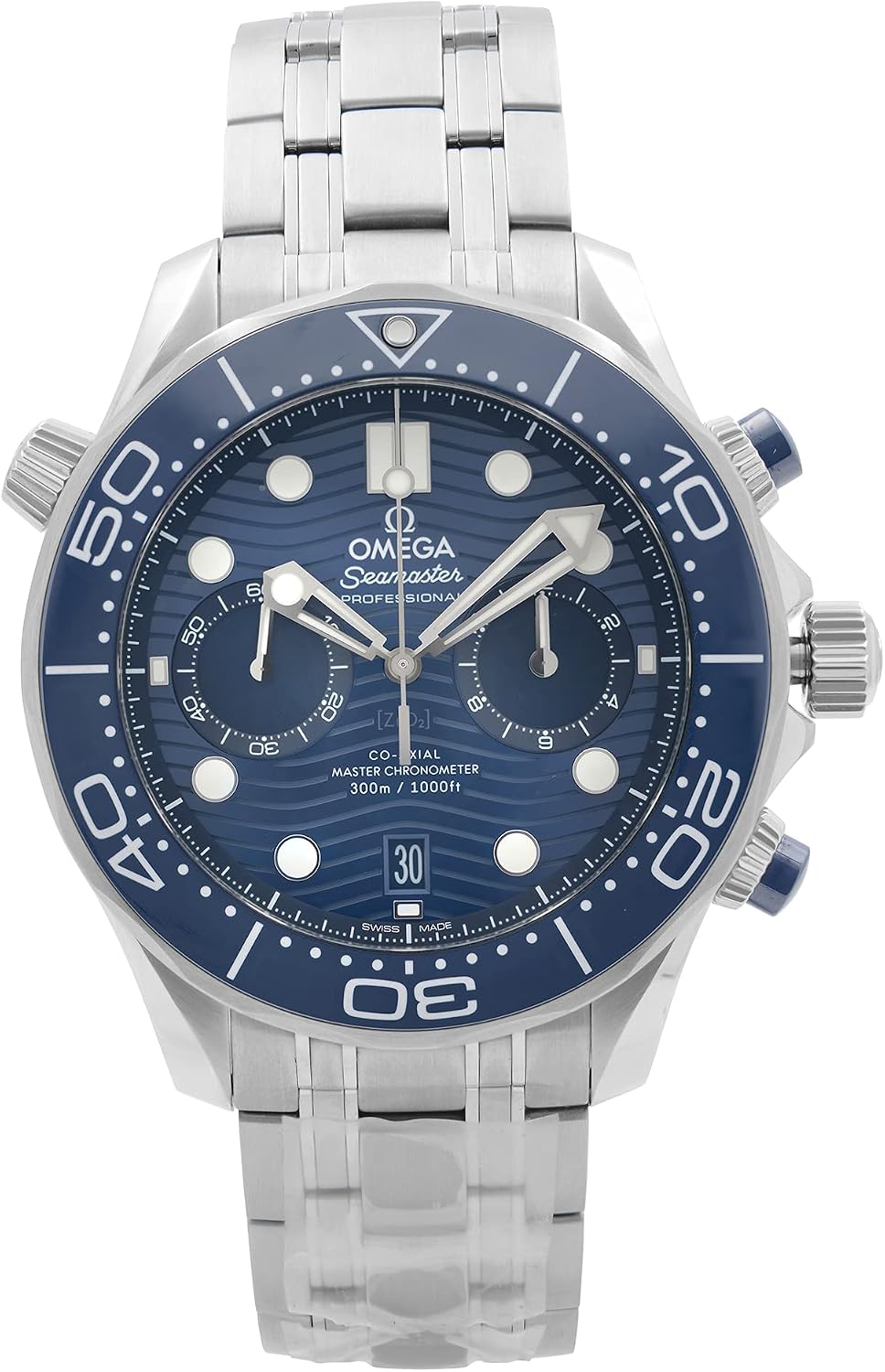
The case is stainless steel, 44mm in diameter, and water resistant to 300 meters. That is real dive-watch territory, even if most owners will never take it deeper than a hotel pool. The crystal is sapphire, and the bezel is ceramic with a white enamel dive scale. The dial is also ceramic, with laser-engraved waves that give it a deep, three-dimensional look. The lume is Super-LumiNova, and it glows bright blue in low light. The bracelet is a stainless steel design with a foldover clasp and a comfort setting, which is Omega's version of a micro-adjust. The watch also comes on rubber if you prefer a lighter feel. The build quality is excellent. The case has a mix of brushed and polished surfaces, and the ceramic bezel is scratch-resistant. The helium escape valve at 10 o'clock is a signature Seamaster detail, even if it is useless for most people. The crown is signed with the Omega logo, and the pushers are screw-down, which helps with water resistance. This is a watch that can take a beating.
Wrist Feel and Presence
On the wrist, the 44mm case is substantial. It wears large, and it sits tall. If you have a smaller wrist, it will overhang. If you have a 7.5-inch wrist or larger, it will feel appropriate. The weight is noticeable, especially on the steel bracelet. The watch is top-heavy, and it can slide around if the bracelet is not sized correctly. The rubber strap helps a lot: it reduces weight and keeps the watch centered. The lugs curve down, so it does not feel as wide as the 44mm number suggests, but it is still a big watch. The chronograph pushers are easy to reach, and the crown is grippy. The bezel action is firm and precise, with no backplay. The dial is legible, though the wave pattern can make the hands blend in at certain angles. The date at 6 o'clock is small but useful. Overall, this is a watch that commands attention. It is not subtle. It is a statement piece, and it feels expensive on the wrist.
Wrist presence is a 4 out of 5. It is not as loud as a gold Daytona, but it is unmistakably a Seamaster. The ceramic dial and bezel catch the light, and the steel bracelet is shiny. It is the kind of watch that gets noticed at a dinner table, especially if you are wearing short sleeves. It is not a dress watch, but it can pass with a suit if you are confident. It is a sport watch first, and it looks best with casual clothing.
Accuracy: METAS Master Chronometer
Omega Master Chronometer certification means the watch is tested to run within 0/+5 seconds per day. That is a tighter tolerance than COSC, which allows -4/+6 seconds per day. In real life, most examples run within 1 to 3 seconds per day. The 9900 is also resistant to magnetic fields up to 15,000 gauss, which is more than you will ever encounter. The vertical clutch means the chronograph can be started and stopped without the seconds hand jumping. The column wheel gives the pushers a smooth, mechanical feel. If you are used to a Valjoux 7750, this is a different league. The accuracy is one of the best reasons to buy this watch. It is a true chronometer, and it will keep time better than most watches in your collection. The only caveat is that service costs are higher because of the co-axial escapement and the chronograph module. But if you buy a well-maintained example, it will be reliable for years.
Occasions and Wearability
This is a sport watch, but it is versatile. It works for daily wear, travel, and casual weekends. It is not a formal dress watch, but it can be worn with a suit if you are going for a rugged look. It is not a true dress watch because of its size and thickness. It is also not a pure dive watch because the chronograph adds complexity and cost. But for the collector who wants one watch for everything, it is a strong candidate. It is at home on a boat, at a beach, or in a boardroom. The 300m water resistance means you can swim with it. The chronograph is useful for timing everything from parking meters to steaks. The date is useful for daily wear. The lume is bright enough for night use. The only occasion where it fails is black tie. Do not wear this with a tuxedo. Otherwise, it is a go-anywhere, do-anything watch.
Reference Variants
The core reference is 210.30.44.51.01.001, which has a black ceramic dial and a stainless steel bracelet. The blue dial version is 210.30.44.51.03.001, also on steel. Both use the same 44mm steel case and Cal. 9900. There are also rubber strap versions, which are lighter and more casual. The black dial is the most classic, while the blue dial is more playful. The steel bracelet is the most versatile, but the rubber strap is more comfortable in hot weather. If you are buying pre-owned, the steel bracelet adds value because buying it separately is expensive. The blue dial tends to sell for a slight premium on the secondary market, but not by much. The black dial is the safer choice for resale.
Family References and Similar Watches
Within the Seamaster family, the closest siblings are the Seamaster Diver 300M 42mm and the Seamaster Planet Ocean 600M. The 42mm is the pure dive watch, with no chronograph. It is smaller, thinner, and cheaper. The Planet Ocean is the heavy-duty diver, with greater water resistance and a more robust case. If you want a chronograph, the Seamaster Diver 300M Chronograph is the only option in the modern 300M line. Other Omega models worth considering include the Speedmaster Professional Moonwatch, which is the chronograph icon, and the Seamaster Aqua Terra, which is the dressier everyday watch. The Speedmaster is a better investment and a more historically important watch, but it is not a dive watch. The Aqua Terra is more comfortable but less sporty.
If you are cross-shopping, consider the Rolex Daytona. It is the king of chronographs, with better resale and more prestige. But it is not a dive watch, and it is much more expensive. The Tudor Black Bay Chrono is a strong value alternative, with a similar steel chronograph vibe and a lower price. The Breitling Superocean Chronograph is a direct competitor, with a dive chronograph design and a rich history. The IWC Aquatimer Chronograph is another option, with a more technical look. The Tag Heuer Aquaracer Chronograph is more affordable and more common. Each of these has its own strengths, but none offers the same combination of Master Chronometer accuracy, 300m water resistance, and in-house chronograph movement at this price point.
Homages
If you love the look but do not want to spend the money, there are homages. The San Martin SN0045 is a Seamaster-style dive watch with a similar case and dial, though it is not a chronograph. The Pagani Design PD-1667 is a budget Seamaster-inspired diver with a ceramic bezel and a wave dial. The Heimdallr Sea Ghost is another option, with a similar aesthetic. These are not replacements for the real thing. They do not have the Master Chronometer movement, the ceramic dial, or the build quality. But they can scratch the itch if you are saving for the real watch. Just do not expect them to hold value. They are disposable fashion watches, not investments.
Investment Value: Hold vs. Flip
The Omega Seamaster Diver 300M Chronograph is not an investment piece. It is a depreciating asset. The current retail price is around $8,400. On the pre-owned market, you can find them for $4,800 to $6,800, depending on condition, box, and papers. That means the original owner takes a significant hit. If you are buying new, you are paying for the experience, not the resale. If you are buying pre-owned, you are getting a lot of watch for the money. The trend is depreciating, and it will likely stay that way because Omega produces these in large numbers. There is no major auction history for this reference. It is not a limited edition, and it is not a collector piece in the traditional sense. The hold recommendation is simple: buy pre-owned, wear it, and enjoy it. Do not flip it. You will lose money. If you want an investment, buy a Rolex Daytona or a Patek Philippe Nautilus. If you want a great watch to wear, buy this.
Service and Ownership
Omega recommends servicing your watch every 5 to 8 years, but the exact interval depends on usage. The Cal. 9900 is a complex movement, and service costs are higher than a simple dive watch. You can expect to pay several hundred dollars for a full service, and it should be done by Omega or a certified independent watchmaker. The good news is that Omega has a wide service network, and parts are available. The bad news is that the chronograph module adds complexity and cost. If you buy pre-owned, ask for service records. A watch that has been serviced by Omega will be more valuable and less risky. The co-axial escapement is robust, but it requires proper lubrication. Do not let a local jeweler who does not know Omega touch it. Use an authorized service center or a specialist. The watch is built to last, but it is not indestructible. The ceramic bezel can shatter if dropped, and replacement is expensive. The sapphire crystal is scratch-resistant, but it can chip. The steel case can be polished, but you should avoid over-polishing. Overall, ownership is straightforward if you budget for service.
Pros and Cons
Pros: Master Chronometer accuracy and METAS certification. Robust 300m dive watch with chronograph utility. In-house Cal. 9900 with column wheel and vertical clutch. Strong pre-owned value. Great lume and legibility. Ceramic bezel and dial are durable. Cons: Thick and heavy on wrist. Depreciates from retail. Not a true investment piece. 44mm may be too large for some wrists. Service costs are higher than a simple dive watch. The wave dial is polarizing. The helium escape valve is unnecessary for most owners. The bracelet lacks a quick-release system. The date is small.
Final Verdict
The Omega Seamaster Diver 300M Chronograph is a serious tool watch with genuine chronograph credibility. It is not a flip; it is a hold-and-wear. Buy pre-owned, enjoy the METAS accuracy, and let someone else eat the depreciation. If you want a watch that can go from the beach to the boardroom, and you do not care about resale, this is one of the best values in luxury watches. If you care about investment returns, look elsewhere. The wealthy collector angle is simple: this is a watch you buy because you can, not because you should. It is a great watch, but it is not a great investment. That is the truth.