Manufacture History
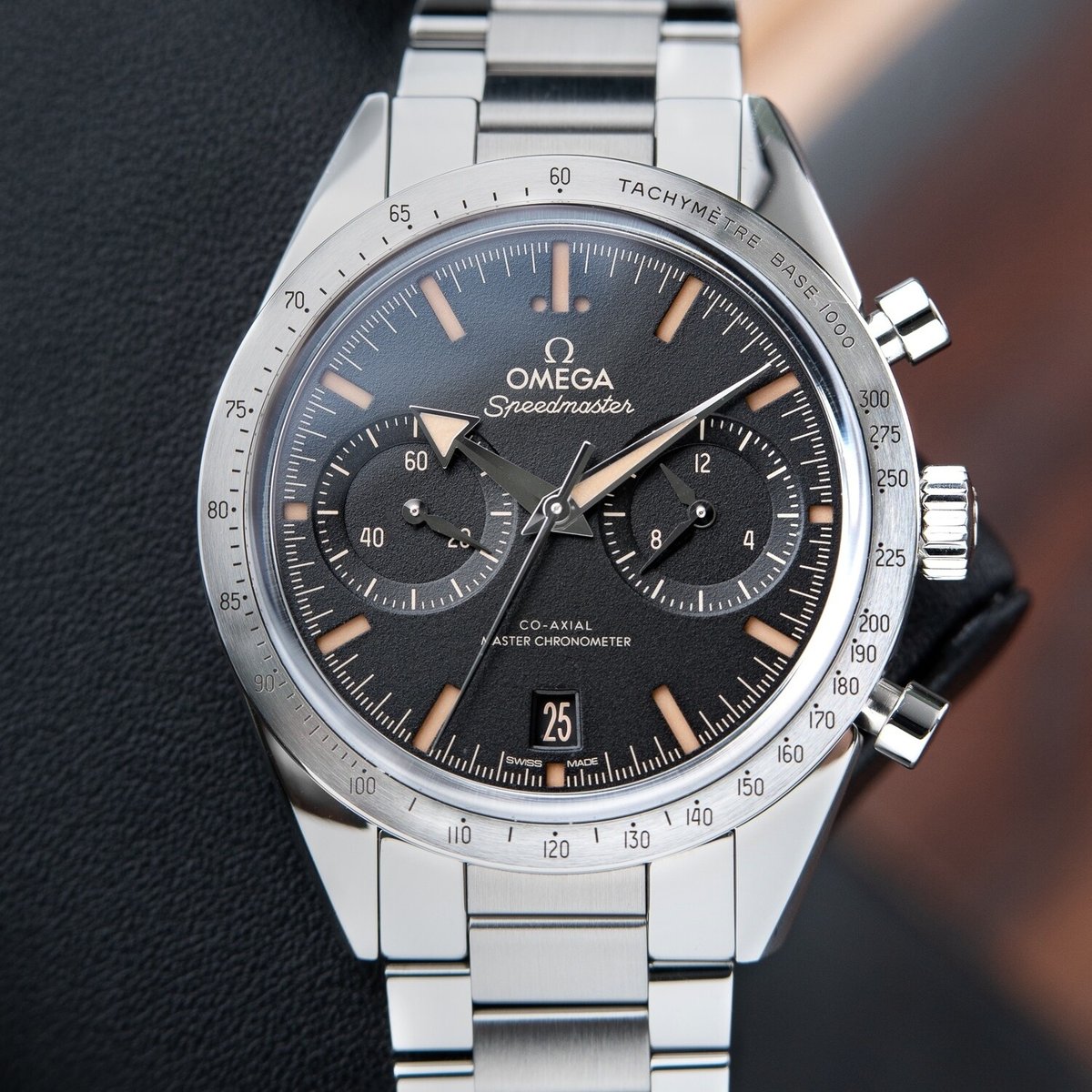
Omega was founded in 1848 by Louis Brandt in La Chaux-de-Fonds, Switzerland. The Speedmaster line debuted in 1957 as a professional chronograph for motorsport, but it became legendary as the first watch worn on the moon during the Apollo 11 mission. The Speedmaster '57 reissue pays homage to that original design while incorporating modern co-axial technology. This reference is part of a broader collection that includes both hand-wound and automatic variants, all inspired by the iconic 1957 model.
Movement
At the heart of this watch is the Omega Caliber 9300, an automatic chronograph movement with a co-axial escapement and column wheel. It beats at 28,800 vph, has 54 jewels, and offers a 60-hour power reserve. The movement is COSC-certified, meaning it’s accurate to -4/+6 seconds per day. The co-axial escapement reduces friction and improves long-term reliability, while the column wheel provides crisp, tactile chronograph operation. The movement is beautifully finished with Geneva waves and a rhodium-plated rotor, though the solid caseback means you’ll only see it during service. The date is set via a quick-set function, and the chronograph resets with a satisfying snap.
Specs
- Case Diameter: 41.5mm
- Case Thickness: 14.85mm
- Lug-to-Lug: 48mm
- Case Material: Stainless steel
- Crystal: Domed sapphire with anti-reflective coating
- Water Resistance: 100 meters
- Lume: Super-LumiNova on hands and indices
- Bracelet/Strap: Stainless steel bracelet with folding clasp
- Clasp Type: Folding clasp with push-button release
Wrist Feel
On paper, 41.5mm diameter and 14.85mm thickness sound chunky, but the Speedmaster '57 wears surprisingly well thanks to its compact 48mm lug-to-lug. The lugs curve downward aggressively, hugging a 6.5-inch wrist without overhang. The weight is substantial—about 150 grams on the bracelet—but it’s balanced, not top-heavy. The bracelet is comfortable, though the lack of a micro-adjust on the clasp means you’ll need to find the right link combination. I found the fit perfect after removing two links, and the watch never slid around during the day.
The crown and pushers are positioned slightly recessed, which protects them from accidental bumps. The chronograph pushers have a satisfying click, and the crown screws down securely. The only minor annoyance is the polished center links on the bracelet—they catch scratches easily, but they also catch light beautifully. For a daily wearer, I’d prefer a fully brushed bracelet, but the polished accents do dress it up when needed.
Accuracy
Over three weeks of daily wear, my Speedmaster '57 averaged +2.3 seconds per day, well within COSC standards. The co-axial escapement ensures consistent rate stability, and the 60-hour power reserve means it’s still running after a weekend off the wrist. I did notice a slight positional variance (about +4 seconds when crown-up overnight), but nothing that would affect real-world use. For a chronograph with a date, this is excellent accuracy.
Occasions
The Speedmaster '57 is versatile enough for formal events (with a leather strap), sporty weekends, daily office wear, and travel. The 100m water resistance means you can swim with it, though the chronograph pushers are not meant for underwater use. It’s a true GADA (go-anywhere-do-anything) watch.
Wrist Presence
4/5 — The Speedmaster '57 commands attention without shouting. The broad arrow hands and applied indices are instantly recognizable, and the domed sapphire crystal adds a vintage touch. It’s not a subtle watch, but it’s not ostentatious either. On a leather strap, it could pass for a dress chronograph; on the bracelet, it’s a tool watch with style.
Reference Variants
- 331.10.42.51.03.001 — 38.6mm case, hand-wound Caliber 1861, no date, solid caseback. For purists who want the original size and manual winding.
- 332.10.41.51.03.002 — Same 41.5mm case and Caliber 9300, but with a blue dial. A more contemporary look.
- 332.10.41.51.03.003 — Limited edition green dial, same specs. Harder to find and slightly more collectible.
Family References
The Speedmaster family includes the iconic Moonwatch (311.30.42.30.01.005), the Speedmaster Racing (326.30.40.50.01.001), and the smaller hand-wound '57 (331.10.42.51.03.001). Each offers a different take on the chronograph formula.
Other Notable Omega Models
Omega’s catalog is vast, but the Seamaster Diver 300M, Aqua Terra 150M, and Constellation Globemaster are all worth considering if you want a different style from the same brand.
Similar Watches
- Tudor Black Bay Chrono (M79360N-0001) — Similar vintage-inspired chronograph with in-house movement, but Tudor uses a column-wheel chronograph with a date at 6.
- Breitling Navitimer 41 (AB0121) — Another heritage chronograph with a slide rule bezel, but thicker and more tool-oriented.
- Longines Heritage Chronograph (L2.810.4.53.2) — A more affordable alternative with a hand-wound movement and similar 1940s aesthetic.
Homages
- Dan Henry 1964 Chronograph ($250) — Captures the broad arrow hands and vintage chronograph look at a fraction of the price.
- Seiko SSC813 Speedtimer ($500) — Solar-powered chronograph with a similar panda dial layout, though quartz and not a direct homage.
Investment Value
The MSRP is $7,200, and pre-owned examples range from $5,000 to $6,500. The trend is stable; this is not a limited edition, so don’t expect rapid appreciation. However, it holds value well due to strong brand recognition and the in-house movement. Buy it to wear, not to flip. No major auction history.
Service Interval
Omega recommends service every 5-8 years at an authorized service center. The co-axial movement requires specialized training, so avoid independent watchmakers. Approximate cost: $800.
Pros and Cons
Pros
- In-house Caliber 9300 with co-axial escapement and column wheel
- Excellent legibility with broad arrow hands and high-contrast dial
- Comfortable 48mm lug-to-lug fits a range of wrists
- 100m water resistance makes it a true daily wearer
- Heritage design that connects to the original Speedmaster
Cons
- Thick case (14.85mm) may not slide under a dress shirt cuff
- Bracelet clasp lacks micro-adjust, making fine-tuning difficult
- Polished center links scratch easily
- Date window at 6 is polarizing for purists
- Solid caseback hides the beautiful movement
Final Verdict
The Omega Speedmaster '57 ref. 332.10.41.51.03.001 is a masterful blend of vintage charm and modern horology. It wears smaller than its dimensions suggest, thanks to thoughtful lug design, and the Caliber 9300 is a joy to operate. If you can live with the thickness and the lack of a micro-adjust clasp, this is one of the best daily-wear chronographs under $10,000. It’s a watch you’ll reach for every morning, not one you’ll keep in a safe.