Introduction: A Watch That Asks You to Pay Attention
Most watches are read in a fraction of a second. You lift the wrist, the eye lands on two hands, the brain resolves the time, and the gesture is over before you have registered it. The Otsuka Lotec № 5 KAI declines that contract. It is not a difficult watch in the way a perpetual calendar is difficult — there is nothing to set, nothing to correct, nothing to fear. It is difficult in the way a well-designed object is difficult: it makes you look twice, and the second look is the whole reward.
Otsuka Lotec is the work of Jiro Katayama, a Japanese industrial designer who spent a substantial part of his career inside Seiko's design department before establishing his own atelier. That pedigree matters. Katayama is not a hobbyist who discovered a lathe; he is a trained designer who spent years learning how a mass manufacturer thinks about legibility, tolerance and cost, and then walked away from all three. The numbered models that carry the Otsuka Lotec name — the № 1 through the № 7 — are essentially a designer's sketchbook made physical, each one an answer to a slightly different question about how time can be displayed.
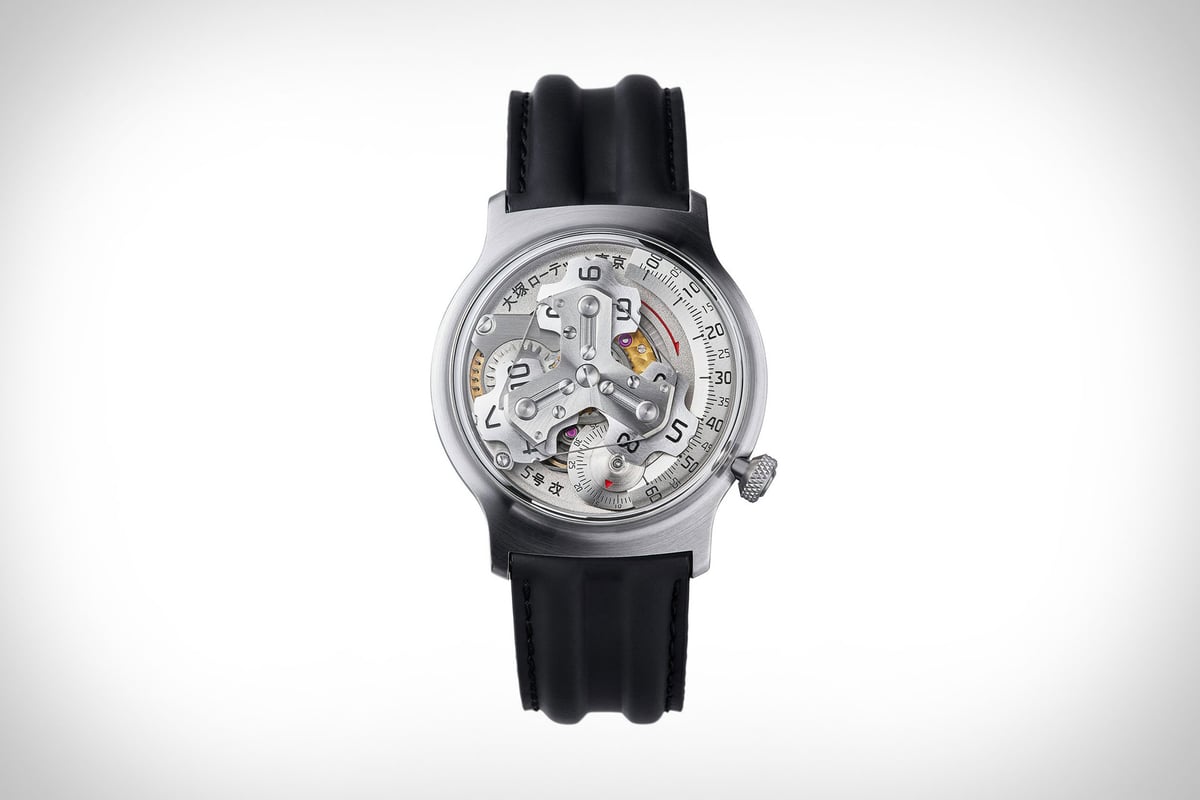
The № 5 KAI is the most persuasive of them. “Kai” is written with the character 回, which carries the sense of rotation, revolution, a turning — and that is precisely the mechanism at the heart of the watch. The hour is not indicated by a hand. It is carried on a rotating element that turns through the course of the day, read against a fixed index, while the minutes continue to be swept by a conventional hand. It is a hybrid: half traditional, half conceptual, and entirely coherent once you have spent a day with it.
The Atelier: Otsuka Lotec and the Japanese Microbrand Tradition
Otsuka Lotec was founded in 2015 in Japan, and it belongs to a very specific moment in Japanese watchmaking. The last decade has seen a flowering of small Japanese independents — Kurono Tokyo, Ming's design studio with its Japanese manufacturing partners, Hajime Asaoka's hand-finished pieces — that sit between the industrial output of Seiko and the rarefied production of the Swiss independents. These are not brands trying to compete on complications. They compete on point of view.
Katayama's point of view is that the dial is a communication surface, not a decoration. Where most brands treat the dial as a canvas for finishing — guilloché, sunburst, enamel — Otsuka Lotec treats it as a problem in information design. How do you communicate the hour and the minute in a way that is unmistakable yet unfamiliar? The № 5 KAI is his most elegant answer, and it is the model that has done the most to establish the brand outside Japan.
Production is small and hand-assembled. That matters for two reasons. First, it explains why the brand is discreet about technical specification: there is no marketing department generating a specification sheet, only a workshop producing a few hundred pieces a year. Second, it means the watches are genuinely scarce in a way that most “limited editions” from large brands are not.
Reading the № 5 KAI: The Rotating Hour
The core idea is simple enough to describe and surprisingly difficult to describe well. The hour is displayed on a rotating element that advances through the day, carrying the numerals past a fixed reference point. The minute continues to be read from a conventional hand sweeping the dial. The result is a dial that is at once more legible than a regulator and less familiar than anything else in the box.
What makes it work is the discipline of the layout. Katayama has resisted the temptation to add. There is no date, no small seconds, no power reserve indicator, no branding clutter. The dial does one thing, and every element on it exists to serve that one thing. The typography is restrained — the numerals are drawn rather than borrowed from a standard font, and their weight and spacing are calibrated so that the active hour reads clearly even at a glance. The fixed index is a simple, unambiguous mark; there is no ambiguity about where the eye should land.
There is a learning curve, and it lasts about a day. On the first morning, the eye goes looking for an hour hand and finds none, and there is a half-second of confusion. By the second morning, the brain has rewired itself, and the rotating display becomes the most natural thing in the world. This is the mark of a genuinely good unconventional display: it does not stay difficult. It becomes obvious, and then it becomes difficult to go back.
The finishing of the dial is where the Japanese sensibility shows. The surfaces are matte where they need to be matte — a high-polish dial would throw reflections across the numerals and destroy the legibility the whole design depends on. The printing is crisp, the edges are clean, and the rotating element sits at a slight depth beneath the fixed components, which gives the dial a subtle three-dimensional quality without resorting to applied indices or gimmicks.
Movement: A Miyota Workhorse Under an Unusual Display
Otsuka Lotec builds the № 5 KAI around a Miyota 9039 automatic. This is an entirely sensible choice and worth defending. The 9039 is a no-date, 28,800 vph Japanese automatic with a power reserve of roughly 42 hours — a movement designed for reliability rather than romance, produced in enormous quantities, and supported by a global spare-parts network. In a watch whose cost is concentrated in the design and the display mechanism, the base movement is the right place to be conservative.
The 9039 is a descendant of the Miyota 9000 family, itself a modern thin automatic architecture with a unidirectional winding system and a decent reputation for rate stability. It is not a decorated movement in the Swiss sense — you will not find hand-bevelled bridges or Geneva stripes of any great ambition — but it is honest, and in a closed-caseback watch, that honesty is largely academic. What matters is that it runs, that it runs for decades, and that any competent watchmaker in the world can service it.
On top of the base movement sits the display mechanism that carries the hour element. This is where the brand's engineering effort lives. Driving a rotating display smoothly and precisely from the motion works, without introducing backlash or hesitation, is not trivial; the element must advance in a controlled way and must not drift between positions. The execution here is clean, and the transition of the hour is calm rather than snappy — a deliberate choice that suits the watch's contemplative character.
Regulation is done in-house, and the brand is candid that this is not a chronometer operation. There is no COSC certification, and none is claimed. What you get instead is a well-regulated Japanese automatic that will keep time to a standard that satisfies anyone who is not timing a rally stage.
Case, Crystal, and Strap
The case is stainless steel, finished with the kind of restraint that has become a signature of the Japanese microbrand scene. There is no attempt to imitate the faceted lugs of a Royal Oak or the twisted casebands of a Nautilus. The geometry is simple, the surfaces are divided between brushed and polished areas with clear intent, and the whole thing reads as a designed object rather than an assembled one.
The crystal is sapphire. This is the correct choice for a watch at this price, and it is also the correct choice aesthetically: a sapphire crystal with a modest internal anti-reflective treatment keeps the dial legible without the milky glare that plagues some coated crystals. The watch is not designed as a sports instrument, and water resistance is not the point — this is a watch for a desk, a dinner, and a train carriage, not a swimming pool. The atelier does not publish a depth rating for this reference, and buyers should treat it accordingly.
The strap is leather, and it is properly matched to the case rather than treated as an afterthought. The leather is supple from the first wear, with a grain that suits the dial's matte restraint, and it is secured by a pin buckle — a decision that will annoy the deployant devotees and delight everyone who has ever tried to size a deployant without a jeweller's screwdriver. The pin buckle is also the historically correct answer for a watch of this character; a folding clasp would add a note of corporate polish that the design does not want.
Luminous material is absent, and this is not an oversight. Luminous paint on a dial this carefully composed would be a foreign body — the numerals on a rotating display are difficult to coat evenly in any case, and the watch is explicitly a daytime, indoor, urban object. If you need to read the time at 3 a.m. in a tent, this is not the watch. If you need to read the time at 3 a.m. in a hotel room in Tokyo, the ambient light will do the job.
On the Wrist
The № 5 KAI wears like a dress watch that has been designed by someone who actually wears dress watches. The case sits close to the wrist, the strap curves naturally around the wrist bone rather than standing off it, and the balance point is where it should be — the head stays centred rather than sliding toward the six o'clock side. There is no sense of a heavy object pulling at the sleeve.
What is more interesting is the psychological wear. This is a watch that invites glances. Not because it is loud — it is not — but because the display rewards looking. The rotating hour element changes position gradually, so the dial you see at nine in the morning is not the dial you saw at eight, and there is a quiet pleasure in noticing the change. Owners of unconventional displays describe this consistently: the watch becomes a small ritual rather than a tool.
The proportions are those of a classic mid-century dress watch rather than a modern sports watch, and the design is comfortable on a range of wrist sizes because the visual mass is concentrated in the dial rather than the case flanks. It is not a watch that announces itself across a room. It is a watch that announces itself across a dinner table, to the one person who knows what they are looking at.
Accuracy and Daily Ownership
A Miyota 9039, properly regulated, will typically run within a handful of seconds a day in either direction. Expect something in the range of −10 to +15 seconds per day in normal wear, with the caveat that any mechanical watch's rate depends on position, temperature, and how much you move. The watch is automatic, so a normal working day of wrist time will keep it wound; if you take it off on Friday evening and put it back on Monday morning, expect to reset it.
The movement hacks, which makes setting straightforward, and the absence of a date means there is nothing to correct at the end of a short month. This is one of the underrated pleasures of a no-date watch: it is always right, and setting it takes ten seconds.
Daily ownership is low-stress. The case is stainless steel and will accumulate the usual hairline scratches on polished surfaces; the sapphire crystal will not. The leather strap will darken and soften over the first year and will eventually need replacing, which is a normal cost of ownership. Nothing about the watch demands special handling.
Occasions and Presence
This is a daily watch, a dress watch, a travel watch, and a formal watch, and it is not a sports watch. It is at its best in the situations where a conventional dress watch would be expected but a conventional dress watch would be boring — a gallery opening, a long lunch, a business meeting where you would like the person across the table to notice something. It works with a suit and it works with a knit and it works with a white shirt and dark trousers.
Wrist presence is high for a watch of its type, but the presence is intellectual rather than physical. It does not glitter. It does not catch light across a room. What it does is create a small puzzle for anyone who looks at it, and puzzles are memorable. In a room full of Submariners, the № 5 KAI is the watch people ask about.
Family, Variants, and Alternatives
Otsuka Lotec's catalogue is organised as a numbered series, and the № 5 KAI sits alongside the earlier № 1 through № 4 and the later № 6 and № 7. Each model explores a different display concept, and collectors of the brand tend to accumulate rather than choose. The № 6, with its own unconventional display, is the other model that has attracted international attention, and it is the natural sibling for anyone drawn to the № 5 KAI's logic.
Within the № 5 line, the KAI is the reference in question. The brand's production is small and its colourways change between batches, so the most reliable advice is to buy the version you can find from an authorised source rather than to wait for a specific dial.
Alternatives and Homages
If the № 5 KAI appeals, a few other watches occupy adjacent territory. The Ressence Type 1 approaches the same problem — how to make time unfamiliar — with an orbital, oil-filled display and a very different price tag. Urwerk's wandering-hour pieces take the concept into haute horlogerie. Kurono Tokyo offers Japanese microbrand design with a more conventional display and a similar sensibility. And Seiko's Presage line provides Japanese craft dials at a fraction of the cost, though without the conceptual ambition.
At the affordable end, Xeric builds wandering-hour and disc-display watches for a few hundred dollars, and Mr Jones Watches produces rotating-disc designs with genuine wit. Neither will satisfy someone who wants the Otsuka Lotec's level of finishing, but both are honest introductions to the idea that a dial can be redesigned.
Investment and Value
Otsuka Lotec does not have an auction history of any significance, and it is unlikely to develop one. This is a small Japanese atelier, not a Swiss maison with a waiting list and a secondary market. What the brand does have is scarcity, a growing collector base, and a design that is genuinely unlike anything else. Prices for the № 5 KAI have been broadly stable, with pre-owned examples trading close to retail when they appear at all.
For a buyer with the means to treat watches as objects rather than assets, the value proposition is straightforward: you are paying for design and scarcity, not for gold or complications. The watch will not appreciate. It will also not embarrass you. And it will be the one in the box that people remember.
Service and Long-Term Ownership
Because the base movement is a Miyota, service is straightforward in principle — any competent watchmaker can handle a 9000-series automatic. In practice, the display mechanism on top of it is proprietary, and that is the argument for returning the watch to Otsuka Lotec or its authorised representatives for anything beyond a basic regulation. The brand is small, which means service turnaround may be measured in months rather than weeks, and it means you should not expect the concierge infrastructure of a major Swiss brand.
The upside is that the movement itself is robust and well understood. A watch like this, worn regularly and serviced at sensible intervals, should outlast its first owner comfortably.
Pros and Cons
- Pros: A genuinely original display that becomes intuitive within a day; restrained, disciplined design; a reliable Japanese automatic base; small-scale production that guarantees rarity; excellent daily wearability.
- Cons: No luminous material; no date; modest water resistance; service requires the brand; the atelier publishes limited technical specification.
Final Verdict
The Otsuka Lotec № 5 KAI is not for the collector who wants a watch that confirms what they already know. It is for the collector who has owned the obvious watches and wants something that makes them look again. Jiro Katayama has taken the oldest problem in watchmaking — how to show the time — and found a solution that is neither nostalgic nor gimmicky. It is quiet, it is precise, and it is unlike anything else at the price. If you can find one, buy it before you talk yourself out of it.