The Industrial Soul of Tokyo: An Introduction to Otsuka Lotec
In the quiet corners of Tokyo's watchmaking scene, far from the polished halls of Ginza, a different kind of horological revolution is taking place. Jiro Katayama, a former product designer with a penchant for the 'Lotec'—his term for a low-tech, mechanical aesthetic—has become a cult figure among serious collectors. His brand, Otsuka Lotec, doesn't rely on marketing blitzes or celebrity endorsements. Instead, it relies on the sheer, undeniable magnetism of its engineering. The № 6, reference P06-23894, is perhaps the most iconic expression of this ethos.
To understand the № 6, one must first understand Katayama’s background. He is not a traditional watchmaker by training but a designer of tools and cameras. This heritage is evident in every facet of the № 6. It does not look like a watch designed in a CAD program to mimic a 1950s diver; it looks like a piece of equipment salvaged from a high-precision laboratory. It is brutalist, it is honest, and in its own way, it is deeply reverent of the mechanical age.
Case Architecture: Machined Perfection
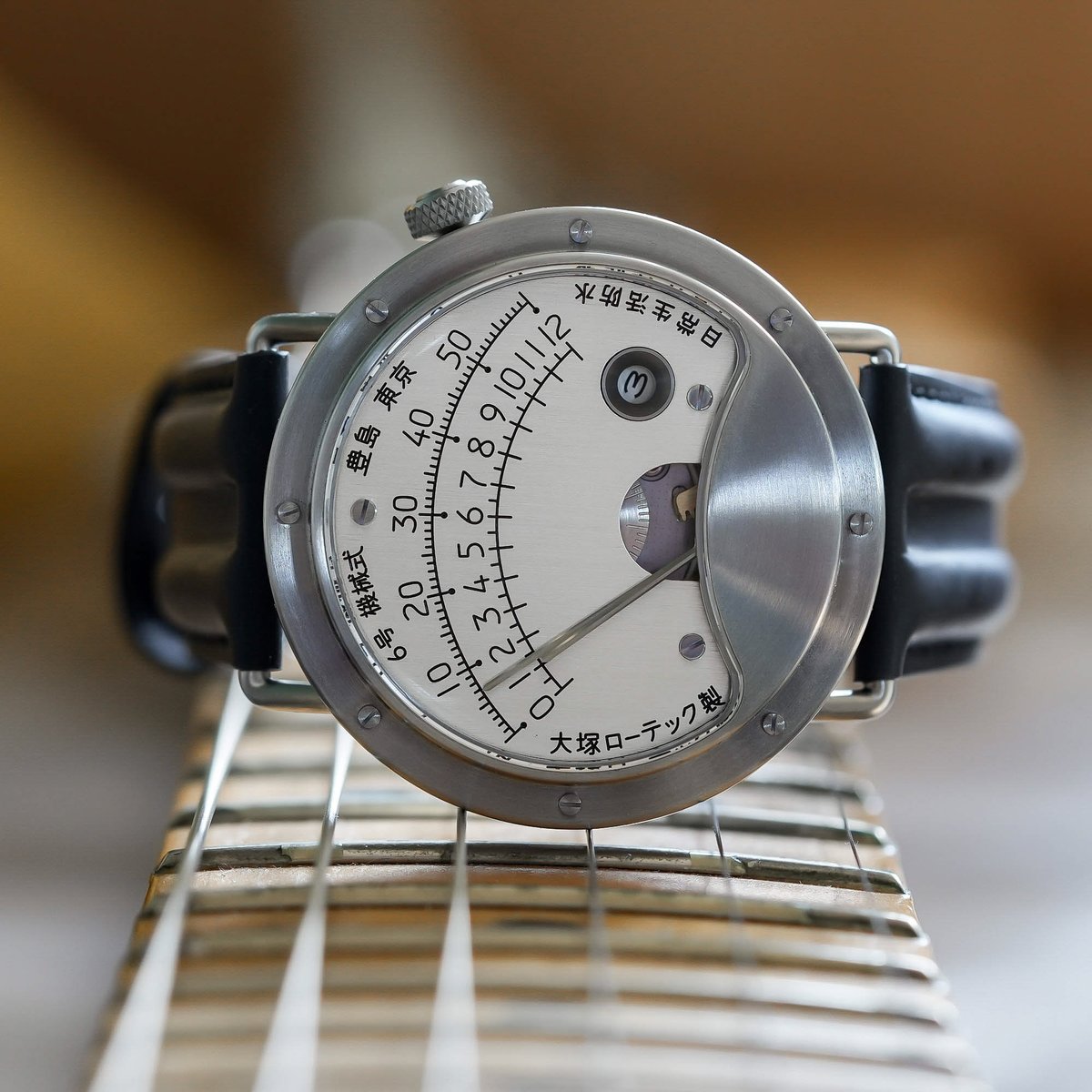
The case of the № 6 is a 42.6mm cylinder of stainless steel that challenges our perceptions of luxury finishing. There are no chamfered edges here, no alternating layers of Zaratsu polishing and satin brushing. Instead, the case features a uniform, industrial brushed finish that feels purposeful. The reference P06-23894 is characterized by its 'puck' shape, which serves as a frame for the complex mechanical theater happening on the dial.
The bezel is held in place by visible screws, a design choice that underscores the 'tool' nature of the piece. These are not decorative screws; they are part of the watch's structural integrity. The sapphire crystal is flat, providing a distortion-free view of the retrograde display. At 12.5mm thick, the watch has presence without being overbearing, sliding under a jacket cuff with surprising ease, though it feels most at home paired with a heavy denim or a technical blazer.
The Dial: A Study in Retrograde Motion
The true genius of the № 6 lies in its display. Katayama has moved away from traditional central hands. Instead, the watch features a jumping hour aperture at the top and a large, sweeping retrograde minute hand that dominates the lower two-thirds of the dial. The minute scale is laid out like a tachymeter or a pressure gauge, with crisp, black numerals against a metallic background.
Watching the retrograde minute hand reach the 60-minute mark is a visceral experience. The tension builds as it approaches the edge of its arc, and then, in a fraction of a second, it snaps back to zero while the hour disc clicks forward. This synchronization requires a high degree of torque and precision, managed by Katayama’s custom module. The dial plate itself features circular graining that catches the light in a way that highlights the depth of the mechanism.
The Movement: The Miyota 9015 Transformed
Purists might initially scoff at the use of a Miyota 9015 as the base caliber. However, such a view misses the point of Otsuka Lotec. Katayama uses the 9015 because it is a slim, reliable, and high-frequency 'tractor' movement capable of supporting the additional weight of his complications. The real 'manufacture' work happens on top of this base.
The module designed by Katayama is a feat of independent engineering. It involves a series of cams and springs that manage the jumping hour and the retrograde return. Because Katayama assembles these modules himself, the level of quality control is immense. The movement architecture is visible through the caseback in some models, but in the № 6, the focus remains on the face. The 28,800 vph frequency ensures that the minute hand moves with a smooth, sweeping motion, belying its industrial appearance.
Wrist Experience and Ergonomics
On the wrist, the Otsuka Lotec № 6 is a study in balance. While the 42.6mm diameter might suggest a large watch, the lack of traditional lugs means it wears closer to a 40mm piece. The strap attaches directly to the underside of the case, allowing the watch to wrap around the wrist. This makes it exceptionally comfortable for daily wear.
The legibility is surprisingly high. Once the wearer adjusts to the gauge-style layout, reading the time becomes second nature. The jumping hour is clear and prominent, and the retrograde minute hand provides a quick, intuitive sense of how much of the hour has passed. There is no lume, which might be a drawback for some, but in the context of this design, Super-LumiNova would feel out of place—like putting neon lights on a vintage microscope.
The Collector's Perspective: Scarcity and Value
Acquiring a № 6 is one of the most difficult feats in modern watch collecting. Otsuka Lotec utilizes a lottery system for its very limited production runs. This has created a secondary market where prices frequently triple the original MSRP of approximately $2,800. For the sophisticated collector, this appreciation is a secondary benefit; the primary draw is the ownership of a piece that represents a singular vision.
The investment value of the P06-23894 is bolstered by the fact that Katayama is a one-man operation. There is no 'factory' that can ramp up production to meet demand. Each watch is, in essence, a hand-made object. In an era of mass-produced luxury, the № 6 offers a return to the artisanal roots of horology, albeit through a lens of modern Japanese minimalism.
Final Verdict: A Modern Icon
The Otsuka Lotec № 6 is a triumph of design over artifice. It does not try to be a status symbol, yet it has become one of the most respected watches in the independent world. Jiro Katayama has succeeded in creating a mechanical language that is entirely his own. For those lucky enough to secure one, the № 6 is a reminder that the most exciting developments in watchmaking are often found far from the beaten path. It is precise, it is technical, and it is, above all, a masterpiece of industrial poetry.