Introduction: The Quiet Cult of Otsuka Lotec
In the crowded landscape of independent watchmaking, few brands manage to stay under the radar while commanding a devoted following. Otsuka Lotec is one of them. Founded in Japan in 2005 by Jiro Katayama, the brand has built a reputation on a simple premise: make watches that look like tools from a parallel universe, where industrial design and vintage military aesthetics collide. The Model No. 6, or 6号, is the clearest expression of that philosophy.
It's not a watch that shouts for attention on Instagram. It doesn't have a celebrity ambassador or a waiting list that stretches for years. Instead, it has something more valuable: a distinct point of view. The Model No. 6 is a field watch that feels like it was pulled from a 1970s Japanese instrument panel, yet it's built for modern wear. For young collectors tired of the same dive watches and chronographs, it offers a refreshing alternative.
This review dives into everything you need to know about the Otsuka Lotec Model No. 6: its history, design, movement, wearability, and whether it deserves a place in your collection. We'll also look at its investment potential and how it stacks up against similar watches. If you're looking for a piece that flies under the radar while making a statement, keep reading.
Brand History: Otsuka Lotec and the Art of Low Technology
Otsuka Lotec was founded in 2005 by Jiro Katayama. The name 'Lotec' is often interpreted as a contraction of 'low technology,' a nod to the brand's approach of favoring mechanical simplicity and utilitarian design over high-tech complications. Based in Japan, the brand operates on a small scale, producing watches in limited batches that often sell out quickly.
Katayama's background is in industrial design, and that influence is evident in every Otsuka Lotec piece. The brand's numbered series—No. 1 through No. 7 and beyond—each take inspiration from different vintage Japanese watches, instruments, or military equipment. The Model No. 6 is arguably the most iconic, with a design that references the rugged field watches issued to soldiers and explorers, but filtered through a distinctly Japanese lens of minimalism and precision.
Unlike many microbrands that rely on off-the-shelf cases and generic dials, Otsuka Lotec puts thought into every element. The Model No. 6 is not a homage to a specific watch; it's an original design that captures the spirit of mid-century tool watches. That originality has earned it a cult following among collectors in Japan and abroad, particularly those who appreciate independent watchmaking with a strong aesthetic identity.
The Philosophy of Otsuka Lotec: Low Technology, High Character
Otsuka Lotec's approach is a reaction against the increasingly complex and expensive world of luxury watches. Jiro Katayama, the founder, has said in interviews that he wants to create watches that are simple, durable, and beautiful in a utilitarian way. The brand's name, 'Lotec,' is a play on 'low technology,' but it's not about being primitive—it's about stripping away the unnecessary and focusing on what matters.
This philosophy is evident in the Model No. 6. There are no diamonds, no skeletonized dials, no tourbillons. Instead, there's a well-proportioned case, a legible dial, and a reliable movement. It's a watch that does one thing and does it well. That kind of focus is rare in an industry that often prioritizes spectacle over substance.
For young collectors, this philosophy is refreshing. It says that you don't need to spend a fortune to own something special. You just need to have an eye for design and a willingness to look beyond the usual brands.
Design and Dial: Instrument Panel Cool
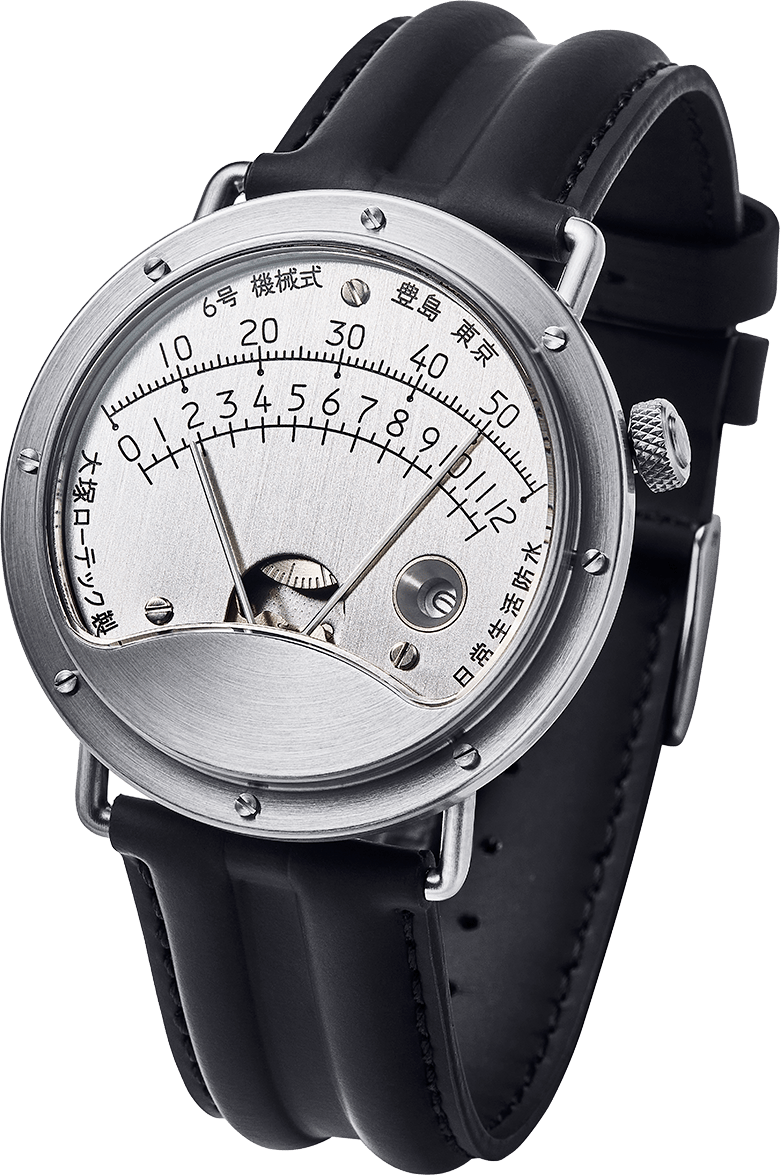
The first thing you notice about the Model No. 6 is its dial. It's a masterclass in legibility and character. The black background is matte, absorbing light rather than reflecting it, which gives the watch a stealthy, purposeful look. Large Arabic numerals are printed in a clean, sans-serif font that feels both vintage and modern. The hour and minute hands are sword-shaped, with luminous fill that glows a soft green in low light.
One of the most distinctive features is the red accent on the seconds hand or the 12 o'clock marker—depending on the variant. This pop of color adds a sporty touch without overwhelming the design. A date window at 3 o'clock is discreetly integrated, framed by a subtle white border. The overall layout is balanced and uncluttered, making it easy to read at a glance.
The case is stainless steel, with a shape that blends cushion and tonneau influences. It's not a traditional round case, which gives the watch a unique profile on the wrist. The lugs are short and curved, designed to hug the wrist comfortably. The sapphire crystal is slightly domed, adding a vintage feel while providing excellent scratch resistance. The finishing is a mix of brushed and polished surfaces, with the brushed areas dominating to keep the tool-watch vibe intact.
The leather strap is supple and well-made, with a pin buckle that matches the case. It's the kind of strap that breaks in quickly and becomes part of the watch. While some collectors might swap it for a NATO or rubber strap, the stock leather is perfectly suited to the Model No. 6's character.
Dial Deep Dive: Legibility Meets Art
The dial of the Model No. 6 is where the watch truly shines. The matte black surface is a perfect backdrop for the white numerals and hands. The font used for the numerals is inspired by vintage Japanese instruments, with a slightly squared-off look that feels technical yet approachable. The 12 o'clock marker is often highlighted with a red triangle or dot, a subtle nod to military watches that used red for orientation.
The hands are another highlight. The hour and minute hands are broad and sword-shaped, with a polished finish that contrasts with the matte dial. The seconds hand is thin and needle-like, with a red tip that adds a dynamic element. The date window at 3 o'clock is small and unobtrusive, with a white date wheel that matches the numerals. It's a thoughtful detail that many brands overlook.
The lume application is generous. The hands and markers are filled with Super-LumiNova, which glows a bright green in the dark. The lume is not the strongest or longest-lasting, but it's more than adequate for a field watch. After a few minutes under a light, you can easily read the time in a dark room.
Movement: The Reliable Heart
Inside the Otsuka Lotec Model No. 6 beats a Miyota 9015 automatic movement. This Japanese caliber is a favorite among independent watchmakers for its thin profile, reliability, and smooth sweep seconds hand. It operates at 28,800 vibrations per hour and offers a power reserve of approximately 42 hours.
The Miyota 9015 is not a decorated movement—you won't find hand-finished bridges or Geneva stripes. But that's not the point. It's a workhorse that keeps accurate time and is easy to service. The date function is a practical addition for daily wear, and the movement's robustness means you can wear the watch without worrying about it.
In terms of accuracy, the Miyota 9015 is known to perform within -10 to +15 seconds per day in real-world conditions. That's not chronometer-grade, but it's perfectly acceptable for a watch in this price range. If you're someone who needs atomic-clock precision, you might be disappointed, but for most collectors, the reliability and character of the movement more than make up for it.
Case and Wearability: Comfortable and Confident
The Model No. 6 is designed to be worn. Its compact case and short lugs make it suitable for a wide range of wrist sizes, from slender to average. It sits close to the wrist, with a balanced weight that doesn't feel top-heavy. The curved caseback allows it to nestle comfortably, and the leather strap conforms quickly.
On the wrist, the watch feels substantial but not heavy. It has a presence that is noticeable without being ostentatious. The high-contrast dial and unique case shape draw the eye, but it's not a watch that screams for attention. It's the kind of piece that rewards close inspection, with details like the red accent and the textured dial that reveal themselves over time.
Water resistance is not published for this reference, but it's safe to say the watch is splash-resistant and suitable for daily wear. It's not a dive watch, so you shouldn't take it swimming or diving. For everyday activities—commuting, office work, casual weekends—it's perfectly fine.
The lume is Super-LumiNova, which provides good legibility in low light. The hands and markers glow brightly after a short charge under a lamp or sunlight. It's not the longest-lasting lume on the market, but it's adequate for reading the time in a dark room or at the movies.
Strap and Wearability: Comfort Is Key
The Model No. 6 comes on a leather strap that is both comfortable and durable. The leather is thick but supple, and it breaks in quickly to conform to your wrist. The stitching is neat and matches the overall aesthetic. The pin buckle is stainless steel and feels solid. It's not a quick-release system, but that's a minor detail.
If you prefer a different look, the watch is compatible with aftermarket straps. The lug width is standard, so you can easily swap in a NATO, rubber, or mesh strap. A grey NATO strap, for example, would give it an even more military look. A black rubber strap would make it more sporty. The versatility is a plus.
On the wrist, the watch feels balanced. It's not too heavy, and it doesn't flop around. The short lugs mean it fits well on smaller wrists, while the case size is large enough to have presence on larger wrists. It's a watch that you can wear all day without discomfort.
Accuracy and Reliability: A Trusty Companion
The Miyota 9015 is a movement that has proven itself in countless microbrand watches. It's known for being reliable and accurate. In real-world use, you can expect it to run within -10 to +15 seconds per day. That's not bad for a mechanical watch at this price point. If you're particular about accuracy, you can have it regulated by a watchmaker, but it's not necessary for most people.
The power reserve is around 42 hours, which means you can take it off for a day and it will still be running. The winding action is smooth, and the hacking seconds allow you to set the time precisely. The date function is a nice convenience, and it changes over crisply at midnight.
Overall, the Model No. 6 is a watch you can rely on. It's not fragile, and it doesn't require special care. It's meant to be worn and enjoyed.
Occasions: Where It Fits
The Otsuka Lotec Model No. 6 is a versatile watch that fits a variety of occasions:
- Daily: Its comfortable case and legible dial make it perfect for everyday wear.
- Sport: While not a dedicated sports watch, its robust movement and sapphire crystal can handle light activities.
- Travel: The date and easy-to-read dial make it a great travel companion.
- Casual: It shines with casual outfits, adding a touch of industrial cool.
It's not a dress watch, so wearing it with a tuxedo would be a stretch. But for most modern dress codes, it works fine.
Investment Value: A Niche with Devoted Fans
Otsuka Lotec is not a brand that you'll find in every watch shop. It's a small independent, and its watches are produced in limited numbers. The Model No. 6 is one of its most popular models, and it often sells out quickly. The MSRP is not widely published, but it's generally in the range of a few hundred dollars—affordable for an independent watch.
On the secondary market, the Model No. 6 holds its value well. Because of its scarcity and cult following, pre-owned prices are often close to or slightly above retail. However, the market is thin, meaning there aren't many transactions. If you're looking to flip it for a profit, you might be disappointed. But if you're looking for a watch that will retain its value while you enjoy it, it's a solid choice.
There is no major auction history for this reference. It's not a watch that appears at high-end auctions. Instead, it's traded among enthusiasts on forums and Japanese marketplaces. That's typical for microbrands and independent watchmakers. The lack of auction presence doesn't mean it's not valuable; it just means it's not a mainstream collectible.
Service and Maintenance: Easy and Affordable
Because the Model No. 6 uses a Miyota 9015, servicing is straightforward. Any watchmaker who works on Japanese movements can service it. You don't need to send it to Japan or pay a premium for authorized service. Parts are widely available, so if something needs replacing, it won't be a problem.
The recommended service interval is every 5 to 7 years, or whenever you notice a significant change in accuracy. The cost of service is typically in line with other watches using the same movement—usually a few hundred dollars. That's reasonable for a mechanical watch.
The sapphire crystal is very scratch-resistant, so you won't need to replace it unless it breaks. The leather strap will wear out over time, but replacements are easy to find and inexpensive.
Similar Watches and Homages: The Alternatives
If you're considering the Otsuka Lotec Model No. 6, you might also want to look at these watches:
- Hamilton Khaki Field Mechanical: A classic field watch with a similar military aesthetic. It's more widely available and has a strong heritage.
- Seiko 5 Sports SRPE: A Japanese automatic field watch that offers great value. It's not as unique as the Otsuka Lotec, but it's a solid everyday watch.
- Timex Expedition North Field Post Mechanical: An affordable field watch with a vintage-inspired design. It's a great budget option.
For those who want the look without the price, there are homages like the Seiko SNK809 or the Timex Expedition Scout. These are great entry-level watches, but they don't have the same level of design detail or the unique case shape of the Otsuka Lotec.
Final Verdict: Should You Buy It?
The Otsuka Lotec Model No. 6 is a watch that stands out for all the right reasons. It's not trying to be a Rolex or an Omega. It's not trying to be the most complicated watch in the world. It's simply a well-designed, well-made field watch with a distinct point of view.
If you're a collector who values individuality, craftsmanship, and a bit of Japanese mystique, the Model No. 6 is a compelling choice. It's a watch that you can wear every day, that will hold its value, and that will start conversations with people who know. It's a cult classic in the making.
If you're looking for a mainstream luxury watch that everyone will recognize, this isn't it. But if you want something that feels personal and authentic, the Otsuka Lotec Model No. 6 is worth seeking out. Just be prepared to hunt for it—they don't stay available for long.