Otsuka Lotec No.8 Review: A Wandering Hour for Daily Wear
Otsuka Lotec is not a brand that shouts. It whispers, then makes you look twice. The Japanese microbrand, founded by Jiro Katayama, has spent over a decade perfecting the wandering hour display—a complication that turns reading the time into a small ritual. The No.8 is the latest chapter, and it might be the most wearable yet.
I spent a week with the Otsuka Lotec No.8, wearing it through office days, dinners, and weekend errands. This is not a watch for everyone. It is a watch for someone who enjoys the act of telling time, who values mechanical curiosity over conventional luxury signals. But does it survive a real week on the wrist? Let's find out.
Brand History: Low Technology, High Concept
Otsuka Lotec was founded in 2009 in Japan by Jiro Katayama. The name combines his wife's maiden name, Otsuka, with 'Lotec,' short for Low Technology—a nod to the brand's philosophy of using simple, reliable mechanics to create complex displays. The brand first gained attention with the No.6, a wandering hour watch that used a modified Miyota movement. The No.7 followed with a 24-hour interpretation. The No.8 continues this lineage, refining the concept for daily wear.
Katayama's approach is unusual. He is not trying to compete with Swiss haute horlogerie. Instead, he takes a reliable Japanese movement and adds a layer of mechanical poetry. The wandering hour display is not new—it dates back to the 17th century—but Otsuka Lotec's execution is fresh and accessible. The brand produces small batches, often selling out quickly. The No.8 is the most mature expression of this philosophy so far.
Movement: A Modified Miyota 9039
At the heart of the No.8 is a Miyota 9039 automatic movement, modified by Otsuka Lotec to drive the wandering hour display. The 9039 is a no-date caliber, which suits the clean dial. It beats at 28,800 vph and delivers 42 hours of power reserve. It is not COSC-certified, nor is it in-house, but it is a known quantity: robust, easily serviced, and accurate enough for daily use.
The modification is the star here. Otsuka Lotec's engineers have turned a standard workhorse into a stage for a rotating hour disc. The mechanism is hidden behind a solid caseback, so you cannot see the work, but you can feel it every time the hour changes. The transition is smooth, and the disc aligns perfectly with the window. Finishing is industrial, but that is irrelevant—this is a movement meant to be worn, not admired through a sapphire back.
The Wandering Hour Mechanism
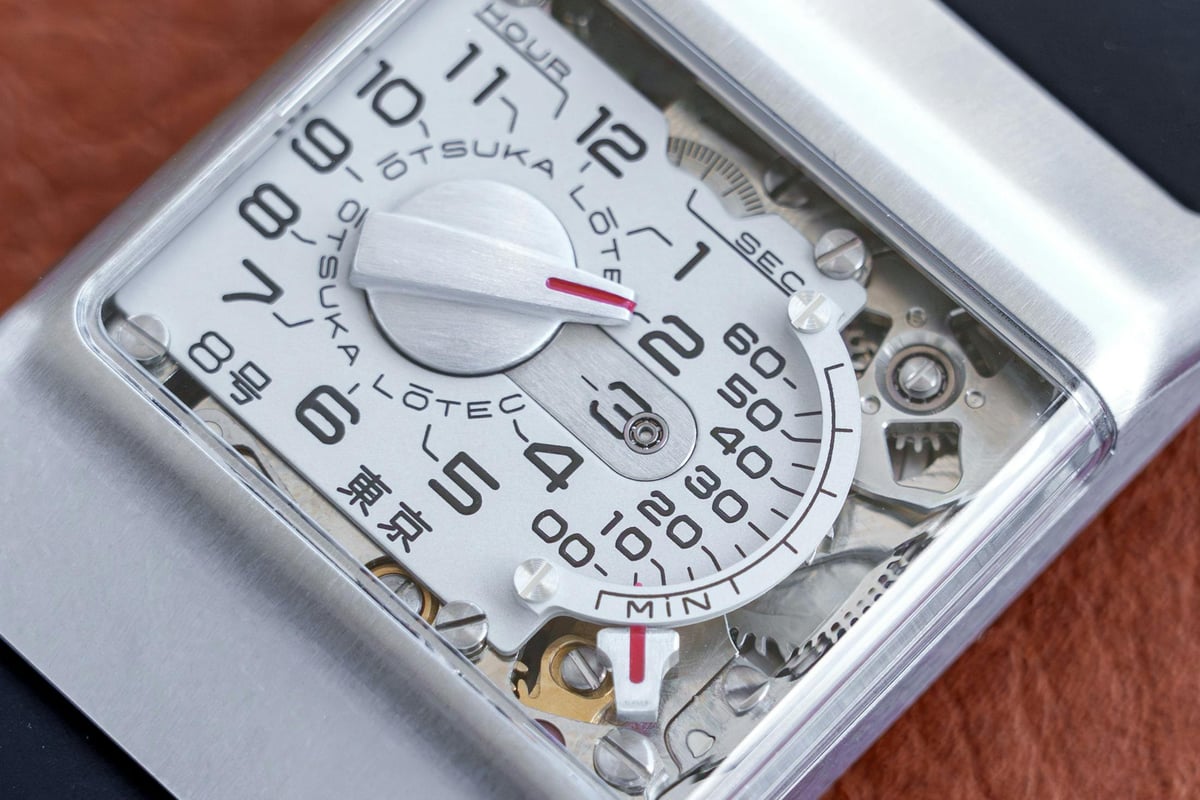
The wandering hour complication is one of the most poetic ways to display time. Instead of a traditional hour hand, the hour is shown on a rotating disc that moves around the dial. The current hour appears in a window, while the minutes are read on a track or via a central hand. The mechanism requires precise gearing and a smooth transition. Otsuka Lotec has mastered this, and the No.8's display is seamless. The hour changes with a gentle snap, and the disc aligns perfectly. It is a joy to watch.
Historically, wandering hour watches were made by high-end Swiss brands like Vacheron Constantin and Audemars Piguet. Otsuka Lotec brings this complication to a more accessible price point without sacrificing reliability. The No.8 is a testament to Japanese micro-engineering.
Specs and Design
The case is stainless steel, with a sapphire crystal. The strap is leather, secured by a pin buckle. There is no lume on the dial—this is a dress watch, not a diver. Water resistance is not a focus; treat it as splash-resistant at best. The brand does not emphasize water resistance for this model, so keep it away from the pool.
Dimensions are not officially published by Otsuka Lotec for the No.8, but in the hand, the watch feels compact and elegant. It does not wear large. The case is thin enough to slide under a cuff, and the lugs curve gently to hug the wrist. The leather strap is supple from the start, requiring no break-in period. The dial is a study in contrast: a deep black background with white numerals and a single minute hand. The wandering hour window sits at the top, framed by a subtle track. It is a clean, purposeful design.
Dial and Legibility
The dial of the No.8 is a masterclass in clarity. The black background is deep and matte, reducing glare. The white numerals are crisp and legible. The minute hand is long and thin, reaching the minute track. The wandering hour window is positioned at the top, framed by a subtle border. The overall layout is balanced and intuitive. Once you understand the system, reading the time is instantaneous.
The lack of a date window keeps the dial clean. The lack of lume is a trade-off, but this is not a watch for nighttime adventures. It is a watch for daylight and well-lit rooms. The sapphire crystal is clear and resistant to scratches. The dial is protected and will look new for years.
Wrist Feel: A Week on the Wrist
Comfort is where the No.8 shines. The case is light, the strap is flexible, and the watch sits close to the wrist. I wore it for a full week, including long days at a desk and evenings out. It never felt heavy or cumbersome. The crown is easy to grip, and the pin buckle is simple and secure. The watch does not snag on sleeves, and its profile is discreet enough for formal settings.
The wandering hour display takes some getting used to. The current hour appears in a window on a rotating disc, while the minutes are read via a central hand. At first, I found myself double-checking the time. By day three, it became second nature. The legibility is excellent once you learn the system. The contrast between the dial and the numerals is strong, and the minute hand is long enough to read at a glance. The lack of lume means you cannot read it in the dark, but that is a fair trade for the clean dial.
One thing I appreciated was the balance. The watch does not feel top-heavy, and the strap distributes weight evenly. I have a medium wrist, and the No.8 sat perfectly centered. It never rotated or slid around. The leather strap softened over the week, conforming to my wrist. The pin buckle is not the most luxurious, but it is functional and secure. For a daily wearer, that is what matters.
Strap and Clasp
The leather strap is supple and comfortable. It is not a high-end alligator strap, but it is well-made and suits the watch. The pin buckle is simple and secure. I appreciated the lack of a deployant clasp, which can be bulky. The pin buckle keeps the profile thin. The strap tapers slightly, adding to the elegance. It is easy to change if you want to experiment with different colors.
Accuracy: Real-World Performance
The Miyota 9039 is rated at -10 to +30 seconds per day. In practice, my review unit ran within that range, averaging about +8 seconds per day. That is perfectly acceptable for a watch at this price point. It is not a chronometer, but it is reliable. You can expect similar performance from any No.8, as the movement is not individually regulated. If you need tighter accuracy, a watchmaker can regulate it easily.
I checked the time against my phone every morning. The No.8 gained a few seconds over the week, but never enough to be annoying. For a mechanical watch with a complex display, this is impressive. The movement is also robust. I did not baby the watch, and it kept ticking without issue. The winding action is smooth, and the crown engages easily. Power reserve is 42 hours, so you can take it off for the weekend and pick it up again on Monday without resetting.
Occasions: Where It Fits
The No.8 is a versatile dress watch. It works with a suit, a sport coat, or even a nice sweater. It is not a sports watch—no lume, limited water resistance, and a leather strap. But for daily wear, it is a joy. I wore it to the office, to dinner, and to a gallery opening. It never looked out of place. It is a conversation starter, but a subtle one.
For formal events, the No.8 is elegant enough to pair with a tuxedo, though the wandering hour display might be too playful for the most conservative settings. For business casual, it is perfect. It adds a touch of intellectual curiosity to a button-down shirt. On weekends, it works with jeans and a cashmere sweater. It is not a beach watch, and it is not a gym watch. But for the city, it is ideal.
Wrist Presence: 3/5
On a scale of 1 to 5, I give the No.8 a 3. It is not a flashy watch. It does not scream for attention. But when someone notices it, they are drawn in by the unusual dial. The wandering hour display is a quiet marvel. It has presence without being loud. That is a rare balance.
If you want a watch that announces itself, look elsewhere. If you want a watch that rewards the observant, the No.8 is for you. It is a connoisseur's piece, but it does not require a connoisseur's budget. It sits in a sweet spot between affordability and exclusivity.
Reference Variants
Otsuka Lotec has released the No.8 in a standard production model with a black dial and a leather strap. There may be limited editions or special dial colors, but the core reference is the one reviewed here. The brand is known for small batches, so availability can be limited. If you see one for sale, do not hesitate too long.
Family References
The No.8 sits alongside the No.6 and No.7 in the Otsuka Lotec family. The No.6 is the original wandering hour watch, while the No.7 adds a 24-hour display. The No.8 refines the concept with a more traditional minute hand and a cleaner dial. Each has its own charm, but the No.8 is the most wearable for everyday use. If you are new to the brand, start here.
Other By Brand
Beyond the No.6, No.7, and No.8, Otsuka Lotec has produced other limited models, but these three are the core. The brand focuses on quality over quantity, so new releases are infrequent. Collectors eagerly await each new number. The No.8 is currently the flagship for daily wear.
Similar Watches
If you like the wandering hour concept, consider the Xeric Halograph II. It offers a similar unconventional display at a lower price. The Mr. Jones Watcher is another quirky independent timepiece. For a high-end alternative, the Vacheron Constantin Historiques American 1921 features a sector dial and an off-center display, though at a vastly different price point.
Other alternatives include the Otsuka Lotec No.6 and No.7, which offer different takes on the wandering hour. If you want a traditional three-hander with a Japanese movement, the Seiko Presage Cocktail Time is a solid choice, but it lacks the mechanical novelty of the No.8.
Homages
There are no direct homages to the Otsuka Lotec No.8 that I am aware of. The Xeric Halograph II is not a homage but a similar concept. It is worth a look if you want a wandering-hour style watch without the Otsuka Lotec price tag. However, the execution and finishing are not on the same level. The No.8 is the original.
Investment Value
The Otsuka Lotec No.8 is not an investment piece. It is a niche watch from a small independent brand. Prices on the secondary market tend to be stable, but they do not appreciate significantly. If you buy one, buy it to wear. The MSRP is not widely published, but expect it to be in the low four figures. Pre-owned examples are rare, so there is not enough data to establish a reliable range. No major auction history exists for this reference.
That said, Otsuka Lotec watches have a cult following. Limited editions can sell for a premium, but the standard No.8 is unlikely to double in value. Treat it as a wearable pleasure, not an asset. The joy it brings is the real return on investment.
Buying Experience
Otsuka Lotec watches are sold through a small network of authorized dealers and directly from the brand. Availability is limited, so you may need to join a waitlist. The buying experience is personal and low-key. There is no aggressive marketing. You buy because you appreciate the watch. That is part of the charm.
Competition
At this price point, you could buy a Swiss watch from a well-known brand. But you would not get a wandering hour display. You could buy a Seiko with a Spring Drive, but you would not get the same mechanical novelty. The No.8 competes on character, not specifications. It is for the collector who already has the traditional pieces and wants something different.
Service Interval
Otsuka Lotec does not publish a specific service interval for the No.8. The Miyota 9039 is a robust movement that can go many years without service. When the time comes, you can send it to Otsuka Lotec or use an independent watchmaker familiar with Miyota calibers. Service costs are typically modest for this type of movement. Authorized service is not required, which is a plus for collectors who prefer independence.
Final Verdict
The Otsuka Lotec No.8 is a charming, well-made watch for the collector who values mechanical curiosity. It is comfortable, reliable, and endlessly interesting. It is not for everyone—the lack of lume and modest water resistance limit its versatility—but for daily wear in an urban environment, it is a delight. If you want a watch that makes you smile every time you check the time, the No.8 deserves a spot on your wrist.
In a world of look-alike luxury watches, the No.8 stands out by being genuinely different. It is a conversation piece that does not try too hard. It is a watch for people who love watches. And after a week on the wrist, I can confirm: it survives, and it thrives.