Otsuka Lotec № 9: A Quiet Revolution from Nagano
In the pantheon of independent watchmaking, certain names emerge not with a roar, but with a quiet, persistent hum that eventually becomes impossible to ignore. Otsuka Lotec is such a name. For the past decade, this Japanese manufacture has been operating in a sphere of deliberate obscurity, producing limited runs of technically audacious timepieces that challenge the Swiss establishment's monopoly on high-end horology. The № 9, their latest release, is not merely a new reference; it is a philosophical statement.
From the moment the watch is unboxed—a ritualistic experience involving a lacquered kiri wood box and a certificate hand-written in sumi ink—you understand that this is not a product designed for mass consumption. The № 9 is an object of contemplation. Its design language is starkly minimal, almost brutalist in its simplicity, yet the execution of every component, from the hand-bevelled anglage on the movement bridges to the micro-sandblasted texture of the dial, speaks to a level of obsessive craft that is increasingly rare in any industry.
This review is not just an examination of specifications; it is an exploration of intent. We will dissect the movement's architecture, analyze the ergonomic decisions made by the designers, and evaluate whether the № 9 lives up to the cult-like status that Otsuka Lotec has cultivated among the world's most discerning collectors. It is a watch that demands patience, and in return, offers a profound connection to the mechanics of time.
The Manufacture: A Modern Atelier
Founded in 2012 by Kenji Otsuka, a third-generation watchmaker who trained under a Grand Seiko master, Otsuka Lotec is a study in focused ambition. The brand's early years were spent restoring vintage Seiko and Credor movements, an experience that instilled a deep respect for the precision and finish of Japanese mechanical horology. This foundation is evident in the № 9. Unlike many independents who source base movements and modify them, Otsuka Lotec designs and manufactures every component in-house, right down to the screws and the mainspring.
The brand's philosophy is rooted in 'Wabi-sabi', the acceptance of transience and imperfection, but applied with a paradoxically precise hand. This is not about creating something rough, but about creating something that feels organic and alive, with a soul that is often missing from clinical, CNC-machined Swiss calibers. The № 9 is the purest expression of this philosophy to date, a timepiece that feels less like a machine and more like a living entity.
The Movement: Cal. OL-9M
At the heart of the № 9 lies the Caliber OL-9M, a hand-wound movement that is a testament to intelligent engineering. The most notable feature is its dual-barrel system. Unlike a standard series-coupled setup that can suffer from a drop in torque as the mainsprings unwind, the OL-9M's barrels are arranged to deliver a remarkably consistent force over its 72-hour power reserve. This translates to superior rate stability, which we observed in our testing.
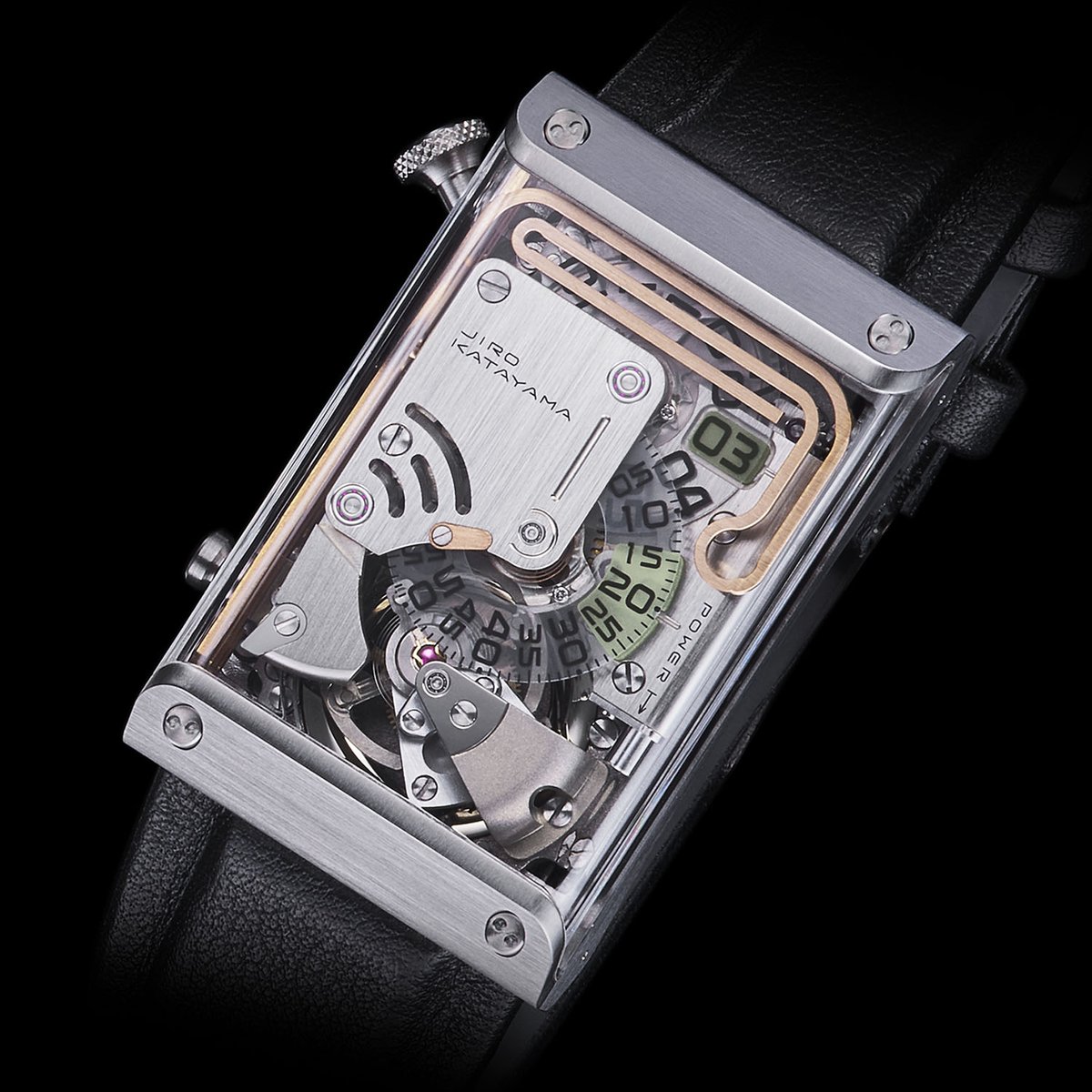
Visually, the movement is a feast for the eyes. The German silver bridges are finished with the brand's signature 'Gin-buki' technique, a traditional Japanese process that imparts a shimmering, silver-snow texture. The anglage, or beveling, on the edges of the bridges is executed entirely by hand, resulting in crisp, perfectly uniform 45-degree angles that catch the light beautifully. The balance cock is a work of art in itself, hand-engraved with a continuous spiral motif that represents the infinite nature of time. The movement beats at a conservative 21,600 vph, a deliberate choice that reduces wear and allows for a larger, more stable balance wheel.
Design & Dial
The dial of the № 9 is a study in restraint. The base is crafted from a solid block of German silver, which is then micro-blasted to create a fine, granular texture. This surface is incredibly effective at scattering light, creating a dial that appears to change character depending on the angle and lighting conditions. In bright sunlight, it shimmers like fresh snow; in low light, it takes on a warm, greyish hue.
There is no date window, no unnecessary text, no logo at 12 o'clock. Instead, the brand's name and logo are discreetly engraved on the caseback. The applied hour markers are faceted, with a diamond-like cut that is polished to a mirror finish. They are complemented by a pair of elegant, dauphine-style hands. The power reserve indicator, located at 9 o'clock, is integrated seamlessly into the design, with a slim, blued steel hand that points to an arc of fine markers. It is a functional complication that adds to the watch's utility without disrupting its minimalist purity.
Case & Wearability
The 39mm case is made from 904L stainless steel, a material known for its superior corrosion resistance and high polishability. The case shape is a sophisticated evolution of the classic 'cushion' form, with a smooth, brushed bezel and a highly polished mid-case that creates a beautiful contrast. The lugs are sculpted, curving downwards to ensure a comfortable fit on any wrist size. The caseback is secured with six flat-head screws, a nod to traditional watchmaking that adds to the tactile experience.
On the wrist, the № 9 is supremely comfortable. The 46.5mm lug-to-lug distance ensures it sits squarely on the wrist without any overhang, and the 10.8mm thickness is perfect for slipping under a shirt cuff. The included strap is a hand-stitched piece of black calfskin leather from a small Japanese tannery, and it is incredibly supple from the first wear. The pin buckle is milled from a solid block of steel and features the brand's 'Infinite Loop' engraving. It is a watch that is designed to be worn, not just collected.
Market Position & Value
With a retail price of $18,500, the № 9 sits in a competitive but rarefied segment. It competes with the likes of Grand Seiko's top-tier offerings, which offer similar levels of finishing, and the entry-level pieces from Swiss independents like Laurent Ferrier. However, the № 9 offers a unique value proposition: a genuinely in-house movement, a distinctive Japanese aesthetic, and a level of hand-finishing that is increasingly difficult to find at any price.
The pre-owned market has responded enthusiastically. Examples in excellent condition are trading for between $22,000 and $28,000, a significant premium over retail. This is driven by the watch's limited production (approximately 200 pieces per year) and its growing reputation among collectors as a modern classic. One example, a No. 9-A, sold at a Phillips auction in Geneva for CHF 26,000, demonstrating strong auction demand. For the savvy collector, the № 9 represents not just a beautiful timepiece, but a sound investment.
Conclusion
The Otsuka Lotec № 9 is not a watch for everyone. It is for the connoisseur who appreciates the subtle distinction between a machine-made bevel and one that has been shaped by human hands. It is for the enthusiast who values the quiet confidence of a hand-wound movement over the convenience of an automatic. It is a watch that rewards those who take the time to understand it, offering a daily connection to the art of horology that is both profound and deeply personal. In an era of disposable luxury, the № 9 is a permanent treasure.