The Architecture of the Arc
In the hierarchy of horological complications, the retrograde display occupies a space of particular fascination. Unlike the continuous sweep of a traditional hand, the retrograde hand must travel along an arc, only to snap back to its origin in a fraction of a second once it reaches the terminus. This requires a sophisticated management of energy—storing it within a spring and releasing it via a cam-and-lever system. In the Otsuka Lotec No. 6 (Ref. P06), Jiro Katayama has not just implemented this complication; he has made it the central protagonist of the design.
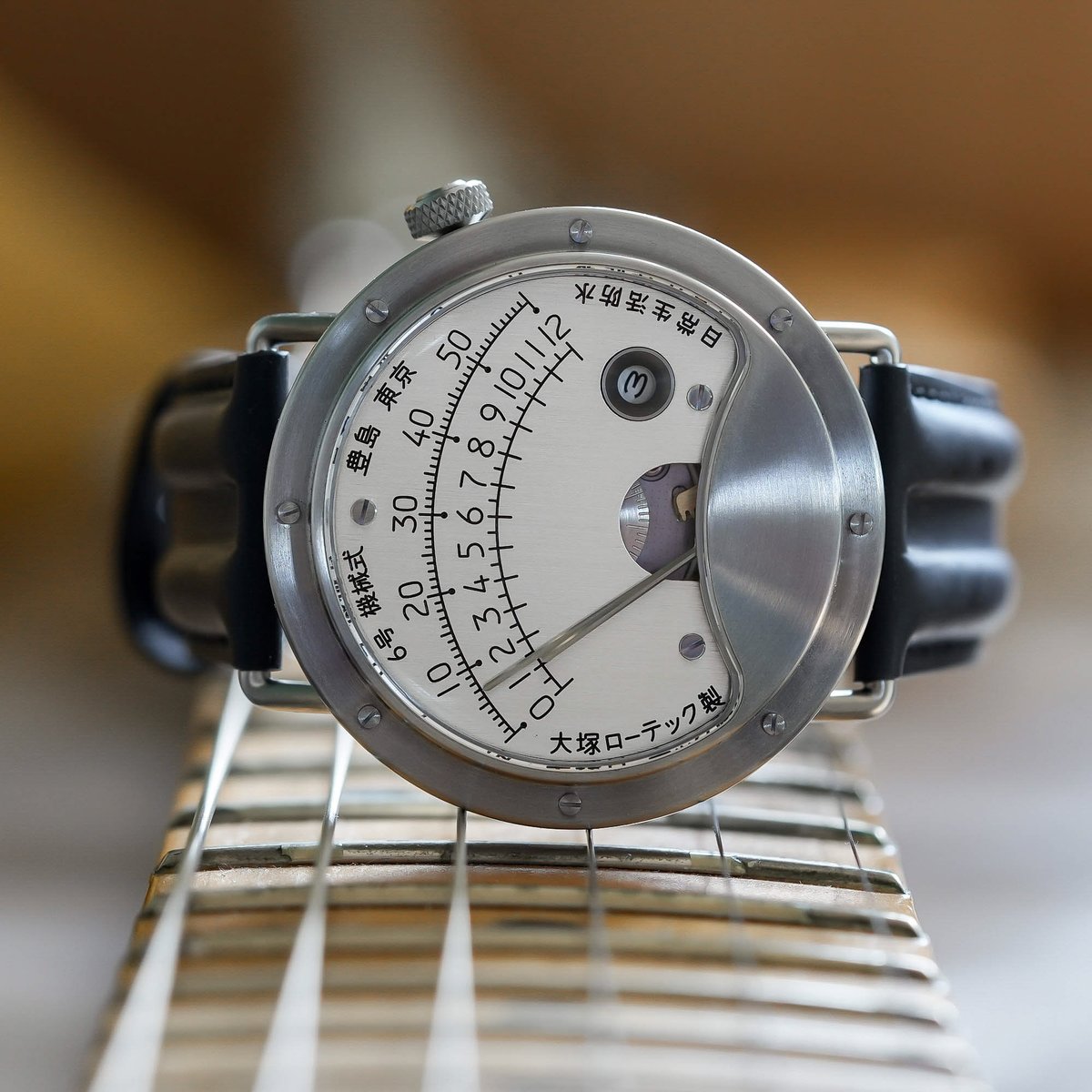
The P06 utilizes a dual-retrograde layout. The upper arc, spanning the 10 to 2 o'clock positions, tracks the hours from 1 to 12. The lower, larger arc tracks the minutes from 0 to 60. This vertical orientation mimics the gauges found in mid-century Japanese industrial machinery or the light meters of vintage Leica cameras. The hands themselves are skeletonized, heat-blued or polished depending on the light, providing a sharp contrast against the multi-layered, silver-toned dial. The visual effect is one of 'mechanical brutalism'—every screw, every plate, and every transition in finish is intentional and exposed.
The Heart of the Machine: The Katayama Module
At the core of the No. 6 lies a Miyota 9015. To the uninitiated, the use of a mass-produced Japanese caliber might seem at odds with the 'luxury' label. However, for a sophisticated collector, this choice is pragmatic and technically sound. The 9015 is a 'slim' movement, providing the necessary real estate for Katayama to mount his bespoke retrograde module without resulting in a case thickness that would be unwearable. The real magic happens on top of the base plate.
Katayama, a self-taught watchmaker with a background in industrial design, manufactures the module components with a level of precision that rivals high-end Swiss independents. The retrograde action is crisp. At the top of the hour, both hands snap back with a synchronized 'click' that is audible in a quiet room. This is achieved through a series of custom-cut cams that determine the path of the hands and hairsprings that provide the tension for the snap-back. The finishing on these internal module parts, though largely hidden, includes perlage and straight graining, reflecting a reverence for the craft that transcends mere outward appearance.
Case Construction and Ergonomics
The case of the P06 is a 42.6mm stainless steel vessel that feels more like a piece of laboratory equipment than a piece of jewelry. The finishing is a sophisticated mix of sandblasting and circular brushing. The bezel is held in place by six prominent hex-screws, a nod to the 'Lotec' (Low-Tech) aesthetic that Katayama champions. These screws are not merely decorative; they are integral to the structural integrity of the multi-part case construction.
One of the most impressive aspects of the P06 is its wearability. On paper, 42.6mm might suggest a large watch, but the lug-to-lug measurement is a mere 45mm. This is achieved through an integrated-style lug design where the strap attaches almost directly beneath the case perimeter. This allows the watch to center itself perfectly on the wrist. The crown is positioned at 3 o'clock, featuring a deeply knurled texture that makes setting the time a tactile pleasure. The resistance felt when advancing the retrograde hands through the crown is a reminder of the mechanical tension inherent in the design.
The Cultural Significance of Otsuka Lotec
The rise of Otsuka Lotec coincides with a broader movement in Japanese horology—a shift away from the corporate giants of Seiko and Citizen toward the 'Shokunin' (craftsman) spirit. Katayama represents a bridge between the old world of Japanese manufacturing and the new world of independent design. His workshop in the Otsuka district of Tokyo is a testament to this; it is filled with vintage lathes and modern CNC machines, where he produces watches in extremely limited batches, often distributed via a lottery system due to overwhelming demand.
The No. 6 is the realization of a specific vision: that a watch can be a piece of kinetic art without losing its identity as a tool. In a market saturated with heritage re-issues and integrated steel sports watches, the P06 offers something genuinely original. It does not look like a Submariner; it does not look like a Royal Oak. It looks like an Otsuka Lotec, and in today's horological climate, that identity is the ultimate luxury.
Investment and Scarcity
The No. 6 presents a fascinating case study. The MSRP is approximately 385,000 JPY (roughly $2,600 USD), which is remarkably low given the level of engineering involved. However, because Katayama produces so few pieces—estimated in the low hundreds per year—the secondary market has exploded. It is not uncommon to see the P06 trading for $8,000 to $12,000 on the secondary market. This 4x premium is a testament to the brand's cult status and the genuine scarcity of the product.
Is it a 'bubble'? Unlikely. Unlike hype-driven brands, Otsuka Lotec's value is underpinned by the fact that these watches are hand-assembled by a single individual with a unique vision. As long as Katayama remains at the bench, the demand will likely continue to outstrip supply. For those lucky enough to secure one at retail, it represents one of the most significant value propositions in modern watchmaking. For those buying on the secondary market, it is an investment in a piece of horological history.
Final Thoughts
The Otsuka Lotec No. 6 (Ref. P06) is a triumph of independent engineering. It challenges our perceptions of what a Japanese watch should be and how time should be displayed. While the Miyota base may deter those who only value 'in-house' prestige, the technical brilliance of the retrograde module and the uncompromising industrial design make it a must-have for the serious collector. It is precise, it is technical, and above all, it is a piece of living horology that breathes with the rhythm of the city that created it.