The Rise of the Japanese Indie
For decades, the narrative of Japanese watchmaking was dominated by the giants: Seiko, Citizen, and Casio. They represented the peak of industrial efficiency and mass-market perfection. But recently, a new movement has emerged from the backstreets of Tokyo—one that is gritty, artisanal, and fiercely independent. At the forefront of this movement is Otsuka Lotec.
Founded by Jiro Katayama, Otsuka Lotec doesn't follow the Swiss playbook. There are no alpine workshops or heritage-based marketing campaigns. Instead, Katayama works out of a small studio, applying his background in automobile design to create watches that feel like they belong on the dashboard of a custom-built café racer or inside the cockpit of a mid-century jet. The No. 7 is his most cohesive vision to date, a watch that has transcended its tool-watch origins to become a legitimate cultural icon among watch enthusiasts.
Design: Brutalism Meets Precision
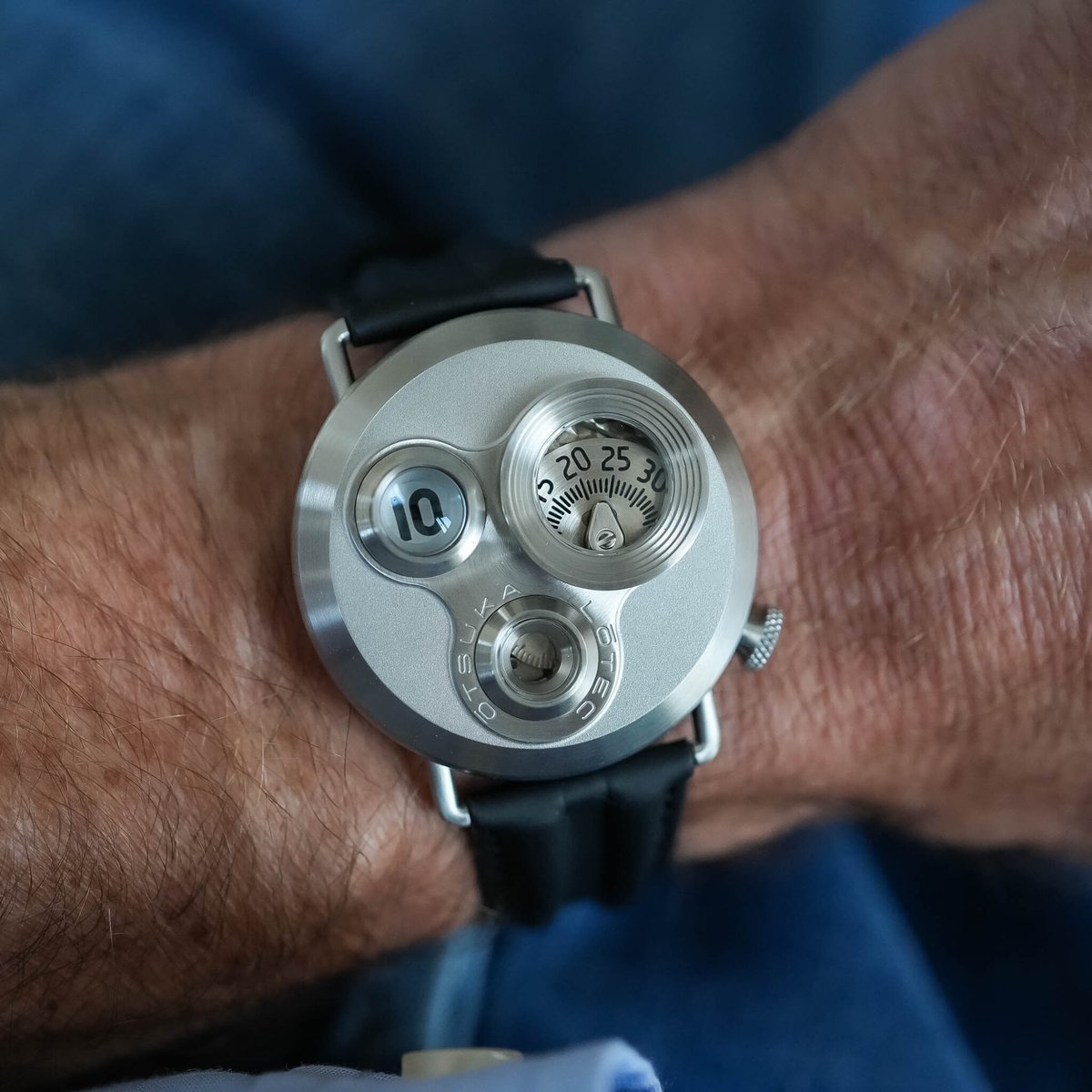
The first thing you notice about the No. 7 is the case. It’s not polished to a mirror finish, nor is it brushed in the traditional sense. It has a raw, machined quality that highlights the manufacturing process. The 40mm stainless steel body is punctuated by visible screws and sharp, geometric lines. It is unapologetically mechanical.
The 'dial' isn't a dial at all, but a series of apertures. Inspired by the light meters of vintage cameras, the time is read through three windows. The top window displays the jumping hour, while the lower windows show the dragging minutes and seconds. This layout forces the wearer to engage with the passage of time in a linear, almost mathematical way. The font used for the numerals is custom-designed, further cementing the watch's unique identity.
The Heart of the Machine
Under the hood, Katayama has taken a reliable workhorse—the Miyota 9015—and transformed it. While some purists might scoff at a non-Swiss movement, the choice is entirely practical. The 9015 is thin, robust, and provides the necessary torque to drive Katayama's custom jumping-hour module. This module is the real star of the show. The 'jump' of the hour disk is crisp and perfectly synchronized, a testament to the tight tolerances Katayama maintains in his workshop.
The movement isn't visible through a display caseback, which is a deliberate choice. The No. 7 is a tool, and its back is a solid plate of steel, held in place by industrial-grade screws. It reinforces the idea that this is a piece of equipment, not a piece of jewelry to be stared at under a loupe.
The Culture of Scarcity
Owning an Otsuka Lotec No. 7 is not as simple as walking into a boutique with a credit card. Katayama produces only a handful of watches each year. To buy one at retail, you must enter a lottery system that is notoriously difficult to win. This has created a secondary market where the No. 7 is treated like a rare sneaker drop or a piece of fine art.
We’ve seen the No. 7 on the wrists of influential creative directors, automotive designers, and high-level tech founders. It has become a secret handshake among those who find traditional luxury a bit too 'obvious.' It’s the watch you wear to the Paris Design Biennale or a private track day at Fuji Speedway. It signals that you value craftsmanship and originality over brand recognition.
Final Thoughts: A New Perspective
The Otsuka Lotec No. 7 is a polarizing watch, and that is exactly why it is successful. It doesn't try to please everyone. It is loud, it is mechanical, and it is difficult to read at first glance. But for those who 'get' it, there is nothing else like it on the market. It represents a shift in the watch world—a move away from status symbols and toward objects with a clear, uncompromising soul.
If you are looking for a daily driver that will spark conversations and hold its value, the No. 7 is a formidable contender. It is a piece of Tokyo's industrial heart, captured in 40mm of stainless steel. In the world of Rina Park, this isn't just a watch; it's the future of the hobby.