The Industrial Soul of Tokyo: An Introduction to Otsuka Lotec
In the quiet district of Otsuka, Tokyo, a former product designer named Jiro Katayama is quietly rewriting the rules of independent horology. Unlike the sprawling factories of the Swiss Jura or the high-tech cleanrooms of Shizukuishi, Katayama’s workshop is a testament to the shokunin spirit—a place where traditional craftsmanship meets a gritty, industrial aesthetic. The Otsuka Lotec No.7.5 is the most refined expression of this vision to date, a watch that feels less like a luxury accessory and more like a precision instrument salvaged from a mid-century laboratory.
The No.7.5 occupies a unique space in the market. It is technically a 'modular' watch, using a reliable Japanese base caliber, but the modification is so extensive that it renders the original movement unrecognizable. This is not a simple dial swap; it is a fundamental re-engineering of how time is displayed. For the sophisticated collector, the appeal lies in this transparency—the way Katayama allows the mechanical logic of the watch to dictate its form.
Design Philosophy: Mechanical Brutalism
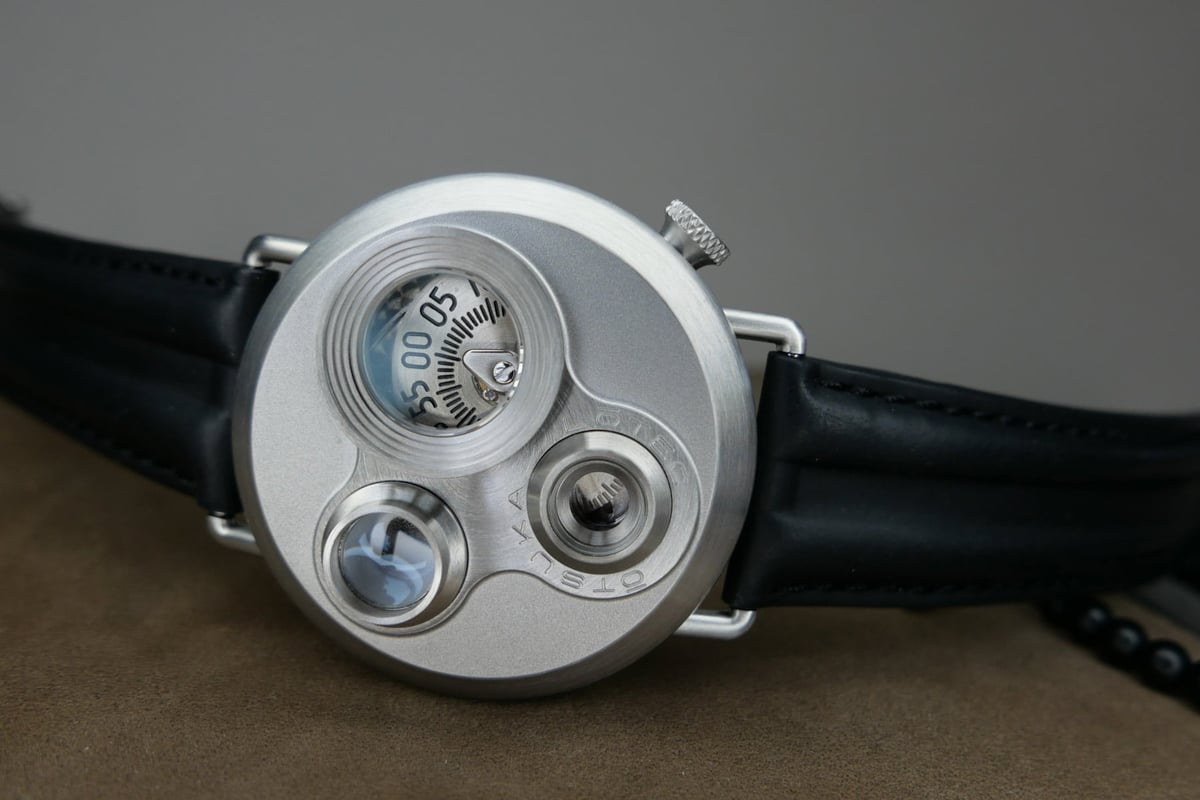
The design of the No.7.5 is often described as 'brutalist,' but that term carries a coldness that doesn't quite fit the warmth of Katayama's work. It is industrial, yes, but it is also deeply human. The case is a 40mm cylinder of stainless steel, finished with a combination of fine brushing and sandblasting that gives it a muted, utilitarian gray tone. There are no polished chamfers here, no zaratsu finishing to catch the light. Instead, the focus is on the topography of the dial—or rather, the lack of one.
The 'dial' of the No.7.5 is actually the top plate of the retrograde module. Visible screws, circular graining, and precisely machined apertures create a sense of depth that a flat dial could never achieve. The time is read through a jumping hour window at the 12 o'clock position and a large retrograde minute hand that sweeps across a 120-degree arc. The hand itself is a work of art—a skeletonized steel pointer that snaps back to zero with satisfying mechanical crispness at the end of every hour.
Technical Deep Dive: The Module and the Movement
At the heart of the No.7.5 beats a Miyota 9015. While some snobs might scoff at the use of a mass-produced caliber in a piece of high-concept horology, Katayama’s choice is a pragmatic one. The 9015 is a robust, thin, and reliable workhorse that provides the necessary torque to drive his proprietary module without increasing the case thickness beyond the point of wearability. At 11mm thick, the No.7.5 is remarkably svelte for a retrograde jumping hour watch.
The magic happens in the module. Katayama designs and assembles these components himself, ensuring that the 'jump' of the hour and the 'snap' of the minute hand are perfectly synchronized. The retrograde mechanism requires a significant amount of energy to be stored and released; Katayama’s engineering ensures that this process doesn't compromise the timekeeping accuracy of the base movement. The result is a complication that feels alive on the wrist—a constant cycle of tension and release that mirrors the industrial heartbeat of Tokyo itself.
Wrist Presence and Ergonomics
On the wrist, the No.7.5 is a masterclass in proportion. The 40mm diameter is the 'Goldilocks' size for modern collectors, and the 45mm lug-to-lug distance ensures it remains centered. Because the lugs are integrated into the case design, the watch wears more like a 38mm piece, making it suitable for a wide range of wrist sizes. It does not shout for attention with gold or diamonds; it commands it through its sheer weirdness. It is the kind of watch that stops other collectors in their tracks at a Meetup, prompting the inevitable question: 'What is that?'
The Investment Landscape
Acquiring an Otsuka Lotec at retail is a feat of endurance. Katayama-san produces watches in extremely limited batches, often sold via a lottery system that is heavily oversubscribed. This scarcity has driven secondary market prices into the stratosphere. While the MSRP sits at a very reasonable 400,000 JPY (approx. $2,800 USD), pieces frequently trade for $10,000 or more among collectors who are unwilling to wait. From an investment standpoint, the No.7.5 is a 'blue chip' of the independent Japanese scene, with a value trajectory that continues to point upward as Katayama’s reputation grows globally.
Final Verdict: A Modern Classic
The Otsuka Lotec No.7.5 is not for everyone. It lacks the traditional markers of luxury—there is no precious metal, no hand-painted enamel, and no Swiss pedigree. But for those who find beauty in the machine, in the honest expression of steel and gears, it is a masterpiece. It represents a bridge between the world of industrial design and high horology, built by a man who refuses to compromise his vision for the sake of mass-market appeal. In a world of derivative designs, the No.7.5 is a breath of fresh, metallic air.