The Industrial Poet: Jiro Katayama
In the quiet suburbs of Tokyo, far removed from the polished boardrooms of Ginza or the snow-capped peaks of Shiojiri, Jiro Katayama operates with the precision of a laboratory technician and the soul of an architect. His brand, Otsuka Lotec, has become a beacon for collectors who find the traditional flourishes of European watchmaking—the côtes de Genève, the anglage, the blued screws—somewhat disconnected from the reality of the 21st century. Katayama’s work is a celebration of the machine age, an era where form followed function with such rigor that it achieved a beauty all its own.
The Otsuka Lotec No. 8 is the culmination of this vision. While previous models like the No. 6 were celebrated for their audacity and sheer scale, they were often criticized for being difficult to wear on a daily basis. With the No. 8, Katayama has addressed these concerns without sacrificing an ounce of his signature aesthetic. It is a watch that looks like it was plucked from the dashboard of a 1950s experimental aircraft or the control panel of a mid-century submarine, yet it fits perfectly under a shirt cuff.
Architecture of the Case
The case of the No. 8 is a study in monochromatic texture. Crafted from 316L stainless steel, it eschews the typical mix of brushed and polished surfaces found on luxury sports watches. Instead, Katayama employs a uniform bead-blasted finish that gives the metal a soft, matte grey appearance, reminiscent of titanium or aeronautical aluminum. This choice is intentional; it prevents the watch from feeling like jewelry and reinforces its identity as a precision instrument.
Measuring 40mm in diameter, the No. 8 strikes the 'golden ratio' for modern collectors. However, the lug-to-lug measurement of 45mm is where the magic happens. By integrating the strap attachment points into the case body, Katayama has eliminated the traditional 'overhang' that plagues many avant-garde designs. The watch wraps around the wrist with an intimacy that belies its mechanical complexity. The bezel is secured by six exposed screws, their heads perfectly aligned to emphasize the 'built, not grown' philosophy of the brand.
The Mechanical Heart: A Module of Distinction
To understand the No. 8, one must understand the movement. At its core lies the Miyota 9015. To the uninitiated, this might seem like a pedestrian choice for a watch of such acclaim. However, to the technical purist, it is a stroke of genius. The 9015 is a robust, slim, and high-frequency caliber that provides a stable platform for modifications. By using a reliable base, Katayama ensures that the watch can actually be serviced and that its primary function—keeping time—is never in doubt.
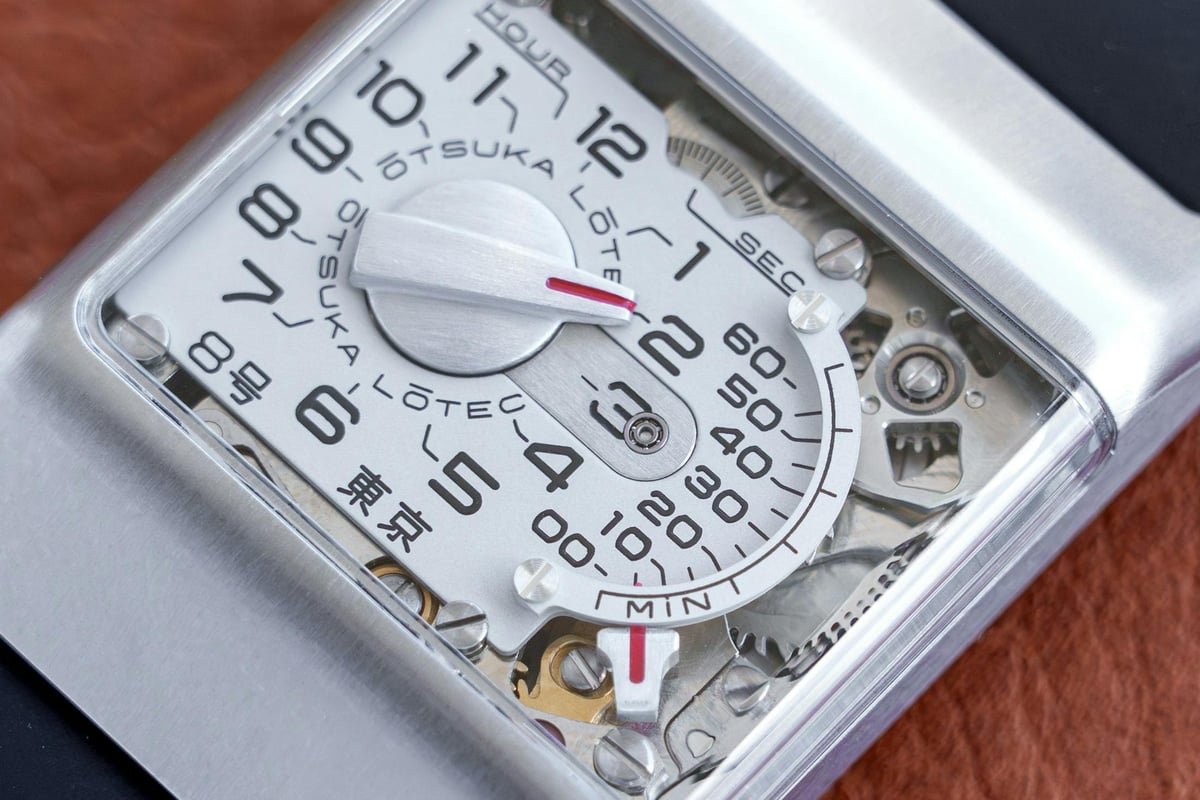
The real star, however, is the in-house module. This is not a simple 'bolt-on' plate but a deeply integrated kinematic system. The No. 8 features a jumping hour display at the 12 o'clock position and a retrograde minute hand that sweeps across a 120-degree arc. The jumping hour is instantaneous; as the minute hand reaches the '60' mark, the hour disk clicks forward with a satisfying, audible snap. The retrograde minute hand then flies back to zero with a speed that is almost too fast for the human eye to track. This requires a sophisticated cam-and-spring mechanism that must manage the energy release without putting undue stress on the base movement's gear train.
Visual Interface and Legibility
Reading the time on the No. 8 is an exercise in re-learning. Traditional three-hand watches rely on spatial recognition—we see the angle of the hands and know the time without looking at the numbers. The No. 8 demands a moment of focus. The jumping hour window is framed by a raised steel border, drawing the eye to the current hour. The retrograde minute scale is printed in a stark, technical typeface that feels plucked from a Leica lens barrel.
There is no luminous material on the dial. In the world of Vivir, this might be seen as a drawback, but in the context of Otsuka Lotec, it is a commitment to the aesthetic. Lume would soften the sharp lines of the hands and the crispness of the printing. This is a daytime instrument, a piece of engineering to be admired in the light. The sapphire crystal is treated with an anti-reflective coating that is so effective the dial often appears to be exposed to the air, allowing the viewer to appreciate the depth of the module construction.
Investment and Scarcity
The market reality of the Otsuka Lotec No. 8 is perhaps the most discussed aspect of the watch in collector circles. With a retail price of approximately 242,000 JPY (around $1,750 USD), it represents an incredible value proposition. However, Katayama’s production capacity is limited to a few hundred pieces per year. To manage the demand, Otsuka Lotec employs a lottery system that is notoriously difficult to win.
On the secondary market, prices for the No. 8 have soared, often reaching three to four times the original retail price. This makes the watch a status symbol of a different kind—not one of wealth, but of access and taste. Unlike a mass-produced luxury watch that can be bought at any AD with a sufficient spend history, an Otsuka Lotec requires patience, luck, and a genuine appreciation for independent Japanese craft. It is a stable investment because its value is derived from scarcity and the unique talent of a single individual, rather than a marketing budget.
Final Thoughts
The Otsuka Lotec No. 8 is a triumph of independent horology. It manages to be technically fascinating without being fragile, and visually arresting without being garish. Jiro Katayama has carved out a niche that is entirely his own, proving that you don't need a centuries-old Swiss lineage to create a watch that resonates with the soul of a collector. If you are fortunate enough to acquire one, you are not just buying a watch; you are securing a piece of the future of Japanese watchmaking history.