Otsuka Lotec No. 9 – A Japanese Micro‑Brand’s Bold Experiment in Haute Horology
By Vivir··Updated
# Otsuka Lotec No. 9 – A Japanese Micro‑Brand’s Bold Experiment in Haute Horology
The watch world rarely sees a piece that tries to cram as many high‑end complications into a modestly sized rectangular case as Otsuka Lotec’s No. 9. Unveiled in 2025, this hand‑crafted time‑piece arrives from a relatively new Japanese micro‑brand that has already begun to carve a niche for itself with daring, technically ambitious creations. At first glance the watch feels more like a miniature machine than a conventional dress‑watch: a stainless‑steel shell that showcases a tourbillon, a jump‑hour display, a rewinding‑minutes function, a power‑reserve indicator and a sonnerie‑au‑passage striking mechanism, all driven by the in‑house Cal. SSGT manual‑wind movement. Priced at roughly US $108 000, the No. 9 is positioned as a collector’s item that asks the wearer to engage with its visible mechanics as much as with the time it tells. Below is a deep‑dive into how this ambitious project lands in practice, from its heritage within Otsuka Lotec’s line to the day‑to‑day experience of wearing it.
---
## Heritage — the model's place in the brand's line and its launch context
Otsuka Lotec emerged only a few years ago, but it has quickly become known for pushing the technical envelope of independent watchmaking. The brand’s catalogue, though still small, already shows a clear progression: the No. 6, launched in 2024, was a sports‑oriented automatic that emphasized robust construction and a more conventional aesthetic. By contrast, the No. 9, introduced a year later, marks a deliberate shift toward “haute horology” – the kind of high‑complication, art‑focused watchmaking traditionally dominated by Swiss maisons.
The No. 9 is the brand’s first rectangular offering and the most complication‑dense model to date. Its launch was framed by founder Jiro Katayama as an exploration of how a watch can convey the feeling of industrial machinery, with every moving part visible under sapphire crystal. While the brand’s earlier pieces leaned on clean, minimalist lines, the No. 9 embraces a more aggressive visual language, positioning Otsuka Lotec as a serious contender in the niche of ultra‑complicated independent watches.
---
## Design & Case — case dimensions, materials, dial
### A rectangular silhouette that demands attention
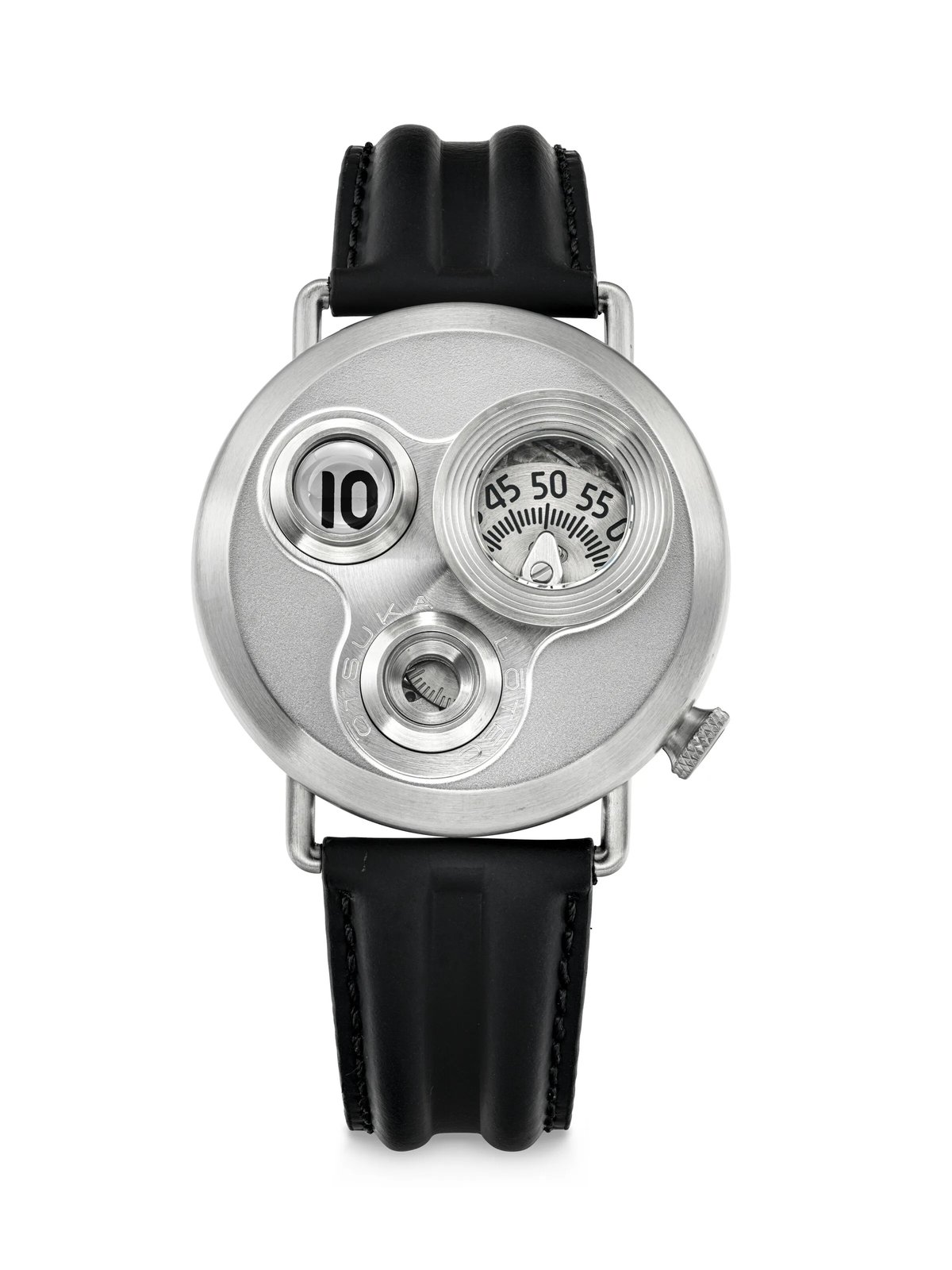
The No. 9 measures **41.3 mm in width** and **26.4 mm in height**, giving it a distinctly rectangular footprint that stands out among the predominantly round watches on the market. The case is forged from **stainless steel**, a material choice that balances durability with a neutral aesthetic that lets the complications take centre stage. The stainless‑steel finish is polished to a subtle sheen, avoiding excessive decoration; this restraint lets the mechanical ballet inside the crystal become the visual focal point.
### Sapphire crystal and visibility
A full‑size sapphire crystal crowns the watch, offering scratch resistance and, more importantly, an unobstructed view of the movement. The crystal is flat rather than domed, which reduces distortion and makes the intricate components – the tourbillon cage, the jump‑hour disc, the minute‑rewind mechanism, and the sonnerie hammer – appear almost like a technical diagram. The crystal is also equipped with a discreet side pusher that lets the wearer toggle the chiming function on or off, a practical touch that prevents unwanted sound in quiet environments.
### Dial layout and finishing
The dial is deliberately sparse, with a **slim power‑reserve indicator** rendered as a rod that slides in and out along the right side of the face. This linear gauge is a visual nod to industrial instrumentation and reinforces the watch’s machine‑like ethos. The hour markers are simple applied indices, and the jump‑hour display is positioned centrally, where the hour disc jumps forward every 60 minutes. The minute hand rewinds in a retrograde fashion, sweeping back to the zero position each hour before resuming forward motion.
The sonnerie‑au‑passage mechanism strikes the hours on demand, delivering a clear, resonant tone that echoes the watch’s industrial inspiration. However, reviewers have noted that the chime lacks the musicality of some high‑end striking watches, a shortcoming that may be more noticeable to connoisseurs who value tonal refinement.
### Ergonomics of the case
The lug width is **26 mm**, which is unusually wide for a watch of this size and contributes to a slightly “stretched” look on the wrist. The lugs themselves are straight and robust, echoing the watch’s mechanical aesthetic. The case thickness is not specified in the source data, but the overall profile appears moderate, allowing the watch to sit comfortably under a shirt cuff despite its visual density.
---
## Movement & Performance — caliber, power reserve, accuracy
### Cal. SSGT – an in‑house manual‑wind engine
At the heart of the No. 9 lies the **Cal. SSGT** – a hand‑finished, in‑house manual‑wind movement designed expressly for this model. The caliber integrates a **tourbillon**, a **jump‑hour** module, a **rewinding‑minutes** (retrograde) system, a **sonnerie‑au‑passage** striking mechanism, and a **power‑reserve indicator**. All of these complications are driven by a single mainspring barrel, delivering a **40‑hour power reserve**.
The tourbillon rotates once per minute, a traditional approach that helps mitigate positional errors caused by gravity. While the source data does not provide an official accuracy rating, manual‑wind movements of this complexity typically require careful regulation by the manufacturer. Otsuka Lotec’s reputation for meticulous hand‑finishing suggests that the movement is likely regulated to within a few seconds per day, though the lack of a documented chronometer certification means the watch should be considered a high‑complication piece rather than an ultra‑precise regulator.
### Power‑reserve display
The power‑reserve indicator is a **slim rod** that protrudes from the right side of the dial when the mainspring is fully wound and retracts as the reserve diminishes. This linear display is both functional and thematic, reinforcing the industrial aesthetic while providing a quick visual cue for the wearer.
### Chiming control
A side pusher allows the user to **activate or deactivate the sonnerie** at will. This feature is practical for those who appreciate the striking function but wish to silence it in formal or quiet settings. The chime itself is a straightforward hour strike; reviewers have expressed a desire for a more melodious tone, noting that it does not reach the musical richness found in some boutique striking watches.
### Finishing and finishing quality
The movement’s finishing is described as competent but not on par with the ultra‑high‑end Swiss boutiques that devote countless hours to polishing and decorating every component. While the visible parts under the crystal are clean and functional, the overall aesthetic lacks the hand‑polished brilliance of some of the most celebrated micro‑brand movements. This is a trade‑off that reflects Otsuka Lotec’s focus on mechanical innovation over decorative perfection.
---
## On the Wrist — wearability, lug-to-lug, comfort notes
### Dimensions and wrist fit
The rectangular case, at **41.3 mm × 26.4 mm**, creates a distinctive silhouette that can feel bold on smaller wrists but proportionate on medium to larger ones. The **26 mm lug width** is unusually wide for a watch of this size, which can make the bracelet appear slightly “over‑engineered.” However, the straight lug design distributes weight evenly, preventing a top‑heavy feel.
The watch’s **30 m water resistance** is modest, indicating that it is intended primarily for everyday wear and not for aquatic activities. The stainless‑steel case provides a solid, slightly heavy feel that adds to the perception of durability.
### Bracelet and strap options
While the source data does not detail the strap, the lug width suggests that a robust leather strap or a stainless‑steel bracelet would be the most appropriate choices. A leather strap would soften the industrial look, whereas a metal bracelet would reinforce the watch’s mechanical character.
### Comfort and ergonomics
The flat sapphire crystal sits close to the wrist, and the lack of a domed crystal reduces glare while also keeping the profile slim. The jump‑hour and retrograde minute hands move smoothly, and the audible chime is not overly intrusive. The main drawback noted by reviewers is the lug width, which can feel “extreme” and may require a strap that can accommodate the breadth without creating a gap between the case and the wrist.
---
## When to Wear — occasion, setting and dress-code fit
The No. 9 is a statement piece that naturally gravitates toward **formal and semi‑formal settings** where its mechanical drama can be appreciated. Its rectangular geometry and visible complications make it a conversation starter at watch‑focused events, high‑end dinner parties, or gallery openings.
Because of its **$108 000 price point**, the watch is best reserved for occasions where the wearer wishes to showcase a serious horological acquisition. It would feel out of place in casual, sport‑centric environments or in settings where a low‑profile, understated timepiece is expected.
The watch’s **30 m water resistance** and lack of a highly polished finish suggest that it should not be worn for rigorous activities, swimming, or diving. However, its manual‑wind nature means it can be worn comfortably for extended periods, provided the wearer winds it daily.
In a business context, the No. 9 can be a bold accessory for a creative executive or an entrepreneur who wishes to signal a penchant for technical ingenuity. Paired with a well‑tailored suit and a sleek leather strap, the watch adds an industrial elegance that distinguishes the wearer without clashing with traditional dress codes.
---
## Value & Verdict — price‑positioning + final take
At **approximately US $108 000**, the Otsuka Lotec No. 9 sits in the upper‑mid tier of independent high‑complication watches. Its price reflects the cost of developing an in‑house manual movement that integrates a tourbillon, jump‑hour, retrograde minute, power‑reserve indicator, and sonnerie‑au‑passage—all within a compact rectangular case.
When comparing value, it is essential to consider what the watch delivers:
* **Technical ambition** – Few independent brands attempt to combine this many complications in a single manual‑wind calibre. The tourbillon, jump‑hour, and striking mechanisms are all functional and visible, aligning with the brand’s industrial aesthetic.
* **Design uniqueness** – The rectangular stainless‑steel case and linear power‑reserve rod set the No. 9 apart from the sea of round, classic‑looking watches. For collectors seeking a distinctive silhouette, the watch offers a rare visual language.
* **Finishing trade‑off** – The movement’s finishing is competent but not as refined as the most meticulously hand‑polished Swiss pieces. The chime, while functional, lacks the musical richness of higher‑priced striking watches.
* **Wearability considerations** – The 26 mm lug width and modest water resistance limit strap options and usage scenarios. The watch is best suited to formal or semi‑formal environments rather than everyday casual wear.
**Verdict:** The Otsuka Lotec No. 9 is a daring experiment that succeeds in showcasing the brand’s engineering capabilities and its willingness to challenge conventional watch design. It delivers a compelling package of complications that are rare among independent manufacturers, and its industrial aesthetic is executed with confidence. However, the piece is not without drawbacks: the finishing, while solid, does not reach the pinnacle of haute‑horlogerie; the chime is functional but not sonically luxurious; and the wide lug width may require careful strap selection.
For collectors who prioritize **technical novelty** and **design distinctiveness** over flawless finishing, the No. 9 represents a worthy addition to a high‑complication portfolio, especially at a price that, while high, is still below the multi‑hundred‑thousand‑dollar range of comparable Swiss tourbillon striking watches. For those who seek the utmost in finishing artistry or a more understated dress watch, other options may provide better alignment with those priorities.
In short, the Otsuka Lotec No. 9 stands as a bold statement of what a Japanese micro‑brand can achieve when it decides to treat a watch like a miniature, visible machine. It invites the wearer to look, listen, and engage with the inner workings—a rare experience that, for the right enthusiast, justifies its price tag.