The Genesis of the Cushion Case
In the world of luxury horology, few silhouettes are as instantly recognizable as the Panerai Radiomir. While the Luminor, with its patented crown-protecting bridge, has become the commercial face of the brand, the Radiomir remains the connoisseur’s choice. It represents the earliest chapter of the Panerai story—a time when the company was not yet a lifestyle brand, but a specialized supplier of precision instruments to the Decima Flottiglia MAS of the Royal Italian Navy.
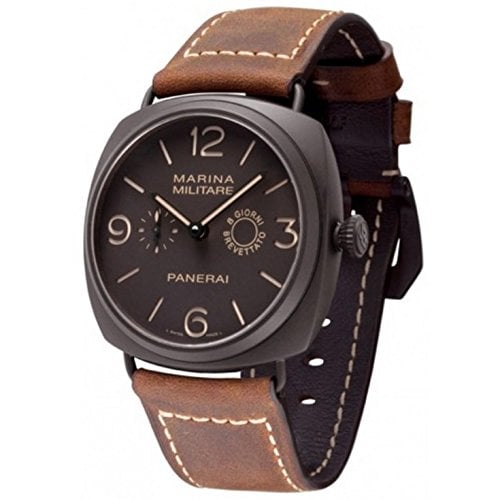
The Radiomir Officine (specifically the PAM00753) is a modern tribute to this utilitarian past. It is a 'base' model in the best sense of the word. It lacks the complications that often clutter modern dials, focusing instead on the core tenets of the Radiomir design: a large, legible dial, a cushion-shaped case, and the signature wire lugs. For the young collector, this watch offers a sense of historical gravitas that few other brands can replicate at this price point.
Dimensions and the Wire Lug Paradox
The most common reservation potential buyers have regarding the Radiomir is its 45mm diameter. On paper, 45mm sounds like a dinner plate. However, the Radiomir is the perfect example of why case diameter is a misleading metric. In watch design, the 'lug-to-lug' measurement—the distance from the top tip of the lugs to the bottom tip—determines how a watch actually sits on the wrist. Because the Radiomir uses slim, curved wire lugs that are welded directly to the case, its effective lug-to-lug is roughly 48mm. To put that in perspective, a 41mm Rolex Submariner has a lug-to-lug of approximately 47.6mm.
What this means in practice is that the Radiomir Officine fits comfortably on wrists as small as 6.5 inches. The cushion case distributes the weight across a flat plane, preventing the watch from sliding toward the ulnar bone. During a week of testing, I found that the 13mm thickness—while substantial—is tapered enough to slide under a standard French cuff, provided the shirt isn't overly tailored. It is one of the few 45mm watches that can truly transition from a weekend polo to a weekday suit without feeling like an oversized novelty.
Dial Architecture and Legibility
The dial of the PAM00753 is a masterclass in minimalism. It features the 'Officine Panerai' (OP) logo at 6 o'clock, which adds a touch of vintage charm to the otherwise stark layout. The Arabic numerals at 3, 6, 9, and 12 are oversized and rendered in a warm, cream-colored Super-LumiNova that mimics the look of aged tritium. This is not a 'sandwich' dial—where the lume sits on a plate beneath the dial cutouts—but a 'sausage' dial, where the lume is printed in thick, three-dimensional relief. While some purists prefer the sandwich construction, the sausage dial on the Officine models is historically accurate to many vintage references and offers exceptional legibility in low-light conditions.
The leaf-shaped hands are finished in a matte black, which prevents unwanted reflections and ensures that the time is readable at a glance, even from an angle. There is no date window, no power reserve indicator, and no running seconds. This 'two-hander' configuration forces the wearer to appreciate the passage of time in a more relaxed, less frantic manner. It is a watch for someone who doesn't need to track seconds, but rather moments.
The P.6000 Caliber: A Three-Day Workhorse
Inside the Radiomir Officine beats the P.6000 caliber. Introduced to replace the ETA-based movements of the past, the P.6000 is an in-house, manual-wind movement that provides a robust 72-hour power reserve. In a rotation of several watches, a three-day power reserve is the 'goldilocks' zone; you can set it on a Friday morning, leave it on your nightstand over the weekend, and find it still ticking on Monday morning.
The tactile experience of winding the P.6000 is one of the joys of ownership. The large, onion-style crown is easy to grip and provides a satisfying, mechanical click with every turn. Because it is a manual wind, the wearer develops a ritualistic relationship with the watch. There is a certain mindfulness in spending thirty seconds every few days powering up your timepiece. From a technical standpoint, the movement features 19 jewels and beats at 21,600 vibrations per hour. While it lacks the high-beat sweep of a 28,800 vph movement, the slower beat rate is more appropriate for a vintage-inspired piece and contributes to the longevity of the components.
A Week on the Wrist: Real-World Utility
I wore the Radiomir Officine for seven consecutive days, taking it through a variety of environments—from a high-stakes boardroom presentation to a casual Saturday at an outdoor market. On Monday, paired with a charcoal suit, the watch acted as a subtle statement piece. The high-polish finish of the AISI 316L stainless steel gives it a level of formality that the brushed-finish Luminors lack. It catches the light in a way that feels expensive but not garish.
By Wednesday, I had swapped the factory Scamosciato leather strap for a more rugged calfskin strap. This is where the Radiomir shines. The wire lugs, while requiring a small screwdriver to change, allow the watch to take on entirely different personalities. On a distressed leather strap, it looks like a piece of found military history. On a black alligator strap, it is a formal dress watch. The 100-meter water resistance means you don't have to panic during a sudden downpour or while washing your hands, though the leather strap should obviously be kept dry.
The only drawback noted during the week was the lack of a hacking seconds feature on the P.6000. For those who obsessively sync their watches to atomic time, the inability to stop the hands may be a minor annoyance. However, for a watch without a seconds hand, this is a moot point—you are setting the time to the minute, and the P.6000 holds that minute with admirable precision.
Investment and Value Proposition
For the young collector, the Radiomir Officine represents one of the most stable value propositions in the Panerai catalog. With an MSRP of approximately $5,000, it sits at the entry point of the brand's offerings. Unlike limited edition pieces that can see wild price swings, the base Radiomir models tend to hold a steady value on the pre-owned market. You are not buying this watch to flip it for a profit; you are buying it because it is a foundational piece of horological design that will look as relevant in thirty years as it does today.
The 'Officine' logo models are particularly attractive because they distill the brand down to its essence. There is no 'fauxtina' or unnecessary complexity—just the logo, the cushion case, and the history. In an era where many luxury brands are making their watches smaller and more delicate, the Radiomir remains unapologetically bold while maintaining a level of elegance that its larger siblings often lose.
Final Verdict
The Panerai Radiomir Officine is a watch that rewards the wearer over time. It does not shout for attention with a ceramic bezel or a skeletonized dial. Instead, it relies on the strength of its proportions and the purity of its lineage. It is a daily wearer for the individual who understands that true style is often found in what is left out, rather than what is added. Whether you are a seasoned Paneristi or a newcomer to the brand, the Radiomir Officine is a compelling reminder that sometimes, the first design is still the best one.