The Graduation of the Aquanaut
Let's be clear: nobody *needs* a Patek Philippe Aquanaut 5167A. You don't buy this watch to tell the time. You acquire it as an asset, a membership card, and a piece of cultural currency. For years, the Aquanaut lived in the shadow of its older, more famous sibling, the Nautilus. It was the 'Patek-lite,' the entry point for those waiting for the main event. That narrative is now laughably obsolete. The 5167A has not only stepped out of the Nautilus's shadow; it has carved out its own kingdom. It has become the definitive 'stealth wealth' totem for a new generation of collectors who value versatility and understated cool over the brashness of a Royal Oak Offshore or the boardroom formality of a Calatrava. Its meteoric rise on the secondary market isn't just a bubble; it's a fundamental market realignment.
This review isn't about telling you what you already know – that it's a great watch from a top-tier brand. This is an investment analysis. We're breaking down the market dynamics, the value proposition at a ~$75,000 price point, and its place in a well-diversified watch portfolio. Forget the waitlist; the real game is played on the open market, and the 5167A is a blue-chip stock.
A History of Calculated Disruption
Patek Philippe's history is steeped in tradition. Founded in 1839, the brand is synonymous with classical elegance and mind-bendingly complex grand complications. So when they released the Nautilus in 1976, a large, unconventionally shaped sports watch in stainless steel priced like a gold one, the establishment was rattled. It was a calculated risk that paid off handsomely. Fast forward to 1997. Patek, sensing a shift towards a more casual, active lifestyle among its younger clientele, launched the Aquanaut. Initially released as a limited edition to test the waters, its design was a clear evolution of the Nautilus's porthole-inspired case, but softened, modernized, and controversially, mounted on a rubber strap. The embossed 'grenade' pattern on the dial and strap was bold and militaristic. It was Patek's signal to a new generation: we see you.
The Heart of the Matter: Caliber 324 S C
Flipping the 5167A over reveals the Caliber 324 S C through a sapphire exhibition caseback. It is, without question, a beautiful movement. The massive 21k gold rotor, adorned with the Calatrava cross, spins efficiently. The bridges feature Geneva stripes, and the overall finishing is impeccable, as certified by the Patek Philippe Seal—a standard that exceeds COSC requirements. However, from a purely objective, market-driven standpoint, the movement is the watch's most debated feature. Its 35-45 hour power reserve feels anemic next to the 70+ hours now common from competitors like Vacheron Constantin or even Rolex. Furthermore, its 27mm diameter looks small within the 40.8mm case, necessitating a large steel movement holder ring. While it's a reliable and proven caliber, it's a holdover from a previous era. Does it matter to the market? Not one bit. The demand for this watch is entirely disconnected from its power reserve specs.
Case Study: Design and Dimensions
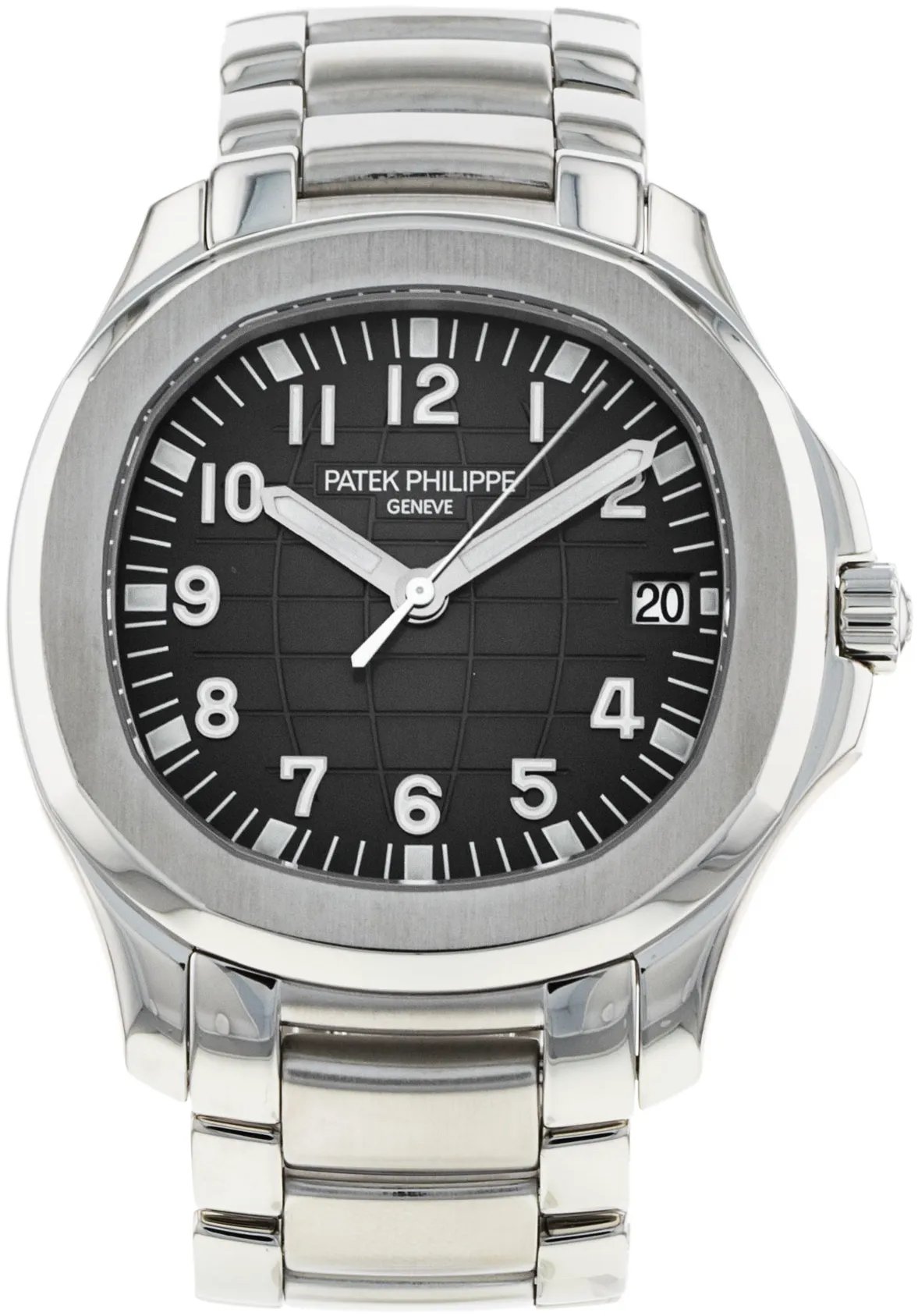
The magic of the 5167A is in its proportions. The official diameter is 40.8mm, measured from the 10 to 4 o'clock positions, but it wears smaller thanks to its sublime thinness of just 8.1mm. This allows it to disappear under a shirt cuff, a feat most sports watches can't manage. The case is a masterclass in finishing, with a satin-brushed bezel that contrasts beautifully with the mirror-polished chamfers. The iconic 'Tropical' strap isn't mere rubber; it's an ultra-resistant composite material, impervious to saltwater, UV radiation, and, presumably, champagne spills. It's supple, comfortable, and integrates flawlessly into the case, creating a seamless wrist-hugging profile. The embossed black dial, with its subtle dégradé effect, is legible at a glance, featuring applied Arabic numerals in white gold filled with Super-LumiNova. It's a design that is both utilitarian and deeply luxurious.
On The Wrist: The Daily Driver Grail
The wearing experience is what solidifies the Aquanaut's legend. You can read about the 8.1mm thickness, but you can't understand it until you wear it. It's a watch that never gets in the way. The balance is perfect, with no top-heaviness. This is the watch you wear on a transatlantic flight, to the gym, to a Michelin-star dinner, and never once feel it's out of place. Its wrist presence is a curious paradox. It's subtle enough to fly under the radar of the general public, but to the horologically inclined, it’s a beacon. It signals not just wealth, but access and taste. It says you're past the need for overt displays of success; your assets speak for themselves.
Market Analysis: An Asset Class of Its Own
The Investment Thesis
The 5167A was discontinued in early 2022, a move that poured gasoline on an already raging fire. With a final MSRP of around $21,650, its current trading price of $65,000 to $85,000 represents a staggering premium. This isn't hype; it's a textbook case of constrained supply and explosive, global demand. Acquiring one at retail was a game of chance and relationships. Now, the open market is the only arena. The 5167A has become a liquid, alternative asset. It's more portable than a painting and more stylish than a gold bar. For collectors, it's a cornerstone piece that has consistently appreciated, acting as a hedge against inflation and market volatility.
Competitive Landscape
In the Holy Trinity sports watch portfolio, the Aquanaut plays a specific role. The Audemars Piguet Royal Oak is the original, the iconoclast. It's sharper, more architectural, and more aggressive on the wrist. The Vacheron Constantin Overseas is the thinking man's choice, with a technically superior movement, a stunning blue dial, and the unmatched utility of its quick-change strap system. The Aquanaut is the choice for the modern tastemaker. It's softer, more versatile, and arguably more 'cool' than its counterparts. It represents the perfect fusion of Patek's aristocratic heritage with contemporary, casual luxury.
The Final Verdict
Evaluating the Patek Philippe Aquanaut 5167A on a simple pros-and-cons list misses the point entirely. Yes, the movement could be more modern. Yes, the price is detached from any rational measure of material value. But the 5167A isn't a rational purchase. It's an acquisition of a cultural icon, a blue-chip asset, and an entry ticket into one of the most exclusive clubs in the world. Its value is dictated by forces far more powerful than technical specifications: brand equity, scarcity, and its status as the chosen watch for a new generation of global elite. For the Vivir.com reader, the question is not whether the 5167A is 'worth it.' The question is whether you can afford not to have it in your portfolio.