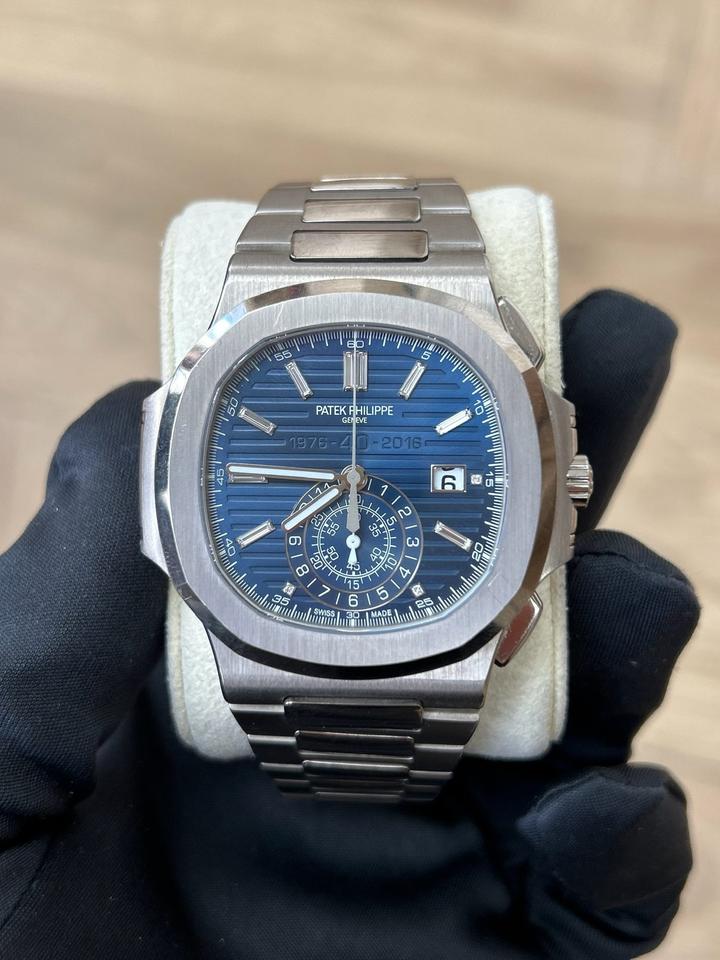
The Anniversary Giant: Contextualizing the 5976/1G
In 2016, Patek Philippe faced a daunting task: celebrating the 40th anniversary of arguably the most famous sports watch in history, the Nautilus. The original 3700, designed by Gérald Genta, was nicknamed 'Jumbo' for its 42mm width—a size considered gargantuan in 1976. For the 40th anniversary, Patek decided to lean into that legacy of scale, producing the Reference 5976/1G. This wasn't just a slightly larger watch; it was a total reimagining of the Nautilus's proportions, rendered in solid 18k white gold.
To understand the 5976/1G, one must understand the controversy. Upon its release, many purists recoiled at the 49.25mm width (including the 'ears' of the case) and the embossed '1976-40-2016' text on the dial. However, as the years have passed, the watch has transitioned from a point of contention to a point of legend. It represents a specific era of Patek Philippe—one where they weren't afraid to be bold, heavy, and unapologetically luxurious.
Case Architecture and Ergonomics
Let's talk about the 'ears.' The Nautilus case is defined by its porthole construction, with lateral hinges at 3 and 9 o'clock. On the 5976/1G, these hinges are more pronounced than ever. When measured across the diagonal from 10 to 4, the watch is 44mm. But when you measure from 'ear to ear,' you hit nearly 50mm. On paper, this sounds unwearable for anyone without the forearm of a professional athlete. In practice, the experience is different.
The lug-to-lug distance is kept remarkably tight at 49.6mm. Because the bracelet integrates directly into the case and drops down sharply, the watch wraps around the wrist rather than overhanging it. During my week with the 5976/1G, I found that it occupied the same 'visual real estate' as a 44mm Panerai, but with a significantly lower profile. At 12.16mm thick, it is actually thinner than many modern dive watches, allowing it to slide—with just a little bit of coaxing—under a bespoke shirt cuff.
The Dial: A Study in Blue and Brilliants
The dial of the 5976/1G is a deep, sunburst blue that shifts from a navy hue in low light to a vibrant electric blue in direct sunlight. The horizontal embossing is wider and deeper than what you’ll find on a 5711, providing a more architectural feel. But the real stars are the hour markers. Instead of the usual luminescent batons, Patek has utilized top-quality baguette-cut diamonds (approx. 0.29 ct).
What I appreciate most as a daily-wear reviewer is how subtle these diamonds are. Because they are baguette-cut and set into the white gold, they don't 'shout.' They catch the light in flashes rather than a constant shimmer, providing legibility that is surprisingly excellent. The monocounter at 6 o'clock handles the chronograph duties, featuring a 12-hour counter on the outer track and a 30-minute counter on the inner. It’s a clean way to display complex information without cluttering the iconic Nautilus aesthetic.
Movement: The Caliber CH 28-520 C
Inside the white gold vault is the Caliber CH 28-520 C. This is a modern, high-performance flyback chronograph movement. Unlike traditional chronographs that use a lateral clutch, this movement utilizes a vertical clutch. This is a massive advantage for daily wear. Because there is no friction-induced wear on the gear train, you can leave the chronograph second hand running constantly to serve as a central seconds hand without worrying about damaging the movement.
The flyback function is also a joy to use. A single press of the pusher at 4 o'clock resets the timer to zero and restarts it instantly. The tactile feedback of the pushers is buttery smooth—there is no 'click' or 'snap' here, just a refined, hydraulic resistance that speaks to the level of hand-finishing Patek Philippe invests in their components. The 21k gold central rotor ensures that the 55-hour power reserve is topped up quickly, even with minimal wrist movement.
Real-World Wearability: The Vivir Test
I wore the 5976/1G for seven days straight. On Day 1, the weight was the most prominent factor. Moving from a steel watch to a white gold watch of this size requires an adjustment period. You become hyper-aware of your wrist's proximity to doorframes and table edges. However, by Day 3, the 'Nautilus Magic' took over. The bracelet is, in my opinion, the most comfortable in the world. Each link is polished to a mirror finish on the bevels and brushed on the flats, and they move with a silk-like fluidity.
Legibility in the real world is fantastic. The contrast between the white gold hands and the blue dial is sharp. Even in the dark, the Super-LumiNova on the hands provides enough glow to read the time at a glance. The date window at 3 o'clock is well-proportioned, though some might find it a bit small given the overall scale of the dial. My only gripe during the week was the lack of a micro-adjustment on the clasp. For a watch at this price point, and given how much a wrist can swell in the heat, a tool-less adjustment system would be a welcome addition.
Investment and Scarcity
With only 1,300 pieces in existence, the 5976/1G is a rare bird. While its retail price was just under $100,000, the secondary market has seen it climb to staggering heights. It is a 'holy grail' for Nautilus collectors. Unlike the 5711, which was produced in massive quantities over decades, the 5976/1G is a fixed-quantity asset. This watch represents a stable place to park capital, provided the market for integrated sports watches remains robust.
Final Verdict
The Patek Philippe Nautilus 5976/1G is not a watch for everyone. It is too large for many, too expensive for most, and perhaps too bold for the traditionalist. But for the collector who wants the absolute peak of the Nautilus family—the 'End Boss' of the collection—there is no substitute. It wears its 40 years of history on its sleeve (and its dial), offering a tactile experience of luxury that steel simply cannot replicate. It is a titan of the industry, a masterpiece of engineering, and a surprisingly capable daily companion for those with the wrist to carry it.