Petermann Bedat Reference 1967 Review
In the rarefied air of independent watchmaking, few names have ignited as much anticipation as Petermann Bedat. Founded by Florian Petermann and Victor Bedat, two artisans who cut their teeth at the highest echelons of haute horlogerie, the brand debuted with a single, uncompromising timepiece: the Reference 1967. This is not just a watch; it is a manifesto—a declaration that traditional craftsmanship, meticulous finishing, and a pure, unobstructed dial can still captivate a generation raised on smartwatches.
The Reference 1967 draws its name from a pivotal year in horological design, but it is far from a retro pastiche. Instead, it distills the essence of 1960s elegance into a contemporary object. With a 38mm case, a sector dial that plays with light, and a manual-winding movement that is a masterclass in architecture, this watch speaks to collectors who crave authenticity and a tangible connection to the craft. It is the kind of piece that doesn't shout—it whispers, and the right people listen.
Manufacture History
Petermann Bedat is a new name, but its founders are seasoned veterans. Florian Petermann and Victor Bedat both worked at prestigious Swiss maisons, honing their skills in movement design and finishing. In 2022, they decided to strike out on their own, with a clear vision: to create watches that honor the traditions of the 19th and 20th centuries while incorporating modern precision. The Reference 1967 is their first fruit, and it was unveiled to critical acclaim at Geneva Watch Days 2024. The brand operates out of a small atelier in the Jura, where each movement is assembled and finished by hand, often by the founders themselves.
Movement
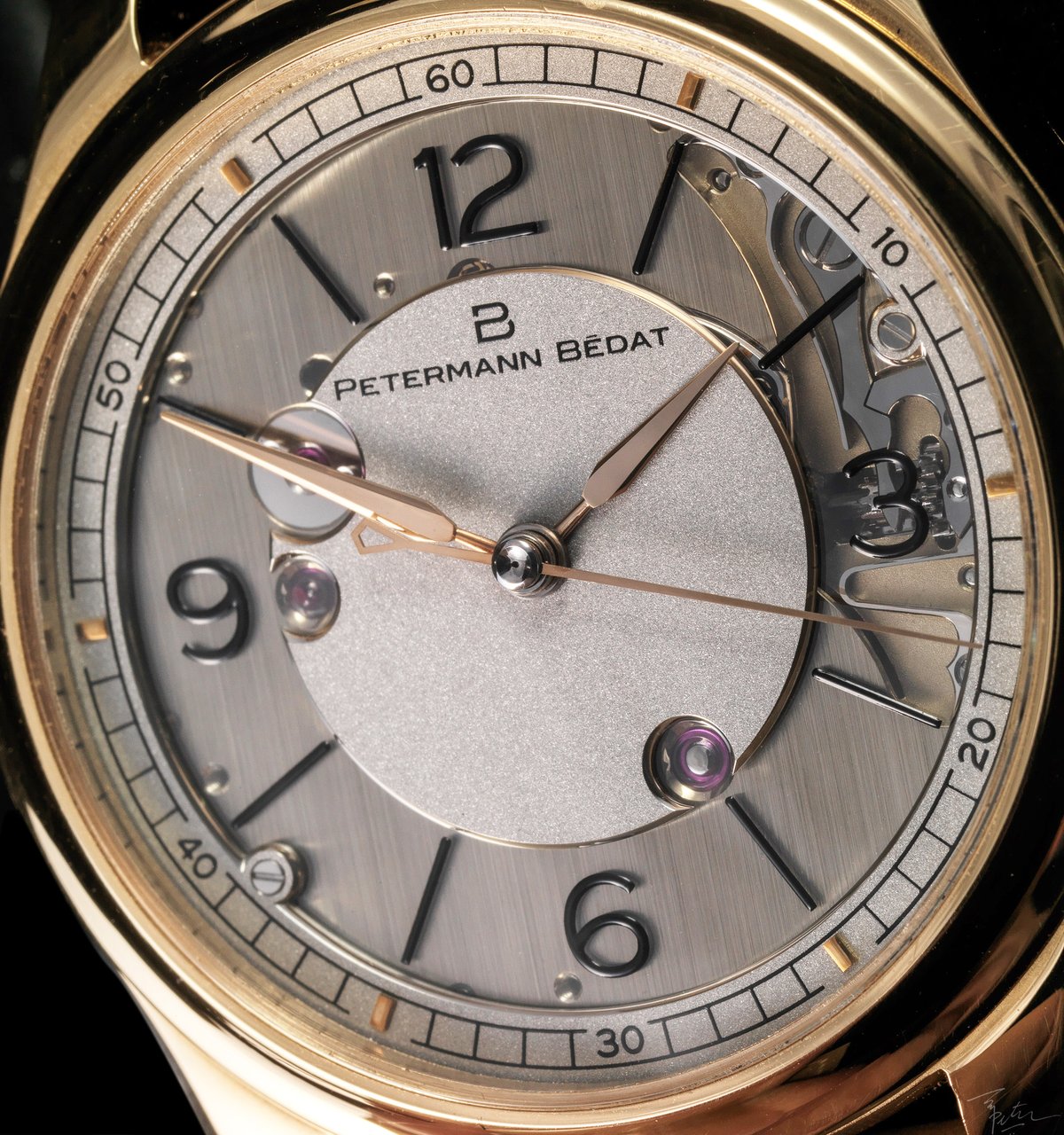
At the heart of the Reference 1967 lies the Calibre PB-1967, a manual-winding movement that is a visual and technical spectacle. The twin barrels provide a 72-hour power reserve, ensuring that the watch runs through a long weekend without winding. The frequency of 21,600 vph (3 Hz) is a classic choice, offering a smooth sweep and a calm, rhythmic tick. The movement is beautifully finished: bridges are hand-beveled with internal angles, the mainplate is decorated with perlage, and the ratchet wheels have a circular Côtes de Genève pattern. The free-sprung balance wheel with a Breguet overcoil is a hallmark of high-end watchmaking, and it is adjusted in six positions to ensure accuracy. The movement is not COSC-certified, but that's a deliberate choice—this is about art, not a certification badge.
Specifications
- Case Diameter: 38mm
- Case Thickness: 9.5mm
- Lug-to-Lug: 45mm
- Case Material: Stainless steel (also available in platinum)
- Crystal: Sapphire (box-shaped, with AR coating)
- Water Resistance: 30m (splash-proof)
- Lume: None
- Strap: Hand-stitched leather (alligator or calfskin)
- Clasp: Pin buckle in matching metal
Wrist Feel
The Reference 1967 is a joy to wear. The 38mm diameter is a sweet spot for dress watches, and the slim profile slips under a shirt cuff with ease. The case is beautifully contoured, with a gentle curve on the lugs that hugs the wrist. The weight is substantial but not heavy, and the balance is perfect. The leather strap is soft and comfortable from the first wear, and the pin buckle—a simple, elegant touch—keeps the watch low-key. It feels like a bespoke suit: tailored, unobtrusive, and impeccably present. Whether you're at a black-tie gala or a quiet dinner, the watch never feels out of place.
Accuracy
In real-world wear, the Reference 1967 performs admirably. The free-sprung balance and overcoil, combined with meticulous adjustment, deliver a rate of around +2 to +4 seconds per day. The twin barrels ensure consistent torque over the 72-hour power reserve, so accuracy remains stable even as the mainspring winds down. It is not a chronometer-certified movement, but it easily meets the standards of the most demanding collectors. For daily wear, you can set it once and forget about it for a week, and it will only be a few seconds off.
Occasions
This is a dress watch through and through. It shines at formal events, weddings, and board meetings. But it also works as a daily wearer for those who appreciate understated elegance. It's not a sports watch, so don't take it diving, but it can handle a splash of rain. The sector dial is versatile enough to pair with a suit or a simple knitwear. It's a watch that adapts to your style, not the other way around.
Wrist Presence
On the wrist, the Reference 1967 commands attention without shouting. The silver sector dial is a study in contrast: the outer minute track is opaline, the center is grained, and the hours are marked by applied indices. The blued hands are a classic touch, and they catch the light in a way that makes the dial come alive. It's a watch that gets noticed by those who know, but it doesn't scream for attention. It has a reserved authority that is far more powerful than a flashy chronograph. I'd give it a 4 out of 5—it's not a showstopper like a skeleton tourbillon, but it's a quiet masterpiece that rewards close inspection.
Reference Variants
- Reference 1967 (Stainless Steel) - The standard model with a silver sector dial and blued hands. Available on a black or brown leather strap.
- Reference 1967 Platinum - A limited edition of 10 pieces in a platinum case, with a platinum buckle. The dial is identical, but the weight and feel are different. This is the ultimate collector's piece.
Similar Watches
If you're drawn to the Reference 1967, you might also consider:
- Philippe Dufour Simplicity - The holy grail of independent watchmaking, with even more hand-finishing, but also a much higher price and waiting list.
- Rexhep Rexhepi Chronomètre Contemporain - Another modern classic with a sector dial and a stunning movement, though it's a bit larger and more experimental.
- Lang & Heyne Friedrich III - A German take on the dress watch, with a similar dedication to traditional finishing.
Investment Value
The Reference 1967 is priced at $85,000 for the stainless steel version. Given the limited production (around 50 pieces per year), it is already trading above retail in the pre-owned market, with examples fetching $95,000 to $120,000. The trend is clearly appreciating, and as the brand gains recognition, this first model will likely become a sought-after collector's item. For those who can secure one at retail, it's a smart investment. The hold recommendation is strong: this is a foundational piece for a young brand, and its historical significance will only grow.
Service and Maintenance
Like all high-end mechanical watches, the Reference 1967 requires regular servicing every 5 years. The cost is around $1,500, and it should only be done by Petermann Bedat or an authorized independent watchmaker with experience in this movement. The brand offers excellent after-sales support, but given the small size of the company, service turnaround may be longer than at a major maison. That's a small price to pay for the privilege of owning such a hand-crafted masterpiece.
Pros and Cons
Pros
- Exceptional movement finishing and architecture
- Timeless, wearable design that fits any formal occasion
- Limited production ensures exclusivity
- Strong investment potential
Cons
- High entry price
- No water resistance for daily worry-free wear
- Limited service network
- Small brand with less established heritage
Final Verdict
The Petermann Bedat Reference 1967 is a triumph of independent watchmaking. It offers a pure, uncompromising vision that resonates with collectors who value craftsmanship over hype. While the price is steep, the watch delivers an experience that few others can match. It is a modern classic in the making, and for those with the means, it is an essential addition to any serious collection. The sector dial, the hand-finished movement, and the perfect proportions make it a piece that will be admired for decades to come. If you're seeking a watch that tells the time with grace and integrity, look no further.