Piaget Polo – A Timeless Sports‑Chic Icon Re‑examined
By Vivir··Updated
# Piaget Polo – A Timeless Sports‑Chic Icon Re‑examined
When Piaget launched the Polo in 1979, it did more than add a new model to its catalogue; it introduced the brand’s first watch with a distinct name and a silhouette that would become a cultural touchstone. The 34 mm ultra‑thin case, the seamless integrated bracelet, and the quartz‑driven “instant‑read” precision made the Polo an instant style statement—so much so that Robert De Niro wore one on the set of *Casino*. Four decades later the model still commands attention, and Piaget’s 2024 “Polo 79” reinterpretation proves the design’s DNA is still fresh enough to justify a 106 000 SGD price tag. Below we break down the original Polo’s heritage and the newer 79‑edition across design, movement, wearability, and value.
---
## Design & Case
**Original Polo (ref. 7661, 1979)** – The watch measures a modest 34 mm in diameter, a size that feels almost petite by today’s standards but was perfectly proportioned for the late‑70s sports‑chic aesthetic. Its case is crafted from stainless steel and houses Piaget’s signature integrated bracelet, a single‑piece construction that eliminates the traditional lug‑to‑case transition. The bracelet’s flat links flow into the round case, creating a sleek, uninterrupted profile that earned the Polo the description “icon of its era.”
A frequent point of contention among collectors is the amount of polishing many vintage Polos have endured. Over‑polished pieces lose the crisp edges that gave the original its kinetic energy, a flaw that purists frequently cite when evaluating condition.
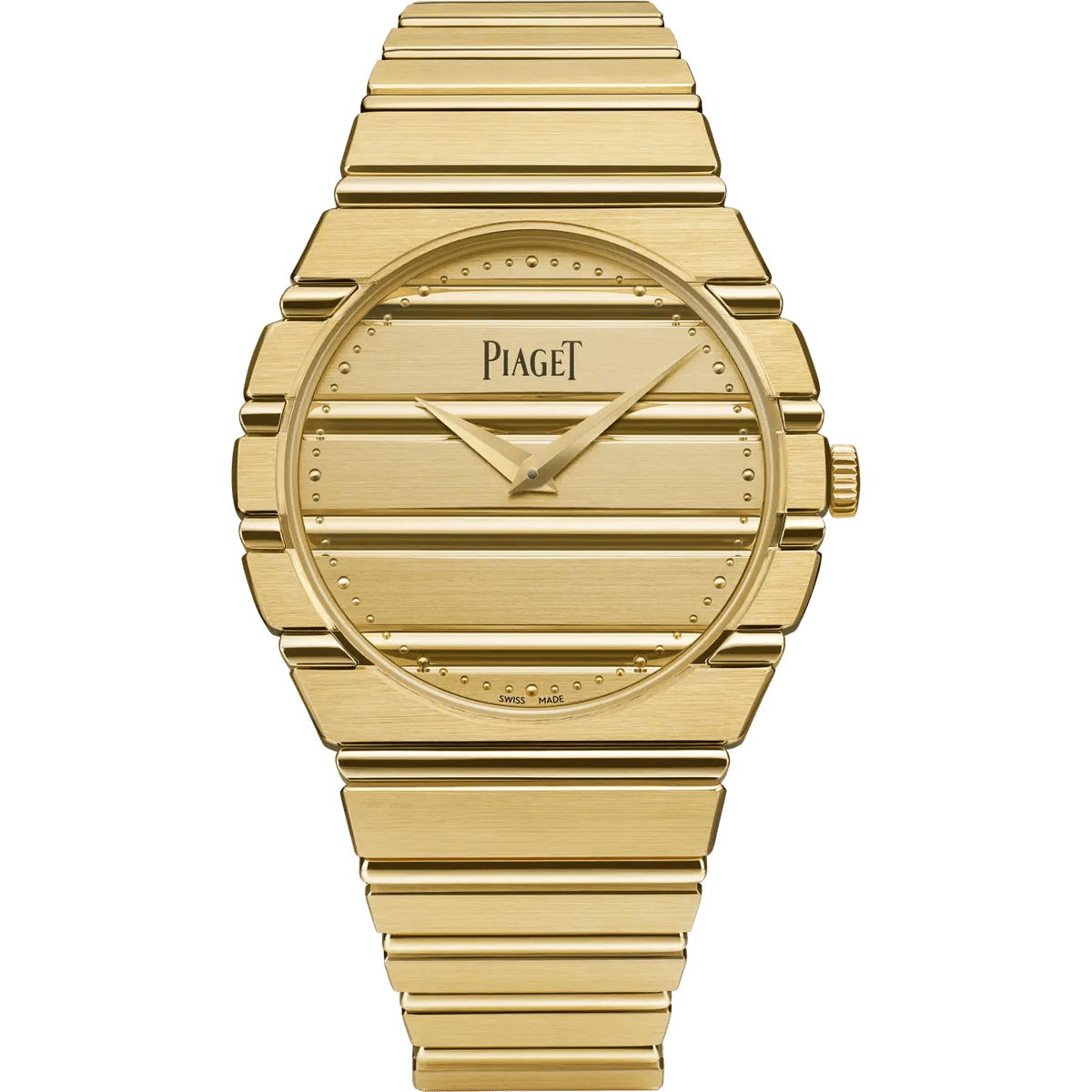
**Polo 79 (ref. G0A49150, 2024)** – Piaget enlarged the silhouette to 38 mm and switched the material palette to 18 k yellow gold for the case and bracelet, while retaining the integrated concept. The design introduces a “gadroon” motif—rounded, convex ridges that echo the original’s fluid lines but add a tactile contrast. Flat segments of 18 k white gold sit alongside the yellow‑gold gadroons, creating a two‑tone visual that makes the bracelet’s continuity even more apparent.
Both models share the same fundamental language: a seamless, bracelet‑watch hybrid that reads as a single sculptural object on the wrist. The original’s steel finish feels more utilitarian, whereas the 79‑edition’s gold construction pushes the Polo into the realm of high‑jewellery sports watches.
---
## Movement & Performance
**Original Polo – Quartz Caliber 7P**
The 1979 Polo was built around Piaget’s ultra‑thin quartz caliber 7P. While the source material does not list a power reserve, quartz movements of this era typically offered a multi‑year battery life and an accuracy that eclipsed most mechanical watches—often within ± 5 seconds per month. The thinness of the movement (the watch was marketed as “ultra‑thin”) allowed the case to sit flush against the wrist, reinforcing the minimalist aesthetic.
**Polo 79 – Automatic Caliber 1200P1**
The modern reinterpretation swaps quartz for a slim automatic movement. Caliber 1200P1 is only 2.35 mm thick, ticks at 21 600 bph (3 Hz), and provides a 44‑hour power reserve. While the movement’s Etachron regulator index has drawn criticism for looking “inexpensive” compared with the rest of the calibre, the overall performance remains robust: a reliable automatic with a respectable reserve for a watch of this thickness. The 79 also adds 50 m water resistance—a practical upgrade absent from the original (water resistance was not specified for the 1979 model).
---
## On the Wrist
**Fit & Comfort**
The original’s 34 mm case translates to a narrow lug‑to‑lug spread, making it sit comfortably on smaller wrists while still looking proportionate on larger ones thanks to the integrated bracelet’s lack of protruding lugs. The steel construction keeps the weight modest, and the bracelet’s flat links provide a secure, yet flexible, grip that resists twisting.
The Polo 79, at 38 mm, feels noticeably larger, but the integrated bracelet still eliminates the typical “lug‑gap” that can cause a watch to wobble. The gold’s density adds weight, giving the piece a substantial, luxurious presence on the wrist. The two‑tone contrast between yellow and white gold helps the wearer track the bracelet’s curvature, aiding alignment and reducing the risk of mis‑fit.
**Wearability in Daily Life**
Both watches are designed for everyday wear, but the original’s quartz movement means fewer service intervals—just a battery change every few years. The Polo 79’s automatic requires periodic servicing (typically every 4–5 years) and a more delicate handling of the winding rotor, but its 44‑hour reserve ensures it can survive short periods off the wrist. The added 50 m water resistance on the 79 makes it more versatile for brief splashes or rain, whereas the original’s water resistance is undocumented, implying a more cautious approach to moisture.
---
## Value & Verdict
**Pricing Landscape**
The source data lists the Polo 79’s retail price at **SGD 106 000 inclusive of GST**, a figure that many reviewers deem “too expensive,” especially when compared to similarly sized gold sports watches such as the Vacheron Constantin 222. The high price reflects the 18 k gold case, the bespoke integrated bracelet, and the brand’s heritage.
For the original Polo, no specific price is provided in the sources. However, the watch’s status as an iconic 1970s collector’s piece means it commands a premium on the secondary market, especially in well‑preserved, minimally polished condition. Enthusiasts also note that quartz movements can be a sticking point for purists, potentially limiting the pool of willing buyers and influencing resale values.
**Final Take**
Piaget’s Polo remains a masterclass in design efficiency: a single‑piece bracelet‑watch that looks as modern today as it did in 1979. The original’s 34 mm steel case and quartz heart deliver a sleek, low‑maintenance accessory that still turns heads—provided the piece retains its original edges. The Polo 79 successfully scales the concept up to 38 mm, dresses it in 18 k gold, and swaps quartz for an automatic movement, but it does so at a price that may make even seasoned collectors pause.
If you value iconic design, a seamless bracelet, and a watch that reads more like a piece of jewellery than a tool, the original Polo offers a compelling blend of heritage and practicality—especially for those who can find a piece in good condition without the over‑polished “plastic” look. For those seeking a contemporary, gold‑laden reinterpretation and are comfortable with a premium price, the Polo 79 delivers the same visual language with the added benefits of automatic power and water resistance.
In short, the Piaget Polo’s DNA proves timeless; the choice between quartz‑driven classic and gold‑capped automatic boils down to budget, material preference, and how much you value the brand’s willingness to charge a six‑figure sum for a modern homage. Either way, the Polo continues to embody the bold, sports‑chic direction Piaget set in motion over four decades ago.