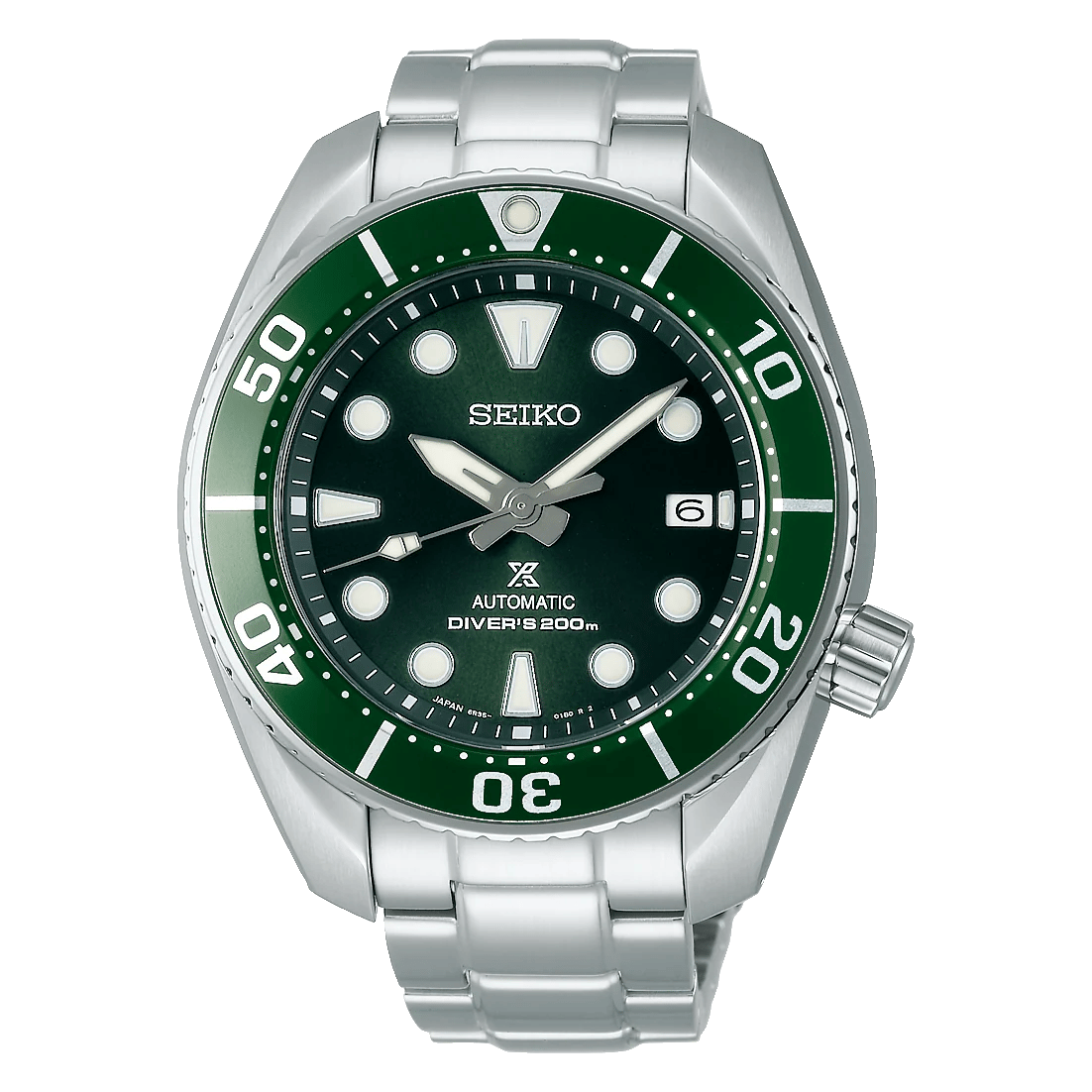
The Green Giant: A Deep Dive into the Seiko Prospex SPB103J1 'Sumo'
In the world of watch collecting, nicknames are the ultimate sign of respect. You have the 'Paul Newman' Daytona, the 'Pepsi' GMT, and then you have the Seiko 'Sumo.' The nickname wasn't born in a marketing meeting in Tokyo; it was bestowed by the fans. Some say it’s because of the sheer bulk of the case; others point to the 12 o’clock marker, which bears a striking resemblance to the mawashi (the heavy loincloth worn by sumo wrestlers). Regardless of its origin, the Sumo has become a pillar of the Seiko Prospex line, and the SPB103J1—the green-dialed third generation—is perhaps its most refined iteration to date.
The Evolution of an Icon
To understand the SPB103, you have to understand where it came from. The Sumo first hit the scene in 2007 with the SBDC001. At the time, it was a revelation. It offered a level of case finishing that punched way above its weight class, featuring alternating brushed and polished surfaces that hinted at the Zaratsu polishing found on Grand Seikos. However, it had its quirks: a mineral 'Hardlex' crystal and a movement that, while reliable, was starting to show its age.
Fast forward to 2019, and Seiko dropped the SPB103. This wasn't just a color swap. The brand listened to the forums and the Instagram comments. They swapped the Hardlex for a scratch-resistant sapphire crystal and replaced the 6R15 movement with the 6R35, boosting the power reserve from 50 to 70 hours. This 'weekend-proof' capability means you can take the watch off on Friday night and pick it up Monday morning without missing a beat—a feature usually reserved for watches twice its price.
Aesthetics: That Green Dial
Let’s talk about the elephant in the room: the green. In a post-'Hulk' world, every brand has tried to capture the magic of a green diver. Most fail, ending up with a shade that is either too neon or too muddy. Seiko, however, nailed it. The SPB103 features a deep forest green dial with a sunray finish. In low light, it looks almost black, maintaining a professional, understated vibe. But when the sun hits it—whether you're on a boat in the Mediterranean or just walking to a meeting in Soho—the dial explodes into a vibrant, metallic emerald.
The bezel matches this hue perfectly. It’s an aluminum insert, which some might criticize in an era of ceramic, but there’s a warmth to aluminum that ceramic can’t replicate. It ages with the wearer, picking up small 'battle scars' that tell the story of the watch's life. The font on the bezel is also slimmer and more modern than previous generations, shedding some of the cartoonish vibes of the original Sumo in favor of a sleeker, more contemporary look.
Case Engineering and Wearability
At 45mm, the Sumo sounds like a monster on paper. But Seiko has always been the king of making large watches wear small. The secret is in the 'Sumo' silhouette. The lugs curve aggressively downward, wrapping around the wrist rather than sitting flat on top of it. The case sides are also heavily sculpted, with a polished undercut that reduces the visual mass. When you look at the Sumo from the side, you see a complex interplay of light and shadow that you simply don't find on the slab-sided divers of many Swiss competitors.
The crown is positioned at 4 o’clock, a signature Seiko move. This ensures the crown doesn't dig into the back of your hand during active use. It’s a small detail, but it’s the difference between a watch you want to take off after four hours and one you forget you’re even wearing. The finishing remains the star of the show; the transition from the brushed top of the lugs to the polished 'crescent' on the side is razor-sharp, reflecting Seiko's obsession with manufacturing precision.
The Movement: Caliber 6R35
Inside the SPB103 beats the Caliber 6R35. This is an in-house, automatic movement that represents the backbone of Seiko's 'Boutique' collection. While it doesn't have the decorative finishing of a Swiss movement seen through a display caseback (the Sumo has a solid steel back for better water resistance), it is a marvel of industrial engineering. It features the Magic Lever winding system, which increases winding efficiency, and a Spron 510 mainspring. For the young collector, the 70-hour power reserve is the real selling point. It reflects a lifestyle that is fluid—moving from a dive watch on the weekend to a dressier piece for a Monday gala without the hassle of resetting the time.
Cultural Context: Why It Matters
At Vivir, we look at watches through the lens of culture. The SPB103 isn't just a tool; it’s a piece of the 'New Vintage' movement. We’re seeing a shift where young collectors are moving away from the obvious status symbols and toward watches with 'insider' credibility. Wearing a Sumo tells the world you’re not just following a TikTok trend; you’ve done your homework. You appreciate the Japanese philosophy of Monozukuri (the art of making things). It’s a watch that looks just as good with a vintage Patagonia fleece as it does with a sharp, unstructured blazer from a brand like The Row or Lemaire.
The Verdict
Is the SPB103J1 perfect? No. The bracelet clasp, while functional and featuring a divers' extension, feels a bit 'tinny' compared to the luxury standards of Rolex or Omega. The 20mm lug width is also a point of contention; some feel a 22mm strap would better suit the 45mm case. However, these are minor gripes when weighed against the sheer value on offer. For under $1,000, you are getting a watch with genuine history, an in-house movement, sapphire glass, and a case that is finished to a standard usually found at the $3,000 mark.
The 'Green Sumo' is a bold, unapologetic celebration of what Seiko does best. It’s a watch that doesn't try to be anything other than itself. In an industry full of homages and copies, the SPB103J1 stands tall—a true heavyweight champion of the dive watch world.