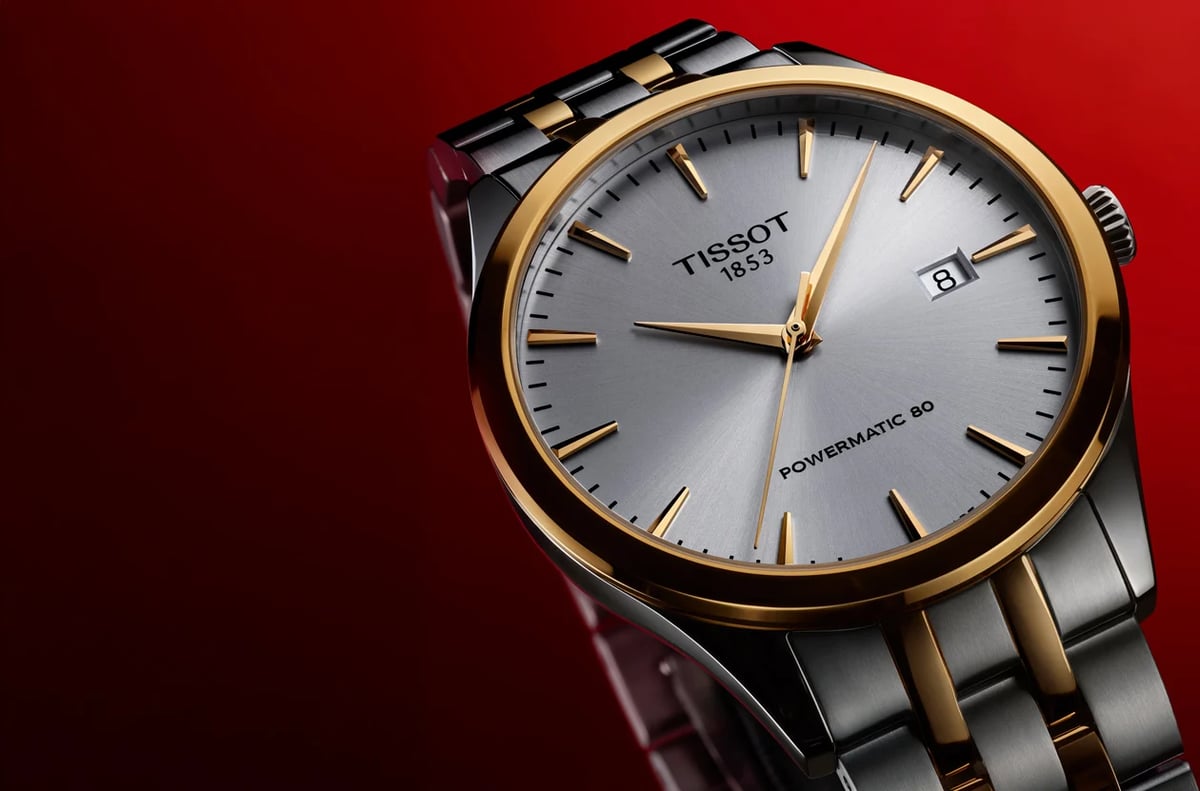
Introduction: The Poor Man's Royal Oak That Actually Delivers
The Tissot PRX (ref. T1374071105100) is not a watch you buy to flip. It's a watch you buy because you understand the assignment: integrated bracelet, 1970s silhouette, Swiss automatic movement, and a price tag that won't trigger a call from your wealth manager. In a market where the Royal Oak and Nautilus are unobtainium for anyone without a family office, the PRX delivers 90% of the wrist presence for 1% of the cost. That's not hyperbole—it's simple arithmetic.
Since its 2021 launch, the PRX has become the default recommendation for young collectors who want the 'Genta-esque' look without the six-figure anxiety. The automatic version, powered by the Powermatic 80, fixed the quartz model's biggest criticism: a deadbeat seconds hand. Now you get an 80-hour power reserve, a date complication, and a case that wears thinner than the spec sheet suggests. The blue dial reference T1374071105100 is the volume seller, and for good reason—it's the most versatile colorway in the lineup.
But let's talk about what actually matters: resale. The PRX is not an investment. It's a consumption good with a remarkably shallow depreciation curve. Pre-owned examples trade between $400 and $550, meaning you lose about $200 if you sell after a year. That's not a loss—that's the cost of wearing a watch that looks like it costs ten times more. The PRX is a no-brainer hold, not a flip.
Manufacture History: Tissot's 170-Year Grind to Relevance
Tissot was founded in 1853 in Le Locle, Switzerland, and has spent 170 years positioning itself as the entry point to Swiss watchmaking. The PRX name stands for 'Precise, Robust, X' (where X is the Roman numeral for 10, referencing 10 atmospheres of water resistance). The original 1978 PRX was a quartz-powered integrated bracelet watch that rode the same design wave as the Audemars Piguet Royal Oak and Patek Philippe Nautilus. Tissot revived the line in 2021 with quartz and automatic versions, instantly becoming the brand's best-selling model family.
The PRX's success is a masterclass in market timing. Tissot saw the integrated bracelet trend exploding on Instagram and TikTok, where young collectors were lusting after Royal Oaks and Nautiluses they could never afford. Instead of ignoring the hype, Tissot leaned in, producing a watch that looked like it belonged in the same conversation—at 1/100th the price. The result? A waitlist at some ADs, a thriving secondary market, and a permanent place in the 'entry-level luxury' conversation.
Movement: The Powermatic 80—Quantity Over Quality
Inside the PRX automatic is the Powermatic 80.111, a heavily modified ETA C07.111. It's not an in-house movement, but it's part of the Swatch Group ecosystem, which means parts and service are cheap and accessible. The headline spec is the 80-hour power reserve, achieved by lowering the beat rate to 21,600 vph (3 Hz) and using a high-efficiency escapement. That's a weekend-proof reserve: take it off Friday evening, put it on Monday morning, and it's still ticking.
What you don't get is finishing. No Geneva stripes, no blued screws, no perlage. The movement is industrial and functional, visible through a sapphire caseback that shows a rotor with a laser-etched Tissot logo. If you're the type who stares at movements with a loupe, this will disappoint. But if you're the type who cares about not resetting the time every Monday, the Powermatic 80 is a gift. Accuracy is not COSC-certified, but real-world performance is +5 to +15 seconds per day, which is fine for a daily beater. A local watchmaker can regulate it to +3 seconds for under $50 if you're obsessive.
Specs: The Numbers That Matter
- Case diameter: 40mm
- Case thickness: 10.9mm
- Lug-to-lug: 44.5mm (integrated, so no traditional lugs)
- Case material: Stainless steel
- Crystal: Sapphire with anti-reflective coating
- Water resistance: 100m
- Lume: Super-LumiNova on hands and hour markers (weak)
- Bracelet: Integrated steel, brushed with polished center links
- Clasp: Butterfly folding clasp, no micro-adjustment
The 40mm case wears smaller than the number suggests because of the integrated design. There's no lug overhang, so it fits wrists from 6.25 to 7.5 inches comfortably. The 10.9mm thickness is excellent for an automatic with an 80-hour reserve—it slides under a shirt cuff without catching. The sapphire crystal is flat, which keeps the profile low but means it's more prone to reflections than a domed crystal. The 100m water resistance is fine for swimming, but there's no screw-down crown, so don't take it diving.
Wrist Feel: Comfortable, Balanced, With One Annoying Flaw
The PRX wears like a watch that costs three times its price. The integrated bracelet hugs the wrist, and the weight—around 140 grams—feels substantial without being heavy. The butterfly clasp sits flush, but here's the catch: no micro-adjustment. If you're between link sizes, you'll either wear it slightly loose or slightly tight. Some owners swap to an aftermarket half-link or a leather strap, but the integrated design makes strap changes a pain. Quick-release spring bars on newer models help, but you're still limited to Tissot's own strap options or custom-made pieces.
For most wrists, the stock bracelet works fine. The brushed and polished surfaces catch light well, and the bracelet doesn't pull hair. The only real comfort issue is the clasp digging into the wrist if you wear it tight. If you have a 7-inch wrist, you'll likely be fine with the stock sizing. If you're between sizes, budget $30 for a half-link from a third-party seller on eBay.
Accuracy: What to Expect Day to Day
Out of the box, expect +5 to +15 seconds per day. The Powermatic 80 is not COSC-certified, and Tissot doesn't regulate it to chronometer standards. In practice, most examples settle around +8 to +12 seconds per day, which is perfectly acceptable for a daily wearer. If you're obsessive about accuracy, a quick trip to a local watchmaker can regulate it to within +3 seconds per day for under $50. Don't expect Grand Seiko Spring Drive precision, but for a $725 automatic, it's more than adequate.
The lower beat rate (21,600 vph vs. the standard 28,800) means the seconds hand doesn't sweep as smoothly as a higher-beat movement. You'll notice a slight stutter if you look closely, but it's not a dealbreaker. The 80-hour reserve is the real win: you can leave it on the nightstand for a long weekend and not have to reset the date on Monday morning.
Occasions: Daily, Sport, Dress—The Trifecta
The PRX is a true all-rounder. On the steel bracelet, it's a daily wearer that works with jeans and a t-shirt or a business casual outfit. Swap to a leather strap (if you can find one that fits the integrated lugs) and it leans dressy enough for a suit. The 100m water resistance means you can swim with it, though I wouldn't take it to the gym—the polished center links will scratch. For travel, the 80-hour reserve is a blessing: no need to pack a watch winder. The only occasion it doesn't fit is black tie, where a thin dress watch on a leather strap is more appropriate. But for 99% of real life, the PRX covers it.
Wrist Presence: 4/5—Not Flashy, But Noticeable
The integrated bracelet and 40mm case give the PRX a strong wrist presence that belies its price. It's not as flashy as a gold Royal Oak, but the brushed and polished surfaces catch light well. On a steel bracelet, it reads as sporty-casual; on a leather strap, it leans dressy. It won't dominate a room, but it will get noticed by people who know watches. The blue dial is the most eye-catching of the standard colors, with a sunburst finish that shifts from navy to electric blue depending on the light. If you want more presence, the green dial is the hype choice, but the blue is the safe bet for resale.
Reference Variants: The Full PRX Lineup
The reference T1374071105100 is the blue dial automatic on a steel bracelet. Other variants include:
- T137.407.11.041.00 – Black dial, steel bracelet. The most understated option; pairs with everything but lacks the pop of the blue.
- T137.407.11.081.00 – Green dial, steel bracelet. The hype colorway; green dials are trending, and this one has a sunburst finish that shifts from forest to emerald.
- T137.407.11.351.00 – White/silver dial, steel bracelet. Clean and dressy, but less popular on the secondary market.
- T137.410.11.041.00 – Quartz version, black dial, steel bracelet. Cheaper ($395) and thinner, but no automatic sweep and less power reserve (obviously).
- T137.207.11.041.00 – 35mm automatic, black dial. For smaller wrists or those who prefer a more vintage proportion.
The 40mm automatic is the sweet spot for most buyers. The 35mm is charming but wears small by modern standards, and the quartz is fine if you don't care about mechanical movements. The chronograph version (ref. T137.427.11.011.00) adds a Valjoux-based automatic chronograph for $1,750, but it's thicker and less elegant.
Family References: The PRX Ecosystem
The PRX family now includes:
- PRX 35mm Powermatic 80 – Smaller case, same movement, for those who want a more vintage fit.
- PRX Quartz 40mm and 35mm – The budget option, starting at $375. No automatic sweep, but the same design.
- PRX Chronograph – 42mm, automatic chronograph, $1,750. Thicker and more tool-like.
- PRX Digital – A retro digital version with a gold case, $450. A fun oddity, but not a daily wearer.
The automatic 40mm remains the core model. It's the one that gets the most wrist time, the most Instagram posts, and the most resale activity.
Other Watches by Tissot Worth Considering
If the PRX isn't your style, Tissot has other strong options:
- Tissot Gentleman Powermatic 80 Silicium – A more traditional round case, same movement, $775. Dressier, but less distinctive.
- Tissot Le Locle Powermatic 80 – Classic dress watch with Roman numerals, $650. Safe but boring.
- Tissot Seastar 1000 Powermatic 80 – Dive watch with 300m water resistance, $795. If you want a tool watch instead of a sports watch.
- Tissot Heritage 1973 Chronograph – A retro racing chronograph, $2,100. More niche, but cool.
None of these have the cultural cachet of the PRX. The PRX is Tissot's halo product right now, and for good reason.
Similar Watches: The Integrated Bracelet Competition
The PRX doesn't exist in a vacuum. Here's what else you could buy:
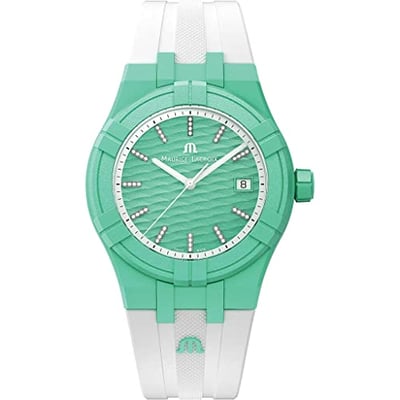
- Maurice Lacroix Aikon Automatic 39mm – $1,900. Better finishing, more distinctive bezel claws, but nearly three times the price. The Aikon is the PRX's older, more polished sibling.
- Christopher Ward C63 Twelve – $1,200. British microbrand with a Genta-inspired case, Sellita movement, and better bracelet micro-adjustment. A serious competitor if you can stretch your budget.
- Citizen Tsuyosa Automatic – $450. Japanese competitor with a 40mm integrated case and Miyota movement. Cheaper, but the bracelet feels flimsier and the design is less refined.
- Casio Edifice EFR-S108D – $150. Quartz, solar, and the ultimate budget integrated bracelet beater. No mechanical soul, but unbeatable value.
The PRX's main advantage is the combination of Swiss automatic movement, 80-hour reserve, and brand recognition. The Christopher Ward Twelve is arguably better finished, but it costs $500 more and lacks the Tissot name recognition. For most buyers, the PRX is the default choice.
Homages: The PRX's Cheaper Clones
Where there's hype, there are homages. The PRX has spawned a mini-industry of clones:
- Pagani Design PD-1644 – $80. A direct homage with a Seiko NH35 automatic, sapphire crystal, and surprisingly decent bracelet. The finishing is rougher, but at this price, it's a steal.
- San Martin SN059-G – $220. Higher-end homage with better finishing, a PT5000 movement, and a more faithful case profile. If you want the PRX look without the Tissot logo, this is the one.
These homages are fine for what they are, but they lack the brand equity and the movement reliability of the real thing. The Powermatic 80 is a known quantity; a PT5000 is a Chinese clone of an ETA 2824 with mixed quality control. If you're buying a watch to wear daily, the extra $500 for the Tissot is worth it.
Investment Value: Hold vs. Flip—The wealthy collector Angle
Let's be clear: the PRX is not an investment. It's a mass-produced watch with no scarcity, no limited editions, and no auction history. The MSRP is $725, and that's what you'll pay at an authorized dealer. Pre-owned examples trade between $400 and $550, depending on condition and completeness (box and papers matter). That means you'll lose $150-$200 if you sell after a year. That's not depreciation—that's the cost of wearing a watch that looks like it costs ten times more.
The PRX is a no-brainer hold. You buy it, wear it for a year, sell it for $500, and you've effectively rented a Swiss automatic for $200. Compare that to buying a $5,000 Maurice Lacroix Aikon, which might depreciate $1,500 in the same period. The PRX is the cheapest way to get the integrated bracelet look without losing your shirt on resale.
The hype cycle for the PRX peaked in 2022, when some ADs had waitlists and pre-owned prices briefly touched $600. Since then, supply has caught up, and prices have stabilized. Don't expect a moonshot. The only way this watch appreciates is if Tissot discontinues the automatic version and the secondary market panics—unlikely given its success.
Service Interval: Cheap and Easy
The Powermatic 80 is a workhorse movement, and service is straightforward. Tissot recommends a service every 5 years, though many owners stretch it to 7-8 years without issues. A full service at a Tissot authorized center costs about $250, including gaskets and pressure testing. Any competent independent watchmaker can also handle it, and parts are readily available through Swatch Group. You don't need to send it to Switzerland, and you don't need to pay $800 like you would for a Rolex. This is one of the PRX's hidden advantages: low cost of ownership.
Price Range and Verdict: The Smartest $725 You Can Spend
Retail price: $725. Pre-owned: $400-$550. For the discerning buyer who wants the integrated bracelet look without the premium, this is the best value proposition in watches. You're paying for design, not heritage or rarity. The pre-owned market is even better—$450 gets you a watch that looks like a $5,000 Maurice Lacroix. The only downside is the clasp's lack of micro-adjustment and the weak lume, but those are minor quibbles at this price.
If you're considering a PRX, buy the blue dial automatic on a steel bracelet. It's the most versatile, the most liquid on the secondary market, and the one that will age best. Skip the quartz unless you're on a strict budget; the automatic's 80-hour reserve is worth the extra $300. And don't bother with the chronograph—it's too thick and too expensive for what it is.
Pros and Cons
Pros:
- 80-hour power reserve beats almost everything under $1,000
- Integrated bracelet design with genuine wrist presence
- Sapphire crystal and 100m water resistance for daily wear
- Minimal depreciation—you can sell it for most of what you paid
- Versatile: works with a suit or a hoodie
Cons:
- Butterfly clasp lacks micro-adjustment, leading to fit issues
- Lume is weak and fades quickly
- Movement finishing is industrial, not decorative
- No screw-down crown (though 100m is fine for swimming)
- Bracelet scratches easily due to polished center links
Final Verdict
The Tissot PRX Powermatic 80 is the smartest $725 you can spend on a watch if you want the integrated bracelet aesthetic without the financial anxiety. It's not a flip, it's not an heirloom, and it's not going to impress a Patek collector. But it will make you look like you know what you're doing, and it will keep ticking for 80 hours after you take it off. Buy the blue dial, wear it daily, and spend the $70,000 you saved on something that actually appreciates—like an index fund.