The Philosophy of the Overbuilt Diver
In the contemporary horological climate, the 'diver' has become the default choice for the modern gentleman. However, most offerings in this category are designed for the boardroom rather than the bathypelagic zone. The Tissot Seastar 2000 Professional ref. T120.607.11.041.01 is a defiant rejection of this compromise. It is a watch that embraces the 'Professional' suffix with a technical earnestness that is increasingly rare in the sub-$2,000 market. To appreciate the Seastar 2000, one must first appreciate the rigors of ISO 6425—the international standard for diver's watches. This is not merely a water-resistance rating; it is a battery of tests involving thermal shock, overpressure, and magnetic resistance. Tissot has not only met these standards but exceeded them, delivering a timepiece rated to 600 meters (2000 feet).
This level of engineering is significant because it represents Tissot's ability to leverage the vast industrial might of the Swatch Group. While a boutique brand might struggle to source a helium escape valve or a ceramic bezel insert at this price point, Tissot integrates them seamlessly. The Seastar 2000 is a testament to the democratization of high-end horological features, providing a 'saturation diver' experience to the enthusiast who values substance over status symbols.
Case Architecture and the Helium Escape Valve
The case of the Seastar 2000 is a fortress of 316L stainless steel. Measuring 46mm in diameter, it is undeniably large, but this size is a functional requirement of its depth rating. The crystal is a thick, domed sapphire with a significant anti-reflective coating, designed to withstand the immense pressure of the deep ocean. One of the most critical features for professional divers is the helium escape valve located at the 9 o'clock position. During decompression in a diving bell, helium atoms can penetrate the watch seals. Without an escape valve, the internal pressure would pop the crystal off the watch as the diver ascends. While 99% of owners will never require this feature, its presence is a mark of authenticity that defines the Seastar 2000’s character.
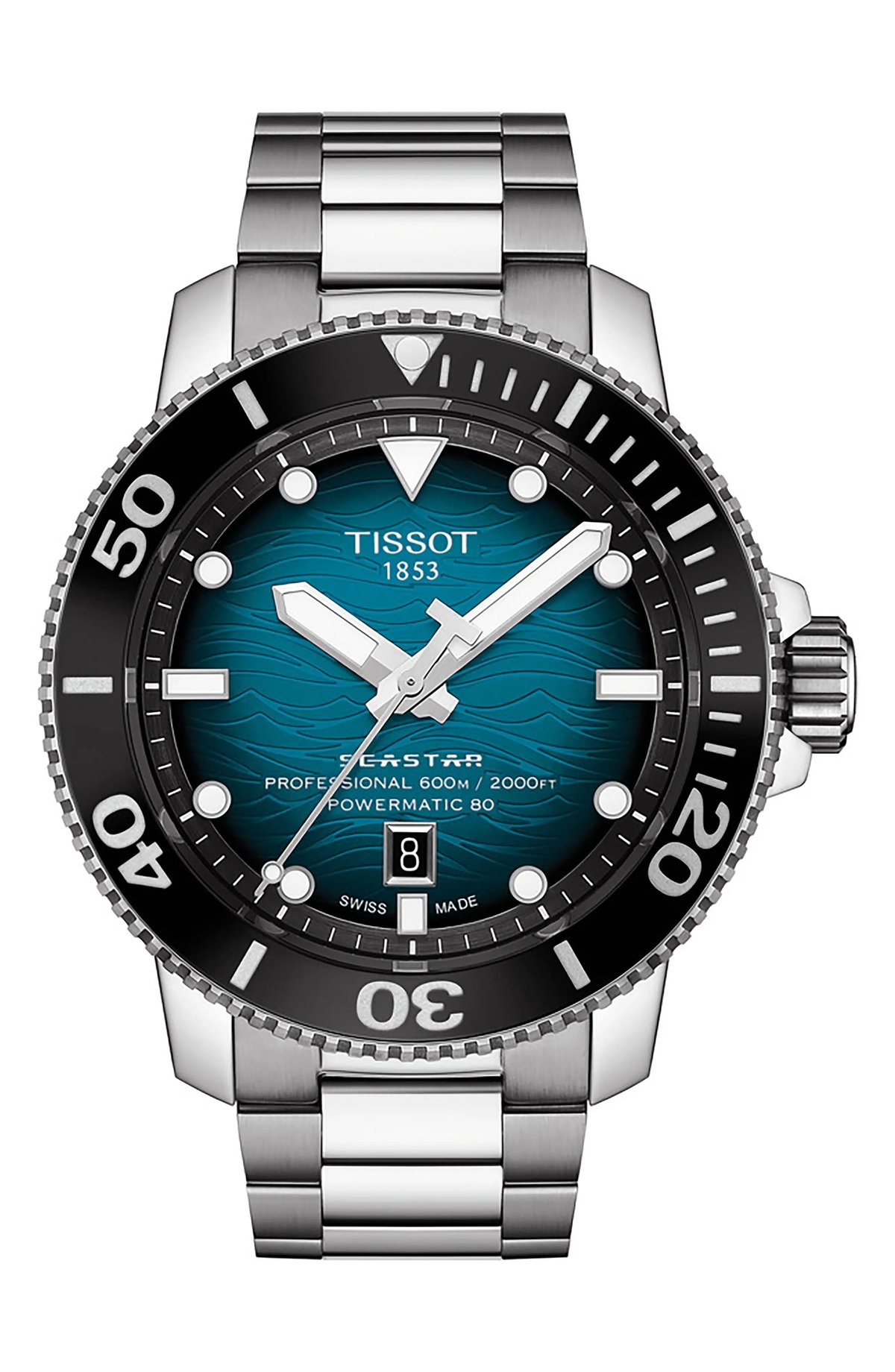
The finishing on the case is a mix of brushed and polished surfaces. The vertical brushing on the case flanks is particularly well-executed, providing a rugged texture that hides the inevitable scratches of a tool watch. The bezel is another highlight, featuring a ceramic insert with an engraved 60-minute scale. Ceramic is virtually scratch-proof and will not fade under UV exposure, ensuring the watch maintains its aesthetic integrity for decades. The bezel action is tactile and precise, with 120 clicks and zero back-play—a detail that speaks to the tight tolerances maintained at Tissot’s manufacturing facilities.
The Dial: Aesthetic Depth and Legibility
The dial of the ref. T120.607.11.041.01 is perhaps its most captivating feature. It features a gradient turquoise-to-black finish with an engraved wave pattern. Unlike printed patterns, these waves are physically etched into the dial, creating a sense of three-dimensional depth that changes depending on the light. This is not just a decorative choice; the high contrast between the turquoise center and the large, luminescent indices ensures maximum legibility in low-light conditions.
Legibility is further enhanced by the use of Super-LumiNova X1, the highest grade of luminous material available. The hour and minute hands are oversized, and the 'lollipop' seconds hand provides a clear indication that the watch is running—a requirement for ISO 6425 certification. The date window at 6 o'clock is well-integrated, featuring a black disc that matches the outer edge of the gradient dial. This symmetry is a subtle but appreciated design choice that maintains the visual balance of the face.
The Powermatic 80.111: A Technical Deep Dive
At the heart of the Seastar 2000 is the Powermatic 80.111 movement. This caliber is a significant evolution of the venerable ETA 2824-2. To achieve the impressive 80-hour power reserve, the frequency was reduced from 4Hz (28,800 vph) to 3Hz (21,600 vph), and the mainspring barrel was redesigned with a thinner arbor to accommodate a longer spring. For the collector, this means you can set the watch down on a Friday evening and find it still ticking on Monday morning.
However, the most important technical upgrade in this movement is the Nivachron hairspring. Traditional Nivarox hairsprings are susceptible to magnetic fields, which can cause a watch to run significantly fast or stop altogether. Nivachron is a titanium-based alloy that is remarkably resistant to magnetism and temperature fluctuations. In an era where we are surrounded by magnets in laptops, smartphones, and tablet covers, this is a practical advantage that cannot be overstated. Furthermore, the Powermatic 80.111 in the Seastar 2000 features a free-sprung balance, which is typically a hallmark of high-end Swiss watchmaking. The absence of a regulator index means the movement is adjusted via weights on the balance wheel, leading to better long-term rate stability.
Wrist Feel and Practicality
Wearing the Seastar 2000 is an exercise in presence. On my 7.25-inch wrist, the watch is dominant but not unwieldy. The 52mm lug-to-lug distance is the critical dimension here; if your wrist is smaller than 6.75 inches, you may find the lugs overhanging. However, for those who can carry the size, the watch feels exceptionally well-balanced. The weight is distributed evenly, and the case back is relatively flat, preventing it from wobbling during movement.
The bracelet is a three-link 'Oyster' style with a combination of brushed and polished links. While the clasp is a standard stamped folding unit, it feels secure and includes a fold-out diver’s extension. My only critique is the lack of a tool-less micro-adjustment system, which has become more common in this segment. Given the watch's weight, the ability to fine-tune the fit as the wrist expands throughout the day would have been a welcome addition. Nevertheless, the overall build quality of the bracelet is commensurate with the price point.
Investment and Market Context
From an investment perspective, the Tissot Seastar 2000 Professional is a 'stable' asset. Tissot is a high-volume manufacturer, meaning these watches are not rare, and they do not typically appreciate in value on the secondary market. However, they hold a respectable percentage of their MSRP compared to fashion brands or less-established microbrands. The true value of the Seastar 2000 lies in its 'cost-per-spec' ratio. When you compare it to a Breitling Superocean or an Omega Seamaster—watches that offer similar depth ratings and ceramic bezels—the Tissot provides 90% of the technical capability for 20% of the price.
For the sophisticated young collector, the Seastar 2000 is an excellent entry point into the world of professional tool watches. It demonstrates an appreciation for technical specifications and movement architecture over mere brand recognition. It is a watch that earns respect from seasoned collectors because it doesn't pretend to be anything other than a highly capable, Swiss-made instrument.
Conclusion: The Verdict
The Tissot Seastar 2000 Professional ref. T120.607.11.041.01 is a rare example of a watch that over-delivers. It is big, bold, and technically sophisticated. By combining an ISO-certified 600m case with a ceramic bezel and a Nivachron-equipped 80-hour movement, Tissot has created a diver that punches far above its weight class. While its size will naturally limit its appeal to those with larger wrists or a preference for 'statement' pieces, its horological merit is undeniable. This is not just a watch for the weekend; it is a watch for the depths, built by a brand that understands its history while looking firmly toward the future of industrial excellence.