The shape before the specification
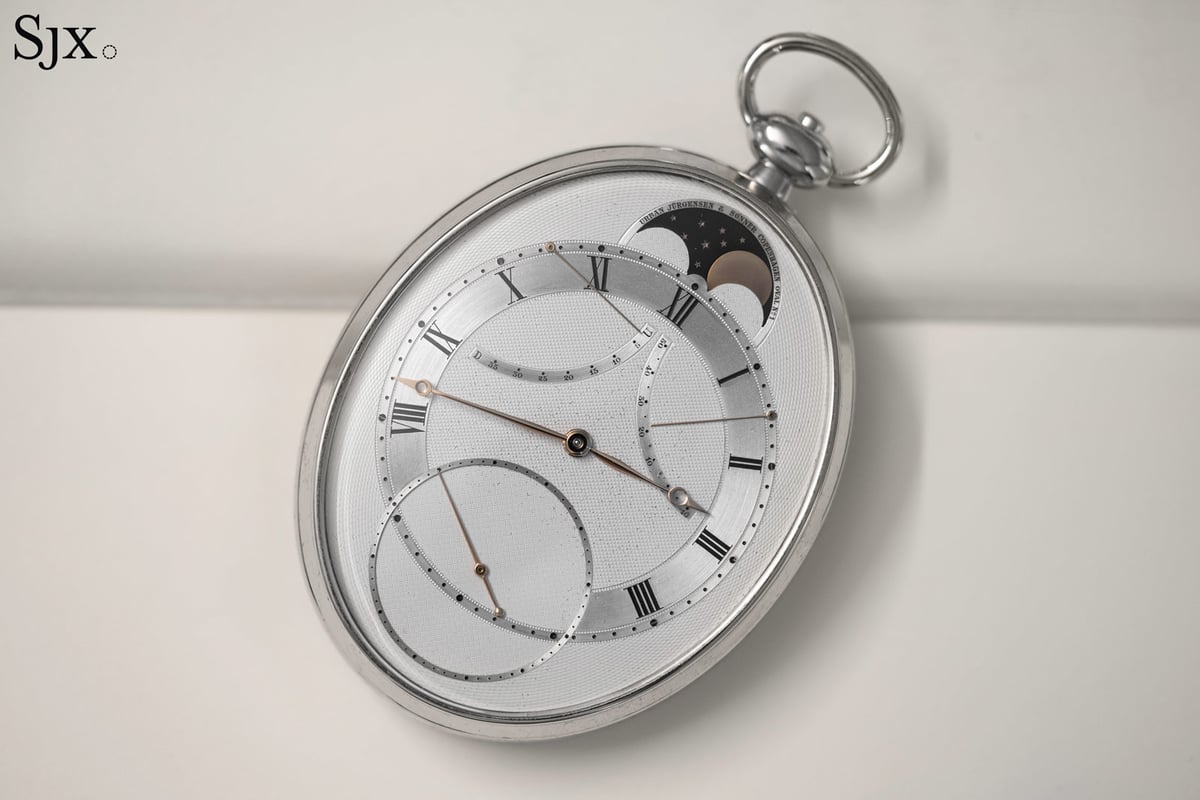
An oval pocket watch is an awkward and beautiful proposition. The circle is the natural geometry of horology: barrel, balance, gear train and mainplate all want to be round, and a round case asks nothing of them. An oval case asks a great deal. The dial has to be laid out on an eccentric canvas without looking unbalanced. The case has to be drawn so that the eye reads an ellipse while the hand reads a disc. And the movement, unless it was made for the case, has to be mounted in a way that hides the fact that it was designed for something else entirely.
Urban Jürgensen's Oval No. 1 meets that problem head-on, and it does so from a house whose name is older than almost any in Switzerland. It is finished to a standard collectors normally associate with watches at several times the price, and by every practical measure it is an anachronism. That last quality is not a defect. It is the entire argument.
Why an oval at all?
Oval cases are not a modern conceit. They turn up throughout the history of the portable watch — in French and Swiss work of the eighteenth and nineteenth centuries, and again in the early twentieth, when thin oval and rectangular dress watches were produced in some numbers by the better Geneva houses. The form was never the mainstream, because the mainstream was always governed by the movement, and the movement was always round. The oval was what a client asked for when the client was paying for something that was not the mainstream: a watch to wear with evening dress, or to give as a gift, or to match the shape of a snuff box or a locket.
That history is worth holding in mind when you handle the Oval No. 1, because it explains why the watch feels like a survival rather than a novelty. It is not a round watch that has been stretched. It belongs to a tradition that has been continuous, if quiet, for two and a half centuries.
A house older than most of Switzerland's
The firm takes its name from Urban Jürgensen, but the workshop was founded by his father, Jürgen Jürgensen, in Copenhagen in 1773. The younger Jürgensen, born in 1776, was sent to Switzerland to learn the trade, and that education is why the name still carries weight. He worked in the orbit of Abraham-Louis Breguet, absorbed the neoclassical restraint that Breguet had made the house style of European watchmaking, and returned to Denmark to a career that ran watchmaking and astronomy in parallel. He was appointed watchmaker to the Danish court in the early nineteenth century, and in Scandinavia his name became shorthand for precision instruments as much as for watches.
What followed was the long decline that swallowed most of the great nineteenth-century houses. The name survived. In the late 1970s it was acquired by Peter Baumberger, a Swiss dealer and collector with an unusually good eye and an unusually long patience, and Baumberger's decision to pair the name with Derek Pratt is the single event that makes the modern Urban Jürgensen worth writing about. Pratt was one of the finest movement designers of the postwar era — a man who worked at the level of the escapement rather than the dial — and for Urban Jürgensen he built a tourbillon and a constant-force escapement of real originality. Both men have since died, and the brand has passed through more than one set of owners, but the standard they set still governs how the current catalogue is judged: hand-finishing first, marketing a distant second.
The movement
Urban Jürgensen does not publish a full technical dossier for the Oval No. 1, and this review will not invent one. Where a figure is not in the public record, it is left blank rather than estimated. What follows is what can be said honestly about the watch and the tradition it belongs to.
It is a hand-wound movement, which is what the format demands: a pocket watch that has to be turned over and wound once a day is a pocket watch that keeps its owner in the ritual. It is time-only. There is no date, no second time zone, no chronograph, nothing to compete with the dial. The seconds are separated from the hour and minute hands in the traditional pocket-watch manner, which is both a practical decision — a large subsidiary register reads better at arm's length — and an aesthetic one.
The finishing is where the watch earns its place. Urban Jürgensen's house standard is not decorative in the modern sense; it is not applied so that a photograph will look impressive. It is applied because the parts were made to be looked at by the person who will one day service them. Bridges are anglé by hand, the bevel drawn out until it is wide enough to carry light along its whole length and flat enough that the polished surface reads as a single plane rather than a series of facets. Screw heads are polished on a tin block. Steel components are black-polished, the hardest of the traditional finishes: a black-polished surface has to be flat to within a few microns, because every error shows under a loupe. Wheels are crossed out and the crossings chamfered. Under magnification the result looks like nineteenth-century bench work rather than a modern industrial product, and that is the highest compliment available in this trade.
The architecture follows the same logic. A pocket-watch movement has room that a wristwatch movement does not, and the best of them spend that room on a large, slow-beating balance and a visible gear train rather than on complication. Size buys stability and it buys legibility. It also buys the movement maker the space to finish properly, because a large bridge is a large canvas.
Case and dial
The oval case is the reason the watch exists. Drawing an ellipse that reads as an ellipse and not as a squashed circle is a matter of proportion — the ratio between the major and minor axes has to be chosen so the eye does not try to correct it — and then of the bezel, the case band and the bow all agreeing with that proportion. Urban Jürgensen's oval pieces are executed in precious metal, and the case work is polished and satin-finished by hand, with the transitions between the two surfaces kept crisp. The crown sits at the top of the case, where a pocket watch's crown belongs, and the bow is shaped to take a chain without looking like an afterthought.
Dial making is the other half of the problem. Urban Jürgensen's signature is grenage, a frosted silver finish produced by hand-treating the metal so that it takes on a fine, granular, almost chalky texture. It is a finish that photographs badly and looks extraordinary in the hand, because it changes as light moves across it. On a round dial, grenage is difficult. On an oval dial it is harder still, because the texture has to stay even across a surface whose curvature is not constant. The numerals and hands are the other place where the house shows its hand: indices that are applied or printed with precision, faceted and polished, and hands that are drawn rather than stamped.
None of this is visible in a thumbnail. All of it is visible at three times magnification.
What it is like to carry
A pocket watch does not have wrist presence, so the vocabulary has to change. What the Oval No. 1 has is pocket presence: the weight of it settling against the hip, the slight forward pull of the chain, and the way a well-drawn oval sits flatter in a waistcoat pocket than a round watch of the same mass, because there is less depth at the edges. An oval also orients itself in the palm in a way a circle does not — it does not roll, and it presents the dial to the eye without being turned.
The ritual is the other half of the experience. You wind it in the morning. You feel the mainspring take up through the crown and you know, without a power-reserve indicator, roughly where you are. You check the time by taking the watch out rather than by turning your wrist, which means checking the time becomes a deliberate act rather than a tic. Owners of pocket watches consistently describe this as the thing they did not expect to enjoy, and it is the strongest argument for the format.
Accuracy
Urban Jürgensen does not publish a rate specification for the Oval No. 1, so there is no figure to quote and no certification to point at. What you should expect from a hand-regulated, hand-finished pocket watch at this level is stability rather than a headline number. A well-adjusted movement of this type will typically hold a consistent daily rate across positions, and the pocket is a kind environment: a watch carried in a waistcoat sits in roughly the same orientation all day, which removes much of the positional variation that makes wristwatch timing so variable.
The practical advice is the same as for any fine mechanical watch. Carry it for a week, note the deviation against a reference at the same time each day, and expect the rate to settle. If it drifts, a competent watchmaker can regulate it; if it is out by more than a few seconds a day, it wants regulating rather than a service.
Occasions
Formal and dress occasions are the obvious territory: a black-tie dinner, a wedding, a board meeting in a room old enough to appreciate the gesture. But the honest answer is broader. A pocket watch is at its best with tailoring — a jacket with a proper pocket — and that covers more of a well-dressed person's week than most people assume. It is not a sports watch and it is not a watch for a t-shirt. It is also, quietly, an excellent travelling companion: no second time zone, but no strap to wear out and nothing to catch on a tray table.
Value, service and the secondary market
Urban Jürgensen does not publish a price for the Oval No. 1, and the secondary market for the reference is too thin to draw a curve through. This is not a criticism; it is a description of a very small market. The brand's modern wristwatches have generally traded below retail at auction, which tells you that the Urban Jürgensen name does not carry the speculative premium of a handful of louder independents. An oval pocket watch is a different proposition again: production is tiny, comparables are scarce, and the price is set by what one determined buyer is willing to pay rather than by an index.
Service is the practical question, and it matters more than resale. A hand-finished movement should be serviced by someone who understands hand-finishing, because a careless polisher can destroy an anglage in an afternoon. The maker's own service network is the safest route; failing that, an independent with a serious finishing bench. Expect a long turnaround and a bill that reflects the labour involved rather than the parts.
Buying one
Because the reference is made in small numbers and documented lightly, condition matters more than usual. Ask for the service history, ask who finished the movement last, and look at the anglage under a loupe before you look at the dial — an over-polished bevel is the first sign that someone has been at the movement with a buffing wheel. Check that the case has not been refinished to soften the transition between polished and satin surfaces, since that transition is the hardest thing to restore. And check the bow and the chain attachment points, which take wear that a wristwatch case never sees.
If the watch comes with its original presentation and paperwork, that is worth having, though on a piece this rare the object itself is the provenance.
Alternatives
There is no direct competitor, which is part of the appeal. The nearest analogues are bespoke: Vacheron Constantin's Les Cabinotiers programme, which will build a one-off pocket watch to order; the pocket watches Breguet still produces in the classical idiom; and the unique pieces that come out of small independent ateliers such as Kari Voutilainen's. Below that, the vintage market offers oval-cased pocket watches from the 1910s and 1920s at a fraction of the money — different finishing, different condition risk, but the same geometry and much of the same pleasure.
Verdict
The Oval No. 1 is not a rational purchase and it is not trying to be. It is a hand-finished, hand-wound, time-only pocket watch in a case shape that almost nobody makes any more, from a house whose history runs back to 1773 and whose modern reputation rests on the fact that it finishes its movements better than it needs to. If you wear tailoring and you want the thing you carry to be the most considered object on your person, there is very little else. If you want a watch you can check without thinking about it, this is not for you — and it would be a poor review that pretended otherwise.