Urban Jürgensen Reference 1 – A Timeless Triple‑Calendar Chronograph
The Urban Jürgensen Reference 1 occupies a singular place in the annals of modern horology.
By Vivir··Updated
# Urban Jürgensen Reference 1 – A Timeless Triple‑Calendar Chronograph
The Urban Jürgensen Reference 1 occupies a singular place in the annals of modern horology. Conceived in the early 1980s, it married the daring spirit of the quartz‑crisis era with a reverence for classic watchmaking that would later become the hallmark of the brand’s renaissance. With only a handful of pieces ever produced, the Reference 1 is both a collector’s artifact and a living example of how a single model can influence a house’s identity for decades to come.
---
## Heritage — the model's place in the brand's line and its launch context
Urban Jürgensen’s modern story began long after the original Danish workshop ceased operations in the early 20th century. The brand was resurrected in the 1980s by a group of enthusiasts who wanted to revive the name with a blend of historic aesthetics and contemporary engineering. The Reference 1 was the very first wristwatch model to emerge from this effort, with production kicking off in **1982**—three years before the company formally announced its relaunch in **1985**.
At a time when most manufacturers were either abandoning mechanical complications or racing to perfect quartz accuracy, Urban Jürgensen chose a different path. The Reference 1 was built on the **Zenith El Primero** platform, specifically an **automatic calibre 3019 PHC** that had been refined for the brand’s purposes. This decision placed the watch among the very few automatic chronographs available in the early 1980s, positioning it as a “quality automatic chronograph in town,” as contemporary accounts described it.
The model’s limited run—**186 examples in yellow gold and 15 in platinum** between 1982 and 1986—underscored its exclusivity. Its creation pre‑dated the brand’s official launch, making it a prototype of the design language and technical ambition that would later define Urban Jürgensen’s revival under the stewardship of Peter Baumberger and the artistic direction of Derek Pratt. In many ways, the Reference 1 can be seen as the seed from which the modern house grew, a tangible proof of concept that “the watch itself has the feeling of two friends fueled by obsession and passion,” according to one admirer.
---
## Design & Case — case dimensions, materials, dial
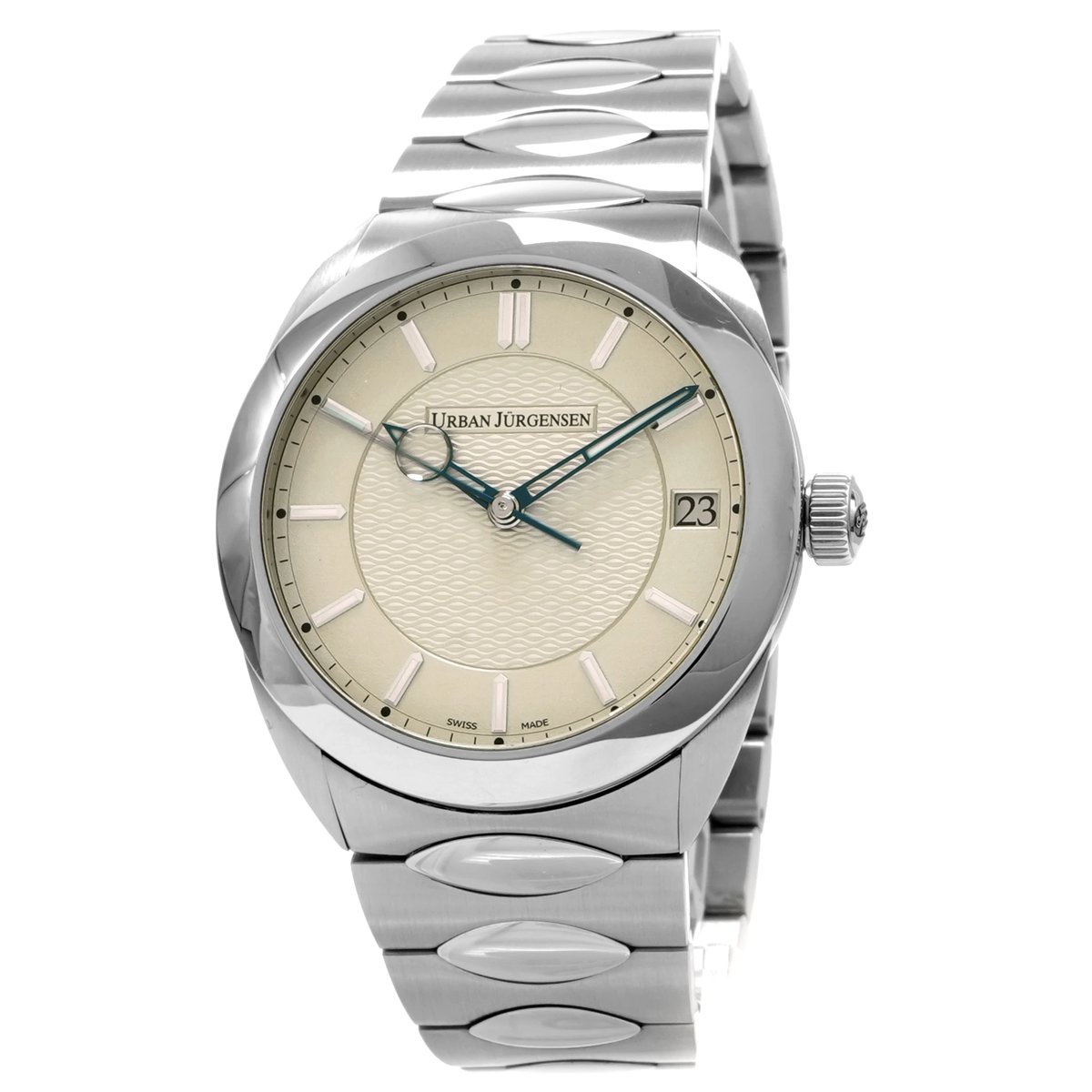
The Reference 1’s case measures **39 mm** in diameter, a size that feels both substantial and wearable today. Its proportions echo the classic dress‑watch silhouette, yet the watch carries a subtle “vintage‑chronometer” (VC)‑looking bezel volume that hints at its chronographic function without overwhelming the overall elegance.
The case is forged from **yellow gold** in the majority of examples, with a very rare platinum version that adds a different hue to the already luxurious presentation. The lugs are a distinctive **teardrop shape**, soldered directly to the case—a nod to historic construction methods that also contributes to a smooth transition onto the wrist. This design choice, paired with the modest bezel, gives the watch a timeless profile that does not chase trends.
Inside, the dial is a work of art. Derek Pratt, the watch’s designer, executed an **engine‑turned guilloché pattern** that catches light in a way that feels both handcrafted and meticulously engineered. The dial’s texture is complemented by clean hour markers and the necessary sub‑dials for the chronograph, triple calendar, and moon‑phase displays. While the source does not detail the hands’ material, the overall aesthetic is deliberately restrained, allowing the dial’s pattern to remain the visual centerpiece.
The watch’s crystal is referenced only generically as “crystal,” with no specification of sapphire or other material, which aligns with the source’s cautious approach to this detail.
---
## Movement & Performance — calibre, power reserve, accuracy
At the heart of the Reference 1 lies the **automatic calibre 3019 PHC**, a refined iteration of Zenith’s legendary **El Primero**. This movement was the only quality automatic chronograph available at the time, and Urban Jürgensen’s choice to base its flagship on it was both pragmatic and visionary. The calibre inherits the El Primero’s high beat rate, which translates into smooth chronograph hand movement and reliable timekeeping.
The movement is fully automatic, self‑winding through a rotor that captures kinetic energy from the wearer’s motion. While the source does not disclose a precise power reserve figure, the calibre’s heritage suggests a respectable reserve typical of El Primero‑derived movements. The watch’s finishing is described as “well” executed, indicating a level of hand‑polishing and decoration that matches the brand’s emphasis on elegance.
Functionally, the Reference 1 offers a **triple‑calendar** (day, date, month) alongside a **chronograph** and a **moon‑phase** complication. The integration of these features into a single movement was a technical achievement for the early 1980s, especially given the limited space within a 39 mm case. The moon‑phase adds a poetic touch, displaying the lunar cycle with a level of detail that appeals to collectors who appreciate both utility and symbolism.
No mention is made of a column‑wheel chronograph mechanism or the specifics of the date‑change system, so the review remains neutral on those technical aspects, focusing instead on the confirmed capabilities of the movement.
---
## On the Wrist — wearability, lug‑to‑lug, comfort notes
Wearing the Reference 1 feels like slipping into a piece of history that has been carefully refined for modern use. The **39 mm** case sits comfortably between the larger sport watches of today and the smaller vintage dress pieces, making it a versatile size for most wrist dimensions. The teardrop lugs, soldered rather than screwed, create a seamless flow from case to strap, reducing the chance of snagging and providing a slightly softer feel against the skin.
The watch’s weight is noticeable but not oppressive—gold adds a pleasant heft that signals quality without causing fatigue during extended wear. The crystal, while unspecified, contributes to a smooth surface that sits flush with the case, minimizing pressure points.
Because the dial is relatively busy—housing chronograph sub‑dials, calendar windows, and a moon‑phase aperture—readability under bright light can be a modest challenge. However, the guilloché pattern adds depth that helps the hands and indicators stand out, especially when paired with a well‑contrasted strap.
Overall, the Reference 1 offers a comfortable on‑the‑wrist experience that balances presence with wearability. Its classic dimensions and ergonomic lug design make it suitable for both formal and semi‑formal settings, though the weight and visual complexity may feel out of place in highly active or athletic contexts.
---
## When to Wear — occasion, setting and dress‑code fit
The Reference 1 is unmistakably a **dress‑oriented chronograph**. Its gold case, elegant guilloché dial, and refined proportions make it a natural companion for black‑tie events, gala dinners, or any occasion where a touch of luxury is expected. The presence of a chronograph and calendar adds functional depth, allowing the wearer to keep track of time, appointments, and lunar phases without sacrificing style.
In a business setting, the watch can transition smoothly from boardroom to after‑hours dinner, provided the wearer pairs it with a classic leather strap rather than a sporty rubber band. Its understated bezel and classic lugs keep the look refined rather than ostentatious.
Because the watch is a limited‑edition collector’s piece, some might hesitate to wear it daily. However, the durability of the movement and the robust construction of the case suggest it can handle regular use, as long as the wearer respects its mechanical nature (e.g., avoiding strong shocks). For those who cherish the romance of a moon‑phase, the Reference 1 becomes a conversation starter at cultural events, art openings, or watch‑focused gatherings.
In short, the Reference 1 shines brightest in **formal and semi‑formal environments**, where its elegance can be fully appreciated, while still being adaptable enough for everyday wear for those who wish to showcase a piece of horological history on a regular basis.
---
## Value & Verdict — price‑positioning + final take
When it first entered the market, the Reference 1 commanded a price reflective of its limited production and high‑grade materials. Today, the **original retail price was listed at USD 58,000**, a figure that places the watch firmly in the upper‑tier luxury segment. Considering the watch’s rarity—only 186 gold pieces and 15 platinum examples were ever made—its market value on the secondary market often exceeds the original price, especially for the platinum version.
From a value perspective, the Reference 1 offers more than just a time‑telling instrument. It represents a pivotal moment in Urban Jürgensen’s history, a technical triumph in the early 1980s, and a showcase of Derek Pratt’s artistic vision. For collectors who prioritize provenance, rarity, and the story behind a piece, the watch delivers strong justification for its price.
That said, the high cost may be a barrier for many enthusiasts. The watch does not incorporate modern conveniences such as a transparent case back with a view of the movement, a sapphire crystal (the type is unspecified), or contemporary anti‑magnetic features. Its design, while timeless, leans heavily on classic aesthetics that may not appeal to those seeking a more avant‑garde or sport‑oriented chronograph.
**Verdict:** The Urban Jürgensen Reference 1 stands as a **pinnacle of elegance** and a testament to the brand’s early ambition. Its combination of an El Primero‑based automatic chronograph, triple‑calendar, and moon‑phase within a 39 mm gold case is a rare achievement that continues to influence the brand’s later models. For collectors who value historical significance, limited‑edition rarity, and a watch that bridges the gap between classic dress aesthetics and functional complications, the Reference 1 is a compelling, albeit pricey, acquisition. For the broader market, the price point and niche appeal may limit its accessibility, but those who can afford it will own a piece of horological heritage that still feels fresh and relevant nearly four decades after its debut.