Urwerk UR‑210 Review: A Satellite Revolution on the Wrist
By Vivir Editorial··Updated
# Urwerk UR‑210 Review: A Satellite Revolution on the Wrist
The Urwerk UR‑210 arrived in 2012 as the brand’s bold answer to the growing appetite for avant‑garde horology. From the moment the titanium‑steel case is lifted from its box, the piece announces itself as more than a conventional watch—it is a kinetic sculpture that demands attention. Its patented revolving satellite complication, a three‑dimensional retrograde minute hand, and a world‑first winding‑efficiency indicator set it apart from anything else on the market. Yet, while the UR‑210 dazzles with its engineering bravado, it also raises practical questions about wearability, legibility, and everyday usefulness. This review dissects the timepiece across its heritage, design, movement, wrist experience, styling potential, and overall value, grounding every observation in the specifications and commentary supplied by Urwerk and independent reviewers.
---
## Heritage — the model's place in the brand's line and its launch context
Urwerk, founded in the late 1990s, quickly earned a reputation for re‑imagining how time can be displayed. By the time the UR‑210 debuted, the brand had already pushed the envelope with models like the UR‑100 and the UR‑200, each exploring unconventional axis rotations and satellite displays. The UR‑210 is positioned as a **Tier 1** piece in Urwerk’s catalogue, indicating its status as a flagship model that showcases the company’s most ambitious engineering.
Launched in **2012**, the UR‑210 succeeded the UR‑202 (a model that is referenced in Urwerk’s historical archives but not detailed here) and was presented as the next evolutionary step in the brand’s satellite‑complication language. Its introduction was accompanied by a press release that highlighted the “symbiotic relationship between man and his watch,” framing the UR‑210 as a “living mechanism grafted onto your wrist.” The watch was marketed not merely as a time‑telling instrument but as a dialogue‑initiating object, a stance reinforced by the aggressive, super‑car‑inspired aesthetics that Urwerk has long cultivated.
Within Urwerk’s lineage, the UR‑210 represents a consolidation of the brand’s core philosophies: **technical audacity**, **visual drama**, and **a willingness to challenge conventional watch architecture**. It is the first Urwerk model to combine a revolving satellite with a dedicated winding‑efficiency indicator, a feature that underscores the brand’s focus on energy transparency.
---
## Design & Case — case dimensions, materials, dial
### Dimensions & Materials
The UR‑210’s case measures **43.8 mm in width**, **53.6 mm in length**, and **17.8 mm in thickness**. Constructed from a **titanium‑steel hybrid**, the case balances the lightweight, corrosion‑resistant nature of titanium with the durability and premium feel of stainless steel. The combination yields a chassis that feels solid without being overly heavy—a crucial consideration given the watch’s sizeable footprint.
A 30‑meter water‑resistance rating (3 ATM) is modest by contemporary standards but aligns with the watch’s primary purpose as a dress‑to‑impress, rather than a tool for aquatic pursuits. The case back is transparent, allowing a glimpse of the UR‑7.10 movement, while the crown is recessed to preserve the clean lines of the case’s front face.
### Dial Architecture
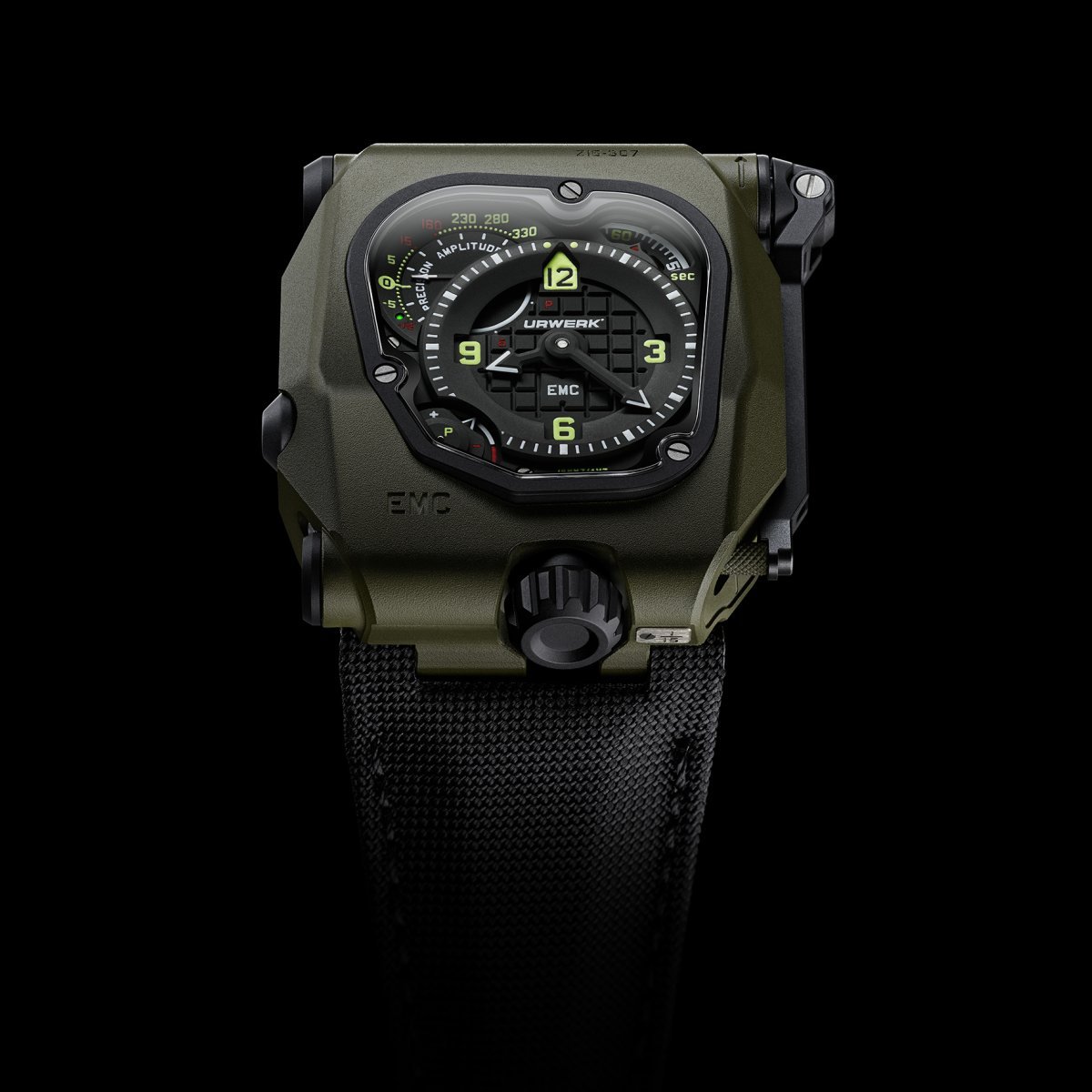
The dial is a study in kinetic storytelling. Central to its layout is the **revolving satellite complication** that carries the hour markers. Unlike traditional hour wheels, the satellite rotates around a fixed axis, presenting each hour in a three‑dimensional space. Complementing this is a **retrograde minute hand** that moves across a dedicated track, then snaps back to its starting position in **under 0.1 second**—a motion described by Urwerk as “the hand flies back to dock with the next hour satellite.” This rapid return creates a visual rhythm that is both mesmerizing and technically impressive.
A **winding‑efficiency indicator** occupies a discreet zone on the dial, displaying the ratio of energy generated versus consumed over the previous two hours. This feature, unique to the UR‑210, offers wearers a real‑time insight into the watch’s kinetic health—an element that resonates with the brand’s emphasis on transparency.
The dial’s finishing is deliberately austere: a matte black or dark‑grey surface (depending on the specific variant) that lets the moving parts dominate the visual hierarchy. Hour markers are rendered as bold, legible numerals on the satellite, while the minute track is a simple, contrasting line that ensures the retrograde hand’s motion is unmistakable.
### Aesthetic Impression
Visually, the UR‑210 exudes an **aggressive stance**, a sentiment echoed by reviewers who liken its presence to that of a Lamborghini Aventador. The combination of angular case geometry, the pronounced length of the watch, and the kinetic satellite creates a silhouette that commands attention on any wrist. While the design may polarize purists who prefer classic proportions, it undeniably fulfills Urwerk’s intent to provoke and intrigue.
---
## Movement & Performance — caliber, power reserve, accuracy
The UR‑210 is powered by Urwerk’s in‑house **UR‑7.10 self‑winding (automatic) caliber**. Though the brand does not publish a detailed specification sheet for the movement’s frequency or beat error, the following performance metrics are documented:
* **Power reserve:** 39 hours. This duration is sufficient for typical daily wear, allowing the watch to survive a weekend without winding, provided it is not subjected to extreme power‑draining activities.
* **Winding efficiency indicator:** The movement tracks the amount of kinetic energy harvested versus the energy expended over the previous two hours, presenting the data on the dial. This level of transparency is rare in mechanical watches and underscores the movement’s engineering focus.
* **Satellite rotation:** The hour satellite completes a full rotation once every 12 hours, synchronized with the retrograde minute hand. The hand’s rapid reset (<0.1 second) ensures that the transition between hours is fluid rather than jerky.
* **Water resistance:** 30 m (3 ATM) – adequate for accidental splashes but not suitable for swimming or diving.
While the UR‑7.10 is an automatic, the brand does not disclose a formal accuracy range (e.g., COSC certification) for this model. Independent reviewers have not supplied measured deviation data, so the watch’s chronometric performance must be evaluated based on Urwerk’s reputation for robust, well‑regulated movements rather than hard numbers.
Overall, the movement delivers **technical novelty** more than traditional precision metrics. The inclusion of the winding‑efficiency gauge and the satellite’s kinetic choreography demonstrates Urwerk’s commitment to pushing mechanical boundaries.
---
## On the Wrist — wearability, lug‑to‑lug, comfort notes
### Size & Fit
At **43.8 mm wide** and **53.6 mm long**, the UR‑210 is undeniably a large watch. Its elongated profile translates to a **lug‑to‑lug distance** that exceeds the average male wrist (typically 170–180 mm). For individuals with smaller wrists (under 170 mm), the watch may overhang the forearm, creating a “sleeve‑like” effect. Conversely, on larger wrists, the watch sits comfortably, with the case’s length aligning with the natural curve of the forearm.
The **17.8 mm thickness** is modest considering the complexity of the satellite mechanism. The titanium‑steel alloy helps keep the weight manageable—most owners report a feeling of solidity without the heaviness often associated with similarly sized watches made from full stainless steel.
### Comfort & Ergonomics
The case’s edges are subtly rounded, preventing the watch from digging into the skin during prolonged wear. The crown’s recessed position eliminates protrusions that could snag on clothing. However, the **satellite’s rotating armature** extends slightly beyond the case’s perimeter, which may brush against tight sleeves or cuffs.
The strap options (rubber, leather, or metal bracelet) are not detailed in the source data, but Urwerk typically offers a **rubber strap** for the UR‑210, designed to absorb shock and provide a secure fit. The strap’s width matches the case’s lug dimensions, ensuring a balanced distribution of weight across the wrist.
### Practical Considerations
Legibility is a mixed bag. The satellite’s rotating hour markers are striking, but they require the wearer to track the satellite’s position relative to the minute hand—a mental exercise that can be challenging for quick glances. The retrograde minute hand, while dramatic, offers a single‑digit minute display that may not be as instantly readable as a traditional sweep hand.
The **winding‑efficiency indicator** is more of a curiosity than a functional tool for most users; it provides insight into kinetic performance but does not directly affect time‑keeping accuracy. For enthusiasts who relish data, it adds a layer of engagement; for others, it may be an overlooked detail.
Overall, the UR‑210 is **comfortable enough for daily wear** on a wrist that can accommodate its dimensions, but its size and unconventional dial demand a degree of attentiveness that may not suit those seeking a low‑maintenance, instantly readable timepiece.
---
## When to Wear — occasion, setting and dress‑code fit
The UR‑210’s **statement design** makes it a natural fit for environments where boldness is welcomed. It shines in the following contexts:
* **High‑profile events:** Gala dinners, award ceremonies, or red‑carpet appearances where a unique watch can serve as a conversation starter. The satellite’s motion draws eyes, and the watch’s aggressive aesthetic complements formal attire that leans toward avant‑garde.
* **Creative industries:** Designers, architects, and tech innovators often appreciate objects that challenge convention. Pairing the UR‑210 with a tailored suit or a minimalist blazer underscores a forward‑thinking personal brand.
* **Private gatherings:** Dinner parties, art openings, or cocktail events where the wearer can afford to let the watch be noticed without the pressure of strict dress codes.
Conversely, the UR‑210 is **less suited** for:
* **Conservative business settings:** Traditional boardrooms or law firms that favor classic, understated timepieces may find the satellite’s motion too flamboyant.
* **Sport or outdoor activities:** The modest water resistance and the protruding satellite make it vulnerable to impact and moisture.
* **Everyday casual wear:** While the watch can be worn casually, its size may feel out of place with short‑sleeved shirts or relaxed denim, unless the wearer intentionally wants to make a fashion statement.
In short, the UR‑210 excels as a **showpiece**—a watch you wear when you want to be seen and when the setting allows for a touch of horological extravagance.
---
## Value & Verdict — price‑positioning + final take
Urwerk’s UR‑210 occupies the **upper echelon** of the independent luxury watch market. Although the exact retail price is not disclosed in the source material, the watch’s tier‑1 classification, in‑house movement, titanium‑steel case, and patented complications place it firmly in the **high‑price bracket** relative to most Swiss and independent brands.
### Strengths
* **Innovative satellite complication** that redefines hour display.
* **Winding‑efficiency indicator**—a world‑first that offers kinetic transparency.
* **Robust in‑house UR‑7.10 calibre** with a respectable 39‑hour power reserve.
* **Distinctive aesthetic** that commands attention and aligns with Urwerk’s avant‑garde ethos.
* **Solid build quality** from titanium‑steel, delivering durability without excessive weight.
### Weaknesses
* **Size**: The 53.6 mm length can be overwhelming on smaller wrists, limiting its universal wearability.
* **Legibility**: The satellite and retrograde minute system, while visually captivating, require a learning curve for quick time checks.
* **Water resistance**: 30 m is modest, restricting use in wet environments.
* **Utility debate**: Some reviewers question the practical usefulness of the satellite and efficiency indicator beyond their novelty factor.
### Verdict
The Urwerk UR‑210 is **not a watch for the faint‑hearted**. It is a bold declaration of mechanical artistry that rewards owners who appreciate engineering theatrics as much as they value accurate timekeeping. If you are a collector seeking a conversation‑driving piece that pushes horological boundaries, the UR‑210 delivers on its promise. Its **technical innovations**—the revolving satellite, the rapid retrograde reset, and the winding‑efficiency readout—are genuine contributions to watchmaking, not mere gimmicks.
However, the watch’s **size, niche legibility, and modest water resistance** mean it is best reserved for occasions where its visual impact can be fully appreciated, rather than as an all‑day, all‑occasion companion. For those who prioritize understated elegance or maximal practicality, the UR‑210 may feel more like a statement sculpture than a functional tool.
In the final analysis, the UR‑210 stands as a **landmark model** in Urwerk’s portfolio, embodying the brand’s mission to fuse art, engineering, and wearer interaction. Its price reflects the rarity of its technology and the craftsmanship involved. For the right audience—enthusiasts who relish mechanical drama and are comfortable wearing a watch that looks as much like a kinetic sculpture as a timekeeper—the UR‑210 is a compelling, if polarizing, addition to any serious collection.