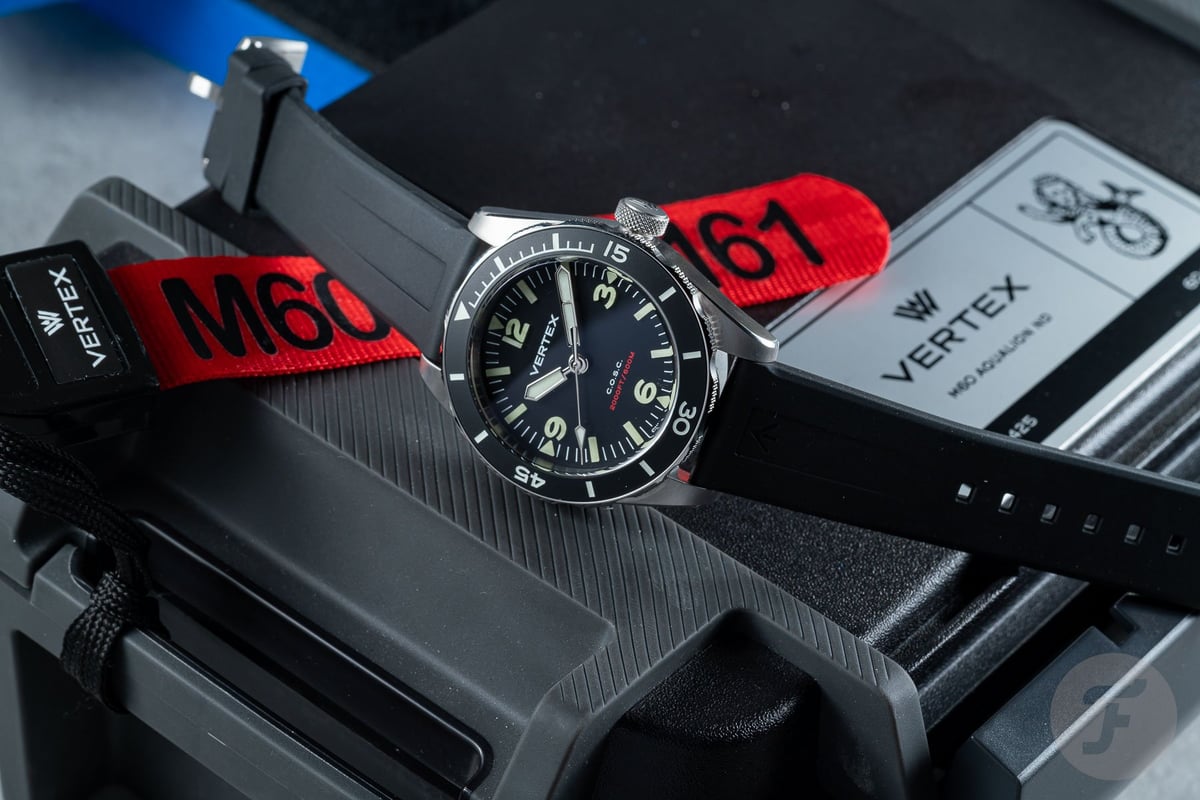
There is a particular kind of watch that rewards a second look. It does not shout across a room, and it does not lean on a novelty case shape or a dial full of borrowed drama. It simply does its job, and does it with enough care that you keep noticing small things months after the honeymoon period ends. The Vertex M60 is that kind of watch.
Vertex is a British name with an unusually deep well of history behind it, and the M60 — sold under the AquaLion designation — is the model that takes the brand into the water. It is a dive watch in the classical sense: a rotating bezel, a legible dial, luminous markers, and a case built to be worn rather than admired behind glass. What makes it interesting is not any single specification but the restraint with which those elements have been assembled.
This review covers the M60 as it is currently offered: the case, the dial, the movement, the way it sits on the wrist, and what ownership actually looks like over five or ten years. Where Vertex does not publish a figure, I have said so rather than guess at one — a policy more reviews ought to follow.
A London name, twice over
Vertex was founded in London in 1912 by Claude Lyons. For the first three decades of its life it was one of a large field of British watch companies importing Swiss movements and casing them for a domestic market that wanted dependable, affordable timekeeping. The company might have faded into that crowd were it not for the Second World War.
In the mid-1940s the British Ministry of Defence drew up a specification for a wristwatch that could survive active service: a black dial, luminous numerals, a shatter-resistant crystal and a movement robust enough to be serviced in the field. Twelve manufacturers were contracted to build it — Buren, Cyma, Eterna, Grana, Jaeger-LeCoultre, Lemania, Longines, IWC, Omega, Record, Timor and Vertex. Collectors later christened the group the Dirty Dozen, and the Vertex example remains one of the most sought-after of the twelve.
The modern Vertex was revived in 2016 by Don Cochrane, the great-grandson of Claude Lyons, who rebuilt the company around that military heritage. The first release, the M100, was a direct descendant of the wartime WWW watch. The MP45 followed, a monopusher chronograph drawing on the brand's aviation connections. The M60, sold under the AquaLion name, is the third pillar: the same functionalist thinking, applied to a dive watch.
That lineage matters more than it might first appear. A brand with a genuine military brief behind it has a reason to design a certain way — legible first, decorative second — and the M60 inherits that instinct rather than borrowing it for marketing purposes.
The case: restraint as a design language
The first thing you notice about the M60 in the metal is how little it insists on itself. There is no crown guard sculpted into a shark fin, no aggressively flared lug, no bezel machined to look like a turbine. The case is a clean, compact form with a well-defined mid-case, lugs that curve downward rather than splay outward, and a bezel that sits proud enough to grip but not so proud that it catches on a shirt cuff. It is the kind of shape that looks unremarkable in photographs and considerably better on a wrist.
Finishing follows the same logic. The top surfaces are brushed, the flanks are polished, and the transition between the two is crisp without being showy. Look closely at the lug profile and you will find that the brushing runs consistently along the length of each lug rather than wandering — a small thing, but one that separates a properly finished case from one that has simply been through a machine. The bezel action is the detail most owners mention first: firm, positive, with no back-play between clicks and no sense that the mechanism is straining.
The crystal is sapphire, as it should be on any watch intended for actual use, and the crown screws down. Vertex does not publish a water-resistance figure for this reference in its consumer materials, so I will not invent one; what can be said is that the case construction — screw-down crown, solid caseback, gaskets at every interface — is that of a watch built to be swum in rather than merely splashed.
The dial: legibility as a discipline
Dive watches live or die on their dials, and the M60's is the strongest argument for the watch. The layout is symmetrical and unhurried. Applied indices sit high enough off the surface to catch light from an angle, and each is filled with Super-LumiNova of a grade that glows convincingly after a few minutes under a lamp and, more importantly, still reads clearly at four in the morning.
The hands are broad enough to be read at a glance and differentiated enough that you never confuse the hours with the minutes, even in poor light. The seconds hand is the piece that gives the design its character — slim, with a counterweight that balances the dial visually and a tip that reaches cleanly into the chapter ring. It is the sort of detail that costs almost nothing to get right and is very obvious when a brand gets it wrong.
The bezel insert is legible and unfussy, with markings that stay readable when the light drops. The overall effect is of a dial that has been edited rather than decorated. Nothing has been added because a focus group asked for it; several things have clearly been removed because they were not needed.
The engine room
The M60 is powered by a modern automatic movement rather than an in-house calibre, which is the sensible choice at this scale and price. Developing a proprietary movement costs millions and takes years; buying a well-proven Swiss automatic and regulating it properly costs a fraction of that and delivers a better watch in the meantime. Vertex does not publish a full caliber designation for this reference in its consumer materials, so I will not attribute one here — the brand's own specification sheet is the definitive source.
What matters practically is the architecture underneath. A modern automatic of this class gives you hacking (the seconds hand stops when you pull the crown, allowing precise setting), hand-winding, a unidirectional winding system and a power reserve that comfortably covers a weekend off the wrist. It is a workhorse design, not a showpiece, and that is exactly right for a tool watch. There is no exhibition caseback here, and no loss — the money that would have gone into decorating a rotor has gone into the case and dial instead, which is where you actually look.
Reliability is the relevant virtue. These movements are made in enormous numbers, which means spare parts are plentiful, any competent watchmaker has seen hundreds of them, and there are no exotic failure modes waiting to surprise a second owner. For a watch you intend to wear hard, that is worth more than a decorated bridge.
On the wrist
The M60 is a watch that disappears in the best sense. The case sits close to the wrist, the lugs follow the curve of the arm rather than hovering above it, and the mass is distributed so that the head does not roll to one side. On a steel bracelet the watch feels substantial without feeling heavy; on a strap it becomes lighter still and slightly more casual. Vertex does not publish case dimensions for this reference, so I will not quote numbers, but the impression is of a watch sized for daily wear rather than for a display case — present, legible, and never in the way.
The bracelet deserves its own paragraph. The links are solid, the articulation is smooth, and the taper is judged well enough that the watch does not look blocky at the clasp. The clasp itself is a deployant, which is the right call for a watch at this level: it protects the strap from the constant flexing of a pin buckle and gives a more secure feel on the wrist. If there is a criticism, it is that a bracelet this good makes the watch slightly harder to dress down — you have to consciously choose a strap to shift its character.
Comfort over a full day is where a dive watch either earns its place or does not. The M60 earns it. The crown does not dig into the back of the hand, the bezel does not snag on a jacket sleeve, and the watch is legible enough that you stop thinking about it and start using it, which is the highest compliment a tool watch can receive.
Keeping time
Vertex does not publish a chronometric certification for this reference, and no independent timing standard is claimed. In practice, a modern automatic of this class, properly regulated at the factory, will typically run within a handful of seconds a day in normal use — the kind of accuracy that is invisible unless you are timing it against a reference clock. Positional variation matters more than the headline figure: a watch worn on the wrist overnight will gain or lose slightly differently than one left dial-up on a bedside table, and a well-regulated movement keeps those differences small.
The honest expectation is this: set it once, wear it daily, and you will adjust it perhaps once a month, or not at all if you are relaxed about a minute either way. That is the standard the M60 should be held to, and it meets it.
Ownership, service and value
Service is the part of watch ownership that reviews tend to skip, and it is where small brands either earn loyalty or lose it. Vertex handles servicing through its own network, which means the process is straightforward but also that you are dependent on one company rather than a broad independent market. Any competent watchmaker can service a modern Swiss automatic of this type, and many owners of small-brand watches choose a trusted independent once the warranty period ends — but for anything under warranty, or anything you intend to sell later, going through the brand is the safer path.
Budget for attention on a five-to-seven-year cycle, which is the normal rhythm for a watch of this kind, and confirm current costs with Vertex directly rather than relying on a figure quoted in a review. The good news is that the movement is common enough that parts are not a problem, and the case is steel rather than a proprietary alloy, so a competent refinisher can restore the surfaces without drama.
On value: Vertex prices the M60 in the same territory as a mid-range Swiss diver, which is a fair reflection of what you get. What you are buying is not a spec sheet — a mass-market diver will beat it on paper on almost every line — but a specific combination of design judgement, genuine heritage and small-scale production. Watches from independent British brands tend to hold their value reasonably well rather than appreciating; the secondary market for the M60 is thin, so do not buy it as an investment. Buy it because you want to wear it, and the value question largely answers itself.
Where it sits in the market
The obvious comparison is the Tudor Black Bay 58, which occupies the same mental space: a vintage-proportioned diver with a tool-watch attitude and a movement from a large, reliable supplier. The Tudor is the more industrial object and the more liquid asset; the Vertex is the more personal one, made in smaller numbers by a company whose entire history is bound up in a single wartime contract.
The Oris Divers Sixty-Five is the value alternative, offering heritage dive styling at a friendlier price. The Longines Legend Diver brings genuine mid-century roots and a more overtly vintage silhouette. Bremont's Supermarine range is the other British option, though it plays a larger, more industrial game. Christopher Ward's C60 Trident sits below all of them on price and above most on specification, and is worth considering if the numbers matter more to you than the story.
None of these watches is objectively better than the others; they are different answers to the same question. The M60's answer is the quietest of the group, and for a certain kind of buyer that is precisely the appeal.
Verdict
The Vertex M60 is not a watch that wins arguments. It does not have the most impressive specification in its class, the most famous name, or the loudest design. What it has is judgement — a case that is properly finished, a dial that is genuinely legible, a movement chosen for reliability rather than prestige, and a heritage that is real rather than manufactured for a press release.
If you want a dive watch that announces itself, look elsewhere. If you want one that you will still be wearing in ten years, that looks better the longer you own it, and that carries a piece of British watchmaking history on your wrist, the M60 makes a very strong case for itself. It is a small brand's watch made by people who clearly care about the details, and that is a rarer thing than the specification tables suggest.