Vertex MG36 DE: first impressions
There is a category of watch that only proves itself over time: the one you forget you are wearing until somebody asks about it. The Vertex MG36 DE is aimed squarely at that slot. It comes from a brand with a legitimate claim on British military watchmaking — Vertex was one of the twelve manufacturers that supplied the Ministry of Defence with the W.W.W. (Watch, Wristlet, Waterproof) in 1945, the group collectors now call the Dirty Dozen — and it is built for people who want that history on the wrist rather than behind glass.
This is a wear-focused review. That means the questions I care about are the ones a spec sheet cannot answer: does the dial read at a glance in bad light, does the case sit still through a working day, does the strap survive a summer, and does the whole thing still feel worth wearing on day seven.
I will also be straight with you about numbers. Vertex is a small independent brand that does not publish a complete technical sheet for every reference it makes, and the MG36 DE is one of the references where the maker stays quiet on several figures. Where a specification is not confirmed for this exact reference, I have left it out rather than fill the gap with a plausible-sounding guess. What is left is what actually decides whether you enjoy owning the watch.
Vertex, briefly: 1912 to now
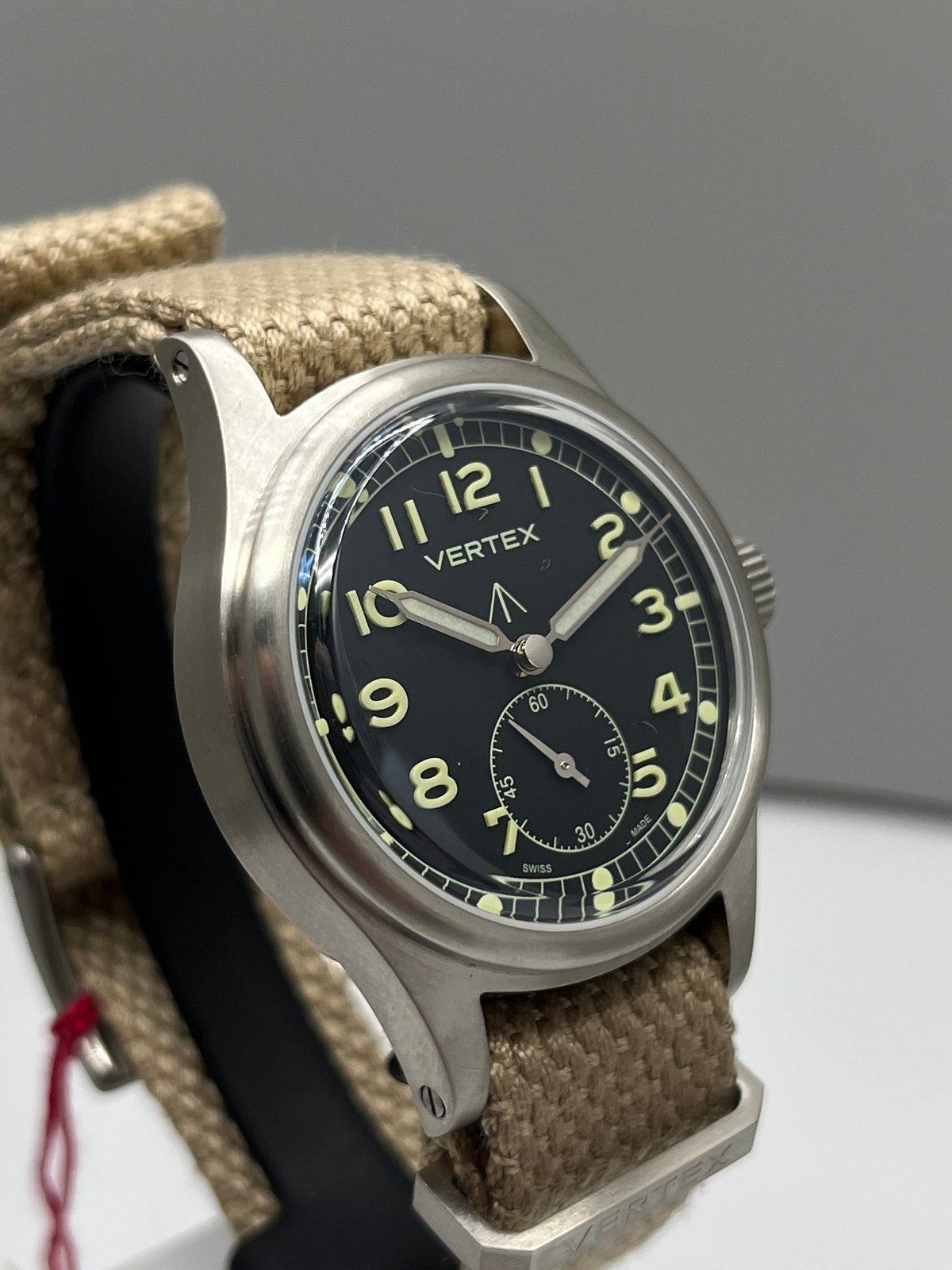
Vertex was founded in London in 1912 by Claude Lyons, which makes it older than most of the Swiss names it competed against. Its defining moment came in 1945, when the British Ministry of Defence tendered for a standard-issue wristwatch for servicemen — the W.W.W. — and Vertex was one of twelve firms contracted to deliver it. Those twelve watches are now among the most collected military timepieces of the twentieth century, and the design language they established is instantly recognisable: a black dial, white Arabic numerals, a small seconds register, and absolutely nothing on the dial that did not need to be there.
The brand went quiet for decades, as many of the Dirty Dozen did. It was relaunched in 2016 by Don Cochrane, Lyons's great-grandson, who brought the name back with Swiss-made watches built around the same legibility-first brief. That lineage matters here, because it explains almost every design decision in the MG36 DE. This is not a heritage brand trading on a logo; it is a heritage brand reinterpreting a specific, functional specification for people who are not, in fact, being issued a watch by the Ministry of Defence.
What the MG36 DE actually is
Strip away the marketing and the MG36 DE is a modern stainless-steel tool watch with a sapphire crystal, a Swiss automatic movement and a leather strap. That is a deliberately unglamorous description, and it is meant to be. The whole point of this genre is that the watch does not ask for attention; it simply works.
What separates a good example from a bad one is not the parts list — it is the ratio between the dial furniture and the dial itself, the height of the crystal above the bezel, the shape of the lugs, and whether the case has been finished with any thought at all. Those are the things you notice on day one and the things you live with on day one thousand.
Vertex does not publish case diameter, thickness, lug-to-lug or water resistance figures for this reference, and I am not going to invent them. What I can tell you is that this is the specification category where those numbers matter most, because a field watch lives or dies on proportions. If you are buying remotely, ask the brand directly, or better, find one to try on. Ten minutes on the wrist beats any table of millimetres.
The movement: what you know and what you do not
The MG36 DE runs a Swiss automatic. That much is consistent with everything Vertex has done since the relaunch, and it is the right call for a watch at this price point and this purpose. Vertex does not manufacture its own movements, and it does not pretend to. The brand also does not publish the caliber designation, power reserve or beat rate for this reference, and no chronometer certification is claimed.
Is that a problem? For a buyer who wants to compare movements on paper, yes — it makes the MG36 DE hard to slot into a spreadsheet against a Longines or a Tudor. For a buyer who wants a watch that runs, winds, hacks and keeps reasonable time for a decade, it is close to irrelevant. Swiss automatics at this level are a known quantity; the servicing infrastructure exists, parts are available, and any competent watchmaker can look after one.
What I would like to see from Vertex is more disclosure, not because the numbers would be impressive but because the silence invites suspicion where none is warranted. A small brand that publishes its specifications signals confidence. Until then, treat the movement as a means to an end rather than a reason to buy.
Case, crystal and finishing
The case is stainless steel with a sapphire crystal, which is the correct combination for a watch meant to be worn rather than preserved. Sapphire will shrug off the desk-edge scrapes that destroy acrylic and mineral crystals, and unlike acrylic it will not need polishing every few months to stay readable. On a military-inspired watch this matters more than usual, because the whole design premise is that you can read the dial instantly, in any light, without thinking about it.
Finishing on watches in this genre tends to fall into two camps: fully brushed, which is honest but flat, or a brushed-and-polished mix that adds a little life at the cost of showing scratches. Either can work. What you should look for when you handle the MG36 DE is the quality of the transitions — the line where the lug meets the case, the crispness of the bezel edge, the way the crown sits against the case flank. These are the details that separate a watch assembled with care from one assembled to a price.
The crown deserves a specific mention. On a daily-wear tool watch, the crown is the part your hand touches most often, and a crown that is too small, too sharp or too proud will annoy you every single day. It should be easy to grip, easy to pull, and quiet against the back of your hand when you bend your wrist.
Dial and legibility
This is where the Dirty Dozen DNA earns its keep. The entire logic of the 1945 W.W.W. specification was legibility under adverse conditions, and any modern watch claiming that heritage has to deliver on it. In practice that means high-contrast printing, numerals that are large enough to read at a glance, hands that are distinguishable from one another in silhouette, and lume that actually glows rather than merely existing.
Vertex specifies Super-LumiNova on this reference but does not publish which grade, so the honest advice is to test it yourself in a dark room rather than trust a specification line. What matters is whether the hands remain readable against the dial after several hours of darkness, not whether the initial glow is spectacular. A watch that is bright for twenty minutes and useless for the rest of the night has failed the brief.
Equally important is legibility in the conditions you actually encounter: a dimly lit restaurant, a car interior at dusk, a stairwell. High-contrast black-and-white dials with minimal furniture win here every time, and that is precisely the design tradition the MG36 DE inherits. If you have ever owned a watch with a beautiful sunburst dial that becomes an unreadable grey smear at 7pm, you will appreciate the discipline.
On the wrist: a week of real wear
Here is the test that no press release survives. Wear the watch for seven days straight. Do not rotate it. Wear it to work, to the gym, to dinner, to bed if you sleep in a watch. By day seven you will know things about it that no reviewer can tell you.
The first thing that emerges is whether the case has been designed for a wrist or for a photograph. A watch built for wear has a flat caseback, lugs that curve down toward the wrist rather than projecting outward, and a crown that sits low enough not to dig into the back of the hand. That combination is what makes a watch disappear — and disappearing is the highest compliment you can pay a daily wearer.
The second thing is balance. A watch head that is too heavy for its strap will rotate around the wrist and need constant repositioning; a watch that is too light feels insubstantial and gets forgotten in the wrong way. The MG36 DE is a stainless-steel watch on leather, which is the classic recipe for a well-balanced daily wearer, and leather has the advantage of conforming to your wrist over the first few weeks rather than fighting it.
The third thing is the strap, and this is where I would set expectations honestly. Leather is the right aesthetic choice for a heritage military watch — it softens an austere design and ages into something personal — but it is also the component that will fail first. Sweat, water and sunlight all attack leather, and a strap worn daily in summer will show it within a season. Budget for a replacement strap, or ask Vertex about alternative options at the point of purchase, and treat the strap as a consumable rather than a permanent fixture. The case, the crystal and the movement will all comfortably outlast several straps.
Accuracy: what to expect
With no published rate specification from Vertex, the realistic expectation for a Swiss automatic in this class is somewhere in the region of -10 to +15 seconds per day in mixed wear, with well-regulated examples performing considerably better. That range is entirely acceptable for a watch of this type, and it is worth remembering that a mechanical watch is not a quartz watch and was never meant to be.
What matters more than the raw figure is consistency. A watch that runs eight seconds fast every single day is far easier to live with than one that swings twenty seconds either way depending on how you slept and whether you left it on a windowsill. Wear it for a fortnight, note the daily deviation, and judge it on that pattern rather than on a single reading taken on a Tuesday morning.
Positional variation is normal and, usefully, exploitable. If your watch runs slightly fast during the day, resting it crown-up overnight will usually pull it back toward zero. If it runs slow, crown-down often helps. Ten seconds a day either way is a non-issue; twenty seconds of drift in both directions is worth having looked at.
Where it fits: occasions
This is a daily wearer, first and last. The design is quiet enough to sit under a shirt cuff in an office and rugged enough to survive a weekend of hiking, which is the definition of a one-watch solution. It travels well, too: a black dial with high-contrast numerals works with almost any clothing, and a leather strap reads appropriately from a business meeting to a bar.
It is not a dress watch in the formal sense — nobody is wearing a military field watch with black tie — but it is perfectly capable of handling a smart-casual dinner, and it will look considerably more at home there than a dive watch will. Think of it as the watch you reach for when you cannot be bothered to decide, which, in practice, is most days.
Ownership: service, parts and the long game
Vertex does not publish a service interval or a servicing cost for this reference, so the sensible assumption is the standard Swiss automatic cadence: a service when the watch starts behaving badly rather than on a fixed calendar. A well-made automatic will often run happily for five to ten years before it needs attention, and premature servicing is one of the more common ways owners waste money.
Because the movement is a Swiss automatic rather than an exotic in-house calibre, servicing options are broader than they would be for a boutique-only movement. Vertex handles service through its own channels, and once any warranty period has passed, a competent independent watchmaker should be able to handle routine maintenance. That flexibility is a genuine ownership advantage and one of the quiet benefits of buying a watch with a conventional heart.
The bigger ownership consideration is the brand itself. Vertex is small, independent and built around a family connection to its own history. That is charming, and it also means the company's continued health is more relevant to your long-term ownership experience than it would be with a Swatch Group brand. Buy from a brand like this with your eyes open: you are backing a small team, and in exchange you get a direct relationship and a watch that most of your friends will never have seen.
Alternatives worth trying
The obvious comparison is the Hamilton Khaki Field Mechanical, which does the same job with a hand-wound movement and a much lower price. It is the benchmark for accessible military field watches and it is genuinely excellent; the Vertex counters with a more refined case, a Swiss automatic and a heritage that Hamilton cannot claim in quite the same way.
The Christopher Ward C65 Sandhurst is the closest modern British rival, with a similar military brief and a very competitive price. If you are comparing on specification-per-pound, Christopher Ward is hard to beat. If you are comparing on story, provenance and the pleasure of wearing something made in tiny numbers, the Vertex has the edge.
At the other end, the Longines Heritage Military offers a Swiss take on the same 1940s language with the reassurance of a large service network behind it. It is a different proposition — less niche, more conventional — but worth trying on if you want to understand what you are buying with the Vertex and what you are giving up.
Pros and cons
What works
- Legibility-first dial design that performs in poor light and at a glance, exactly as the military brief demands.
- Genuine Dirty Dozen heritage rather than borrowed military styling — the family connection is real.
- Comfortable, low-profile case architecture built around all-day wear rather than display-case appeal.
- Swiss automatic movement with broad servicing options once the warranty period ends.
- Small-batch British production and a direct relationship with the brand's owners.
What to weigh up
- Vertex does not publish a full technical sheet for this reference, which makes direct comparison shopping difficult.
- The leather strap is the weak point under hard daily wear and should be treated as a consumable.
- A thin secondary market means resale liquidity is limited if you change your mind.
- No chronometer certification and no published rate specification.
- Small-brand risk: the long-term ownership experience depends on the company staying healthy.
Verdict
The Vertex MG36 DE is a watch you buy with your wrist rather than your spreadsheet. It gets the fundamentals right — a clear dial, a case designed to be worn rather than admired, and a heritage that is genuinely earned rather than licensed — and it rewards an owner who values those things over published specifications.
It is not the right choice for someone who needs a full spec sheet and a liquid resale market before committing. There are larger, safer brands that will serve that buyer better. But if what you want is a British military tool watch that quietly does its job for years, disappears on the wrist by day three and still feels worth wearing on day seven, the MG36 DE makes a persuasive case — provided you try it on first and accept that some of the numbers will remain the brand's business rather than yours.