The Philosophy of the Master Ultra Thin
In the hierarchy of horological complications, the moon phase occupies a unique space. It is arguably the least 'useful' in a practical sense for the modern urbanite, yet it remains the most romantically evocative. Jaeger-LeCoultre, a manufacture that has mastered everything from the Gyrotourbillon to the smallest mechanical movement in the world (the Calibre 101), approaches the Master Ultra Thin line with a specific philosophy: complexity should never compromise elegance. The Q1368420 is the physical manifestation of this ethos.
For the young collector, this watch represents a graduation. It is the move away from the 'loud' aesthetics of oversized sports watches toward a more nuanced appreciation of profile and proportion. The Master Ultra Thin Moon doesn't shout; it whispers of the Vallée de Joux's snow-covered peaks and the centuries of tradition that inform its construction. But beyond the poetry, how does it actually function when you're running between meetings in Midtown or navigating a weekend gallery opening?
Anatomy of the 39mm Case: Why 39 is the Magic Number
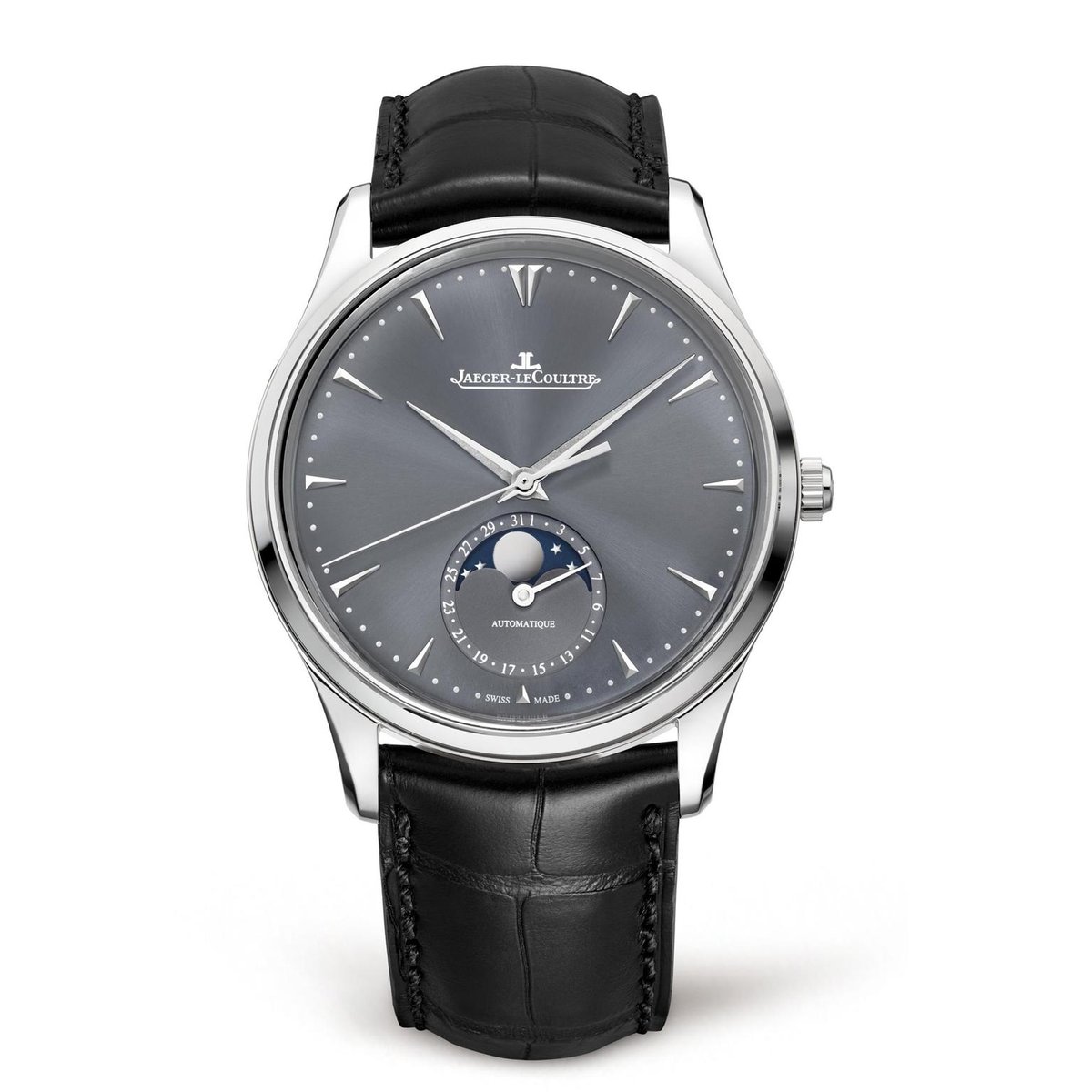
The case of the Q1368420 is a masterclass in restraint. At 39mm, it defies the trend of oversized luxury watches, yet it avoids the diminutive feel of vintage dress pieces that can sometimes look lost on a modern wrist. The lug-to-lug measurement of 46mm is the secret to its versatility. By keeping the lugs short and steeply curved, JLC ensures that the watch occupies the flat part of the wrist perfectly, providing a secure and centered fit.
At 9.9mm thick, the watch is thin enough to be classified as 'ultra-thin' by most standards, though not so thin that it feels fragile. There is a satisfying rigidity to the steel case. The entirely polished finish gives it a jewelry-like quality, reflecting light in a way that emphasizes the stepped bezel and the sharp transition to the lugs. During my week with the watch, I found that the thinness was its greatest asset. It glides under a shirt cuff without snagging, a detail that becomes increasingly important when you are wearing it for 12 hours a day.
The Dial: A Study in Silver and Blue
The dial of the Q1368420 is often described as 'silver,' but that doesn't quite capture the complexity of the sunray finish. In direct sunlight, it takes on a bright, metallic sheen; in soft evening light, it shifts toward a warm, pearlescent gray. This dynamism prevents the watch from ever feeling boring. The dauphine hands are split—one side polished, the other frosted—a clever horological trick that ensures legibility even when light is hitting the dial from a difficult angle.
The moon phase at 6 o'clock is the star of the show. The deep blue disc is populated by a polished gold moon and stars, providing a necessary pop of color against the monochromatic silver backdrop. Surrounding the moon phase is the pointer date. While some find pointer dates difficult to read at a glance, the scale here is well-executed. My only critique is the lack of lume. While expected for a dress watch, it does mean that in a darkened theater or a dimly lit taxi, the dial becomes a beautiful but illegible silver disc.
Caliber 925/1: The Engine Room
The Caliber 925/1 is a descendant of JLC's long line of high-performance automatic movements. It is a thin caliber, yet it doesn't sacrifice stability. The 22-carat gold rotor weight provides enough mass to keep the mainspring wound even with relatively sedentary office work. One of the joys of owning a Jaeger-LeCoultre is the sapphire caseback, which reveals the '1,000 Hours Control' seal—a testament that this specific watch has been tested for nearly six weeks across various conditions.
However, we must address the power reserve. At 43 hours, the Q1368420 is lagging behind the industry's shift toward 70-hour 'weekend-proof' movements. If you take this watch off on Friday evening, it will likely have stopped by Sunday afternoon. For a daily wearer, this is a non-issue, but for the collector with a multi-watch rotation, a watch winder becomes a practical necessity for this reference. (Note: The newer Q1368430 update has addressed this with a 70-hour reserve, but the Q1368420 remains the more accessible entry point on the secondary market.)
The Strapping Experience: Alligator and the Deployant Clasp
The watch comes on a high-grade black alligator strap that is appropriately tapered. JLC’s double-folding deployant clasp is a piece of engineering in itself, shaped like the brand's 'JL' logo. It provides a very secure feel and protects the leather from the wear and tear of a traditional pin buckle. That said, the clasp is somewhat long. For those with wrists under 6.5 inches, the clasp may not sit perfectly centered on the underside of the wrist, which can lead to a slight 'canting' of the watch head. It is worth trying on to ensure the geometry works for your specific bone structure.
Real-World Utility: Monday to Sunday
Monday morning, 8:45 AM: The watch is the perfect companion for a high-stakes presentation. It projects competence and taste without the 'look at me' energy of a gold sports watch. Tuesday through Thursday: It handles the commute and the desk-diving with ease. The steel case is surprisingly resilient to the small scratches that define a daily wearer’s life.
Friday evening: The moon phase adds a touch of whimsy as you transition to a dinner date. Saturday: This is where the watch's limits are tested. It is not a watch for the gym or a poolside brunch. With 50m of water resistance, it can handle a splash of rain, but I wouldn't dream of taking it near a swimming pool. It is a watch that demands a certain lifestyle—one of refinement and urban environments.
The Competitive Landscape
When comparing the Master Ultra Thin Moon to its peers, the value proposition becomes clear. A Patek Philippe Calatrava with a moon phase will cost nearly four times as much, and while the finishing is superior, the gap in horological merit is not as wide as the price suggests. The Glashütte Original PanoMaticLunar is a strong rival, offering a more 'architectural' German aesthetic, but it is significantly thicker and lacks the effortless 'tuxedo' elegance of the JLC. The Zenith Elite Moonphase is perhaps its closest competitor in terms of dimensions, but it lacks the historical 'Watchmaker’s Watchmaker' prestige that comes with the Jaeger-LeCoultre name.
Final Thoughts: The Sophisticated Choice
The Jaeger-LeCoultre Master Ultra Thin Moon (Ref. Q1368420) is a watch that rewards closer inspection. It is a quiet achiever. After a week on the wrist, what stays with you isn't a single feature, but the harmony of the whole. The way the hands catch the light, the smooth click of the moon phase corrector, and the way it settles against the skin all point to a manufacture that understands the intimate relationship between a man and his timepiece.
For the young collector looking to build a 'meaningful' collection, the Q1368420 is more than just a dress watch. It is a piece of horological history that functions perfectly in the modern world. It is, quite simply, the master of its domain.