The Quiet Sophisticate: Living with the Orion 38
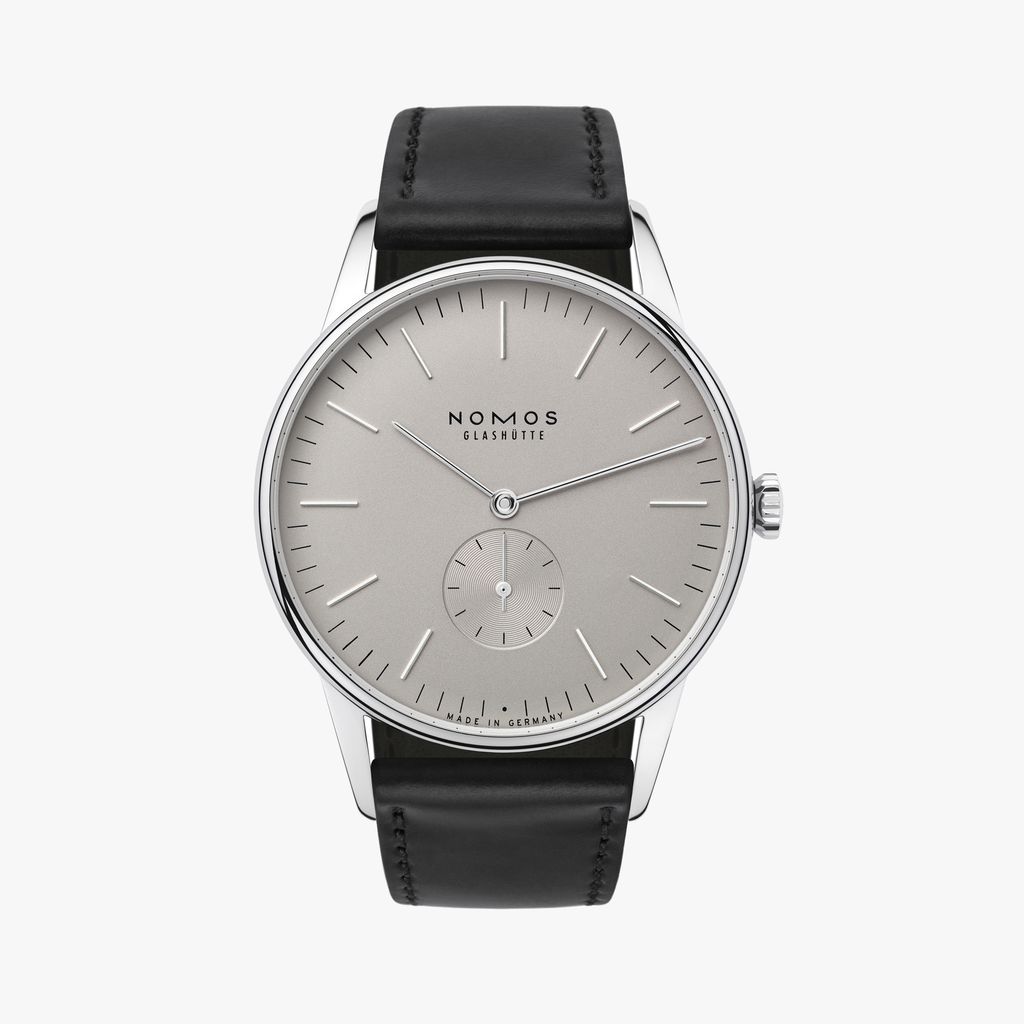
In the hierarchy of the Nomos catalog, the Orion often sits in the shadow of the more famous Tangente. While the Tangente is all sharp angles and typography, the Orion is a study in curvature. It is the watch for someone who finds the Tangente too 'clinical' and the Metro too 'playful.' The Reference 385, with its white silver-plated dial, gold-plated indices, and tempered blue steel hands, is perhaps the most balanced iteration of the line.
The daily experience of the Orion 38 begins with the winding. Unlike an automatic that you simply 'set and forget,' the Orion requires a morning ritual. The crown is small but well-knurled, providing enough grip for the 20-25 turns required to reach full power. There is a tactile joy in feeling the tension build in the mainspring, a connection to the mechanical soul of the timepiece that modern luxury often tries to obscure.
Case Architecture and the 'Lug Factor'
The most important thing to understand about the Orion 38 is how it occupies space. On paper, 38mm is the 'Goldilocks' size for a dress-adjacent watch. However, Nomos is famous—or perhaps infamous—for its long, spindly lugs. The Orion 38 features a lug-to-lug distance of 48mm. To put that in perspective, many 41mm dive watches have shorter lug-to-lug spans.
Because the lugs are so long, the watch wears larger than its diameter suggests. On my 6.5-inch wrist, it fills the entire flat surface. However, the Orion avoids the 'planking' effect of the Tangente because the lugs are dramatically curved. They dive toward the wrist, allowing the strap to wrap around the arm rather than sticking out at an angle. This makes the Orion 38 surprisingly wearable for those who usually find 40mm+ watches too cumbersome.
The case itself is polished to a mirror finish. There are no brushed surfaces here, which adds to its formal appeal but also means it is a 'scratch magnet.' After a week of desk diving, I noticed micro-abrasions on the bottom of the case. For the Vivir reader, this is part of the charm—the watch develops a patina of use that reflects a life well-lived.
Legibility and the Dial
The dial of the 385 is where the Bauhaus influence is most visible. It is not a flat white; it is silver-plated, giving it a subtle metallic sheen that changes from cream to stark white depending on the lighting. The gold-plated appliques are incredibly thin, almost like needle points, and they catch the light with a warmth that balances the 'cold' German aesthetic.
The hands are the star of the show. Tempered blue steel is a hallmark of Glashütte watchmaking, achieved by heating the steel to precisely 290 degrees Celsius. In low light, they look almost black, but when the sun hits them, they pop with a vibrant cornflower blue. The legibility is excellent in daylight, though the lack of lume means that once the sun goes down, you'll be reaching for your phone to check the time.
The Alpha Caliber: A Saxon Workhorse
Flipping the watch over reveals the sapphire crystal caseback, which is a $300 premium over the steel-back version (ref. 384). It is a premium well worth paying. The Alpha caliber is a beautiful sight. It features the classic Glashütte three-quarter plate, which covers most of the moving parts for stability, decorated with Glashütte ribbing (the German equivalent of Côtes de Genève).
The finishing is exceptional for a watch under $3,000. You can see the perlage on the baseplate, the sunburst finish on the ratchet and crown wheels, and the heat-blued screws that match the hands on the dial side. It is a manual-wind movement, meaning there is no rotor to block your view. It is pure, mechanical architecture.
The Strap: Horween Shell Cordovan
We cannot discuss a Nomos without discussing the strap. Nomos uses Horween Genuine Shell Cordovan from Chicago. It is one of the most durable and sought-after leathers in the world, known for its high oil content and ability to develop a deep luster over time. It is also remarkably water-resistant for leather, though I wouldn't recommend testing the 30m water resistance of the case itself.
The strap is unpadded and thin, which perfectly complements the 8.9mm case. It feels like a second skin. If you are a collector who usually swaps out factory straps for aftermarket options, you will likely find yourself keeping the Nomos strap—it is that good.
Investment and Value Proposition
In a market where prices are spiraling upward, Nomos remains an outlier of sanity. The Orion 38 offers a fully in-house movement, a sapphire caseback, and a hand-finished dial for roughly the same price as a mass-produced, Sellita-powered watch from a larger conglomerate. While it won't appreciate like a Patek Philippe, it is a 'safe' purchase. The pre-owned market is robust, and because the design is timeless, it will never go out of style.
Final Thoughts
The Nomos Orion 38 (ref. 385) is not a watch for everyone. It is not for the person who wants to be noticed from across the room. It is not for the person who needs to know the time while scuba diving or in a movie theater. It is a watch for the person who appreciates the 'less is more' philosophy. It is a daily companion that offers a moment of serenity every time you look down at your wrist. After a week of wear, I found it difficult to go back to my heavier, more 'complicated' pieces. There is a lightness to the Orion—not just in weight, but in spirit—that makes it one of the finest daily-wear watches currently in production.