The Evolution of a Modern Icon
The Omega Seamaster Planet Ocean 600M, reference 215.30.44.21.01.001, is not merely a watch; it is a statement of intent. When Omega first introduced the Planet Ocean line in 2005, it was a bold reimagining of the brand’s diving heritage, drawing inspiration from the 1957 Seamaster 300 while incorporating the then-revolutionary Co-Axial escapement. Fast forward to the present, and the Planet Ocean has evolved into a showcase for the brand's most advanced material science and movement architecture. For the sophisticated young collector, this reference represents a point of entry into the world of high-horology tool watches that doesn't rely on heritage alone, but on quantifiable technical superiority.
Case Architecture and Material Science
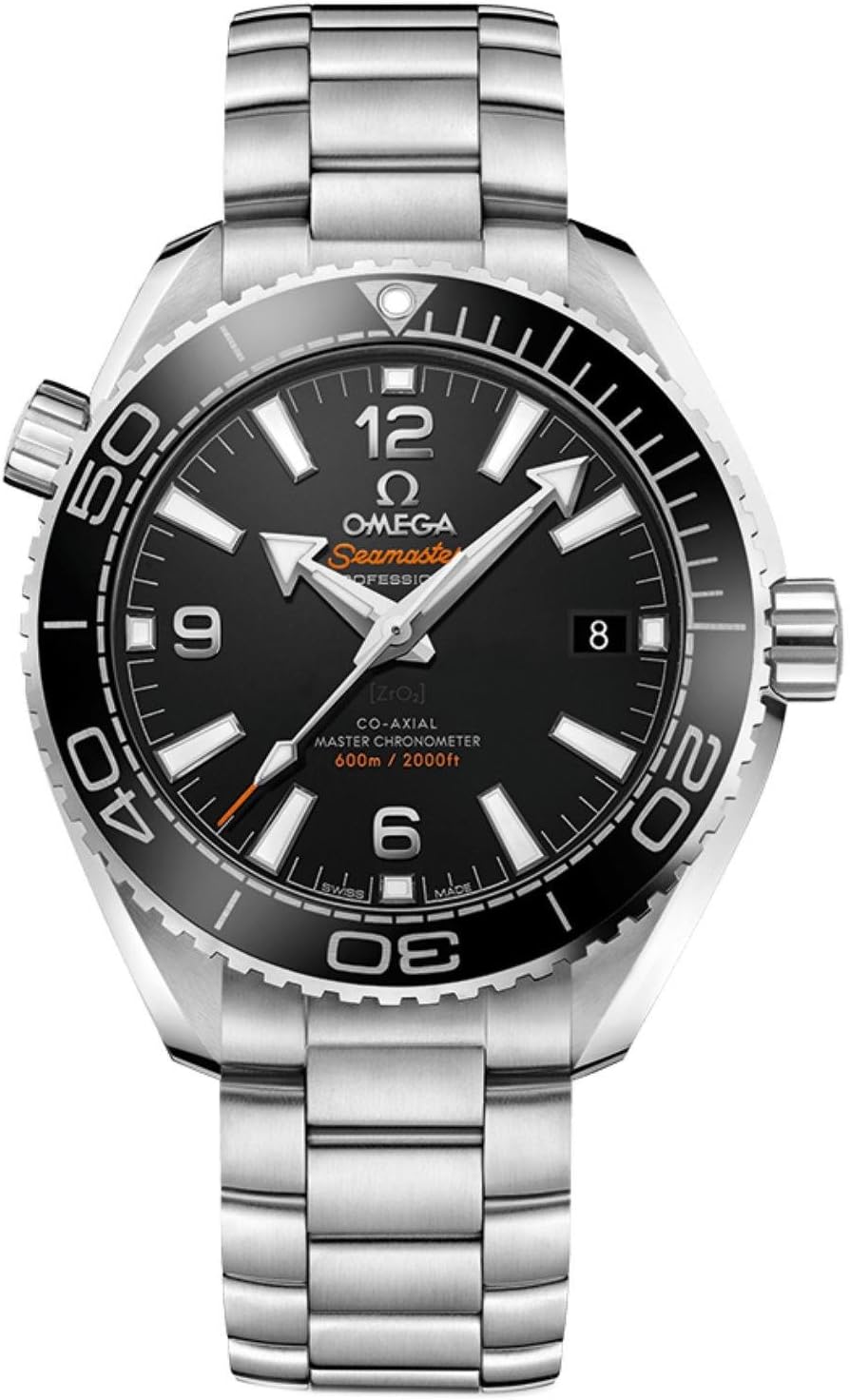
The case of the reference 215.30.44.21.01.001 is a masterclass in 316L stainless steel fabrication. At 43.5mm in diameter, it occupies a significant footprint, yet the execution of the 'lyre' or 'twisted' lugs—a hallmark of Omega design since the 1960s—softens the visual impact. These lugs feature a brilliant interplay of brushed and polished surfaces, a detail that elevates the watch from a simple tool to a luxury object. The polishing on the chamfers is particularly noteworthy, providing a sharp contrast to the vertical brushing on the case flanks.
Perhaps the most discussed aspect of the Planet Ocean’s architecture is its thickness. Measuring 16.1mm from the sapphire crystal to the exhibition caseback, it is a formidable object. However, this volume is not without purpose. To achieve a water resistance rating of 600 meters (2,000 feet) while maintaining a transparent caseback, Omega’s engineers had to ensure structural integrity that could withstand 60 bar of pressure. This necessitates a thicker crystal and a robust case construction. At the 10 o'clock position, we find the signature helium escape valve. While arguably vestigial for 99% of users, it remains a defining characteristic of the Planet Ocean’s professional identity, featuring a conical shape that is both tactile and technically functional for saturation diving.
The Dial and Bezel: A Study in Zirconium Oxide
Omega has moved away from traditional lacquered or painted dials in favor of ceramic. The dial of the 215.30.44.21.01.001 is crafted from black ceramic [ZrO2], as indicated by the subtle engraving just below the center pinion. The result is a surface with incredible depth and an imperviousness to UV degradation that ensures the dial will never patina or fade. The applied indices are fashioned from 18k white gold, filled with Super-LumiNova that glows with two distinct colors: blue for the hour markers and seconds hand, and green for the minute hand and bezel dot. This color-coding is a thoughtful touch for divers, allowing for instantaneous tracking of elapsed time in low-light conditions.
The bezel insert is also ceramic, featuring a Liquidmetal™ diving scale. Liquidmetal™ is an amorphous metal alloy that bonds seamlessly with the ceramic, resulting in a bezel that is entirely smooth to the touch yet incredibly resistant to scratches. The unidirectional rotation of the bezel is precise, with 120 clicks that provide a mechanical feedback that is both crisp and authoritative, devoid of any lateral play.
The Calibre 8900: A Master of Precision
The heart of this timepiece is the Omega Calibre 8900. To understand the significance of this movement, one must look beyond the aesthetic finishing. The 8900 was the first movement to receive the METAS (Swiss Federal Institute of Metrology) certification, a process that subjects the fully cased watch to eight rigorous tests over ten days. Unlike the COSC certification, which tests only the movement, METAS tests the entire watch for water resistance, power reserve, and, most crucially, magnetic resistance up to 15,000 gauss.
The architecture of the 8900 includes two barrels mounted in series. This configuration does not just provide a healthy 60-hour power reserve; it ensures a more consistent delivery of torque as the mainsprings unwind, which in turn leads to better isochronism and more stable timekeeping. The Co-Axial escapement, originally invented by George Daniels and refined by Omega, reduces friction within the gear train, leading to longer service intervals and greater long-term reliability. The finishing is quintessentially Omega: rhodium-plated bridges and rotor decorated with Geneva waves in arabesque, visible through the sapphire caseback. It is a technical landscape that invites close inspection with a loupe.
Ergonomics and the Bracelet
A dive watch of this mass requires a superior mounting system, and Omega delivers with a three-link brushed stainless steel bracelet. The links are solid and secured by a screw-and-pin system that is both secure and aesthetically pleasing. The standout feature, however, is the clasp. The inclusion of a patented extendable foldover clasp with a rack-and-pusher fine adjustment allows the wearer to expand the bracelet by several millimeters without the use of tools. This is an essential feature for a watch of this weight, as it allows the wearer to compensate for wrist swelling throughout the day, ensuring the watch remains centered and comfortable.
The Competitive Landscape
When discussing the Planet Ocean 600M, the comparison to the Rolex Submariner or Sea-Dweller is inevitable. While the Rolex counterparts carry a higher degree of brand recognition and secondary market 'hype,' the Omega offers a arguably superior technical package for a lower retail price. The presence of a METAS-certified movement, a ceramic dial, and a sapphire caseback provides a level of 'spec-sheet' satisfaction that the more conservative Rolex models often eschew. For the collector who views horology through the lens of engineering and value, the Planet Ocean is the more compelling choice.
Final Thoughts
The Omega Seamaster Planet Ocean 600M ref. 215.30.44.21.01.001 is a watch that demands respect. It is a dense, technically sophisticated instrument that represents the absolute state-of-the-art in mass-produced mechanical watchmaking. While its dimensions require a certain degree of confidence to pull off, the reward is a timepiece that feels virtually indestructible and performs with a level of precision that few others can match. It is a testament to Omega's commitment to pushing the boundaries of what a professional diver can be—a perfect marriage of form, function, and futuristic material science.