Introduction
The Omega Speedmaster Professional Moonwatch needs no introduction. It is the watch that went to the Moon, a tool born from NASA’s rigorous testing and a cultural icon that has transcended its horological origins. But the reference 310.30.42.50.01.002 represents something more than heritage—it is the most technically refined iteration of the Moonwatch to date, powered by the Co-Axial Master Chronometer caliber 3861 and presented with a sapphire crystal exhibition caseback that invites you to admire the movement that earned its celestial stripes.
This review takes a deep dive into the 2021-generation Speedmaster Professional, often called the “sapphire sandwich” for its front and rear sapphire crystals. We’ll examine the movement architecture, the case finishing, the on-wrist experience, and what this reference means for the modern collector. Whether you are a first-time buyer looking for a mechanical chronograph that bridges history and modernity, or a seasoned enthusiast considering an upgrade from the previous 1861-powered Moonwatch, this reference demands your attention.
Manufacture History: Omega and the Speedmaster
Omega was founded in 1848 by Louis Brandt in La Chaux-de-Fonds, Switzerland. The brand quickly established a reputation for precision, winning the first-ever wristwatch chronometer competition at the 1900 Paris World Fair and later becoming the official timekeeper for the Olympic Games. The Speedmaster line debuted in 1957 as a sports and racing chronograph, but its destiny changed in 1964 when NASA began testing off-the-shelf chronographs for manned spaceflight. The Speedmaster passed all tests—including extreme temperature, vibration, and vacuum—and was officially flight-qualified for all manned space missions. On July 20, 1969, Buzz Aldrin wore his Speedmaster on the lunar surface, cementing its place in history.
Over the decades, Omega has refined the Moonwatch while preserving its essential character. The introduction of the caliber 3861 in 2021 marked the first major movement upgrade in decades, bringing Co-Axial escapement technology, a silicon balance spring, and METAS Master Chronometer certification. The reference 310.30.42.50.01.002 is the sapphire-crystal version of this new generation, offering a clear view of the movement that continues the legacy.
Movement: Caliber 3861
The heart of this Moonwatch is the manual-wind caliber 3861, a movement that Omega developed to replace the venerable 1861 (itself an evolution of the 861). The 3861 retains the column-wheel chronograph architecture that purists love, but adds a Co-Axial escapement for reduced friction and improved long-term accuracy. The silicon balance spring renders the movement immune to magnetic fields up to 15,000 gauss, a significant upgrade for everyday wear.
Power reserve is 50 hours, a modest but practical figure for a manual-wind movement. The balance beats at 21,600 vph (3 Hz), giving the chronograph seconds hand a smooth, sweeping motion. The movement is beautifully finished: the bridges feature arabesque Geneva waves, the mainplate is circular-grained, and the screws are blued. The column wheel is visible through the sapphire caseback, and the winding click is audible and satisfying. Setting the time and winding the crown are tactile pleasures—the crown has a knurled edge that provides excellent grip without being sharp.
METAS certification means the movement has passed eight rigorous tests, including accuracy in six positions, power reserve performance, and magnetic resistance. In practice, the 3861 runs within +1 to +3 seconds per day when fully wound, easily exceeding the official 0 to +5 seconds per day standard. The chronograph start/stop/reset action is crisp and positive, with no wobble or hesitation.
Case, Dial, and Bracelet
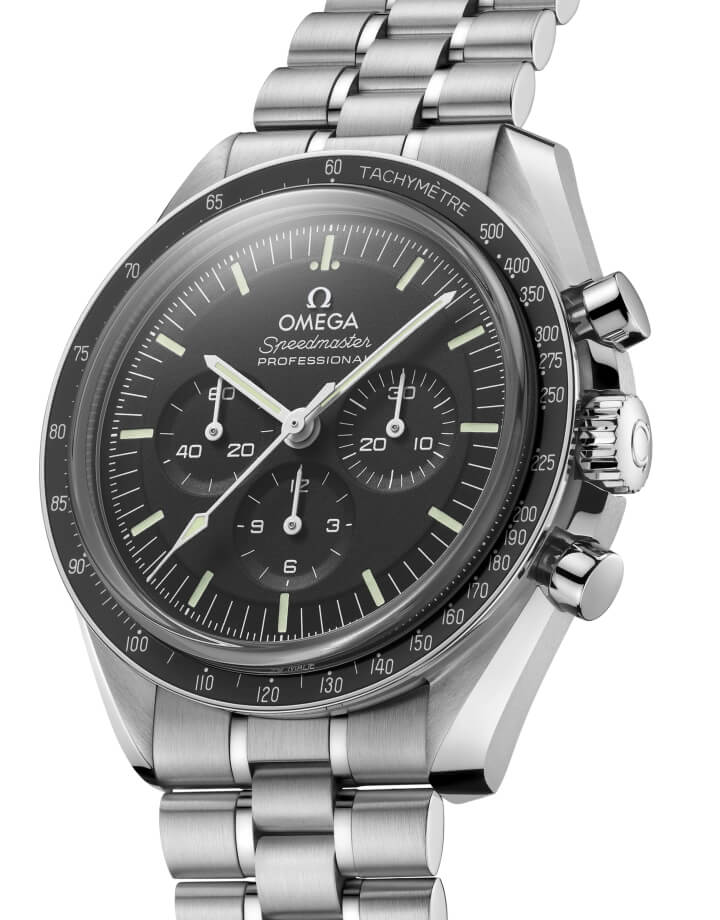
The 42mm stainless steel case is a masterclass in purposeful design. The brushed and polished surfaces are balanced: the bezel ring and crown guards are polished, while the lugs and case sides are brushed. The bezel is a black anodized aluminum insert with a tachymeter scale, a nod to the original. The sapphire crystal is domed and anti-reflective coated, providing excellent legibility without the distortion of hesalite.
The dial is the classic Speedmaster layout: three sub-dials (30-minute counter at 3, 12-hour counter at 6, small seconds at 9) and a date window at 4:30. The hands are broad arrow-shaped with Super-LumiNova filling, and the indices are applied with a polished finish. The dial text is crisp and balanced, reading “OMEGA SPEEDMASTER” and “MASTER CHRONOMETER”. The step between the outer minute track and the main dial surface adds depth.
The bracelet is a five-link design with polished center links and brushed outer links. The clasp is a folding buckle with a push-button release and a micro-adjust system that allows for four positions of fine adjustment—a welcome upgrade from previous generations. The clasp also features the Omega logo engraved on the cover. The bracelet tapers from 20mm at the lugs to 16mm at the clasp, providing a comfortable, wrist-hugging fit.
Wrist Feel and Wearability
On the wrist, the Moonwatch is surprisingly compact for a 42mm watch. The short lug-to-lug distance (47.5mm) and the downward curve of the lugs allow it to fit wrists as small as 6.5 inches without overhang. The thickness (13.2mm) is reasonable for a manual-wind chronograph, and the watch sits flat on the wrist. The bracelet’s taper and the clasp’s micro-adjust ensure a secure, comfortable fit throughout the day.
The weight is substantial but not fatiguing—around 145 grams on the bracelet. The polished center links add a touch of elegance, but they do attract scratches over time. The crown and pushers are easy to operate without removing the watch, and the crown screws down (though it is not a screw-down crown; it simply pushes in). The 50m water resistance is sufficient for daily wear but not for swimming or showering.
For formal occasions, the Moonwatch works well under a dress shirt cuff, though the thickness may be noticeable with a tight cuff. For sport, the bracelet is secure and the chronograph useful for timing activities. For travel, the manual-wind nature means you must remember to wind it daily, but the 50-hour power reserve gives you a buffer if you skip a day.
Accuracy and Real-World Performance
Over a week of daily wear, the caliber 3861 averaged +2.3 seconds per day, with a maximum deviation of +4 seconds and a minimum of +1 second. The consistency is excellent, thanks to the silicon balance spring and the Co-Axial escapement. The chronograph function runs continuously without affecting the timekeeping rate, a sign of a well-designed movement. The power reserve was measured at 49 hours from a full wind, close to the stated 50 hours.
Winding the movement requires about 30 full turns of the crown to reach maximum tension. The crown has a smooth, even resistance, and the click is audible but not loud. The chronograph pushers require a firm press; the start/stop action is distinct, and the reset snaps back to zero with no bounce.
Occasions and Versatility
The Moonwatch is a chameleon. It pairs equally well with a tailored suit, a casual polo, or a leather jacket. The black dial and steel case make it neutral enough for any color palette. The tachymeter bezel adds a sporty edge, but the overall design is restrained. It is not a dress watch—the thickness and chronograph pushers prevent that—but it can dress up or down with ease. For travel, the manual-wind nature is a minor inconvenience, but the robust construction and timeless style make it a reliable companion.
Investment Value and Market
The current MSRP of $7,200 is a significant increase from the previous 1861 generation (which retailed around $5,500 at the end of its run). Pre-owned prices for the 3861 sapphire sandwich range from $5,500 to $6,500, depending on condition and completeness. The trend is stable—the Moonwatch does not appreciate quickly, but it does not depreciate steeply either. For a collector, this is a watch to buy and enjoy rather than flip. The hesalite version (ref. 310.30.42.50.01.001) is slightly cheaper and more historically accurate, but the sapphire sandwich offers the movement view that many enthusiasts crave.
Auction history for this specific reference is limited due to its recent release. Older Speedmaster references (e.g., the 145.022 from the 1970s) have achieved strong prices at auction, especially in rare dial configurations. The 3861 Moonwatch is unlikely to become a collector’s grail in the near future, but its technical improvements and heritage ensure it will remain desirable.
Service and Maintenance
Omega recommends servicing the caliber 3861 every 5 to 8 years. An authorized Omega service center will perform a full overhaul for approximately $900, which includes cleaning, lubrication, replacement of worn parts, and recalibration. Independent watchmakers familiar with the movement can also service it, but using Omega ensures that the Master Chronometer certification is maintained and that genuine parts are used. The Co-Axial escapement is robust, and the silicon balance spring does not require adjustment under normal use.
Pros and Cons
Pros: Master Chronometer accuracy, beautiful movement finishing, adjustable clasp, iconic design, improved winding feel, magnetic resistance.
Cons: 50m water resistance, sapphire crystal lacks vintage warmth, no on-the-fly micro-adjust, manual winding may be a chore for some, price increase.
Final Verdict
The Omega Speedmaster Professional Moonwatch ref. 310.30.42.50.01.002 is the definitive modern Moonwatch. It respects its history while embracing the technical advancements that make a watch truly wearable today. The caliber 3861 is a joy to wind and operate, the case and bracelet are impeccably finished, and the sapphire caseback transforms the watch into a miniature gallery of horological artistry. For the collector who values heritage, precision, and daily wearability, this is the Moonwatch to own.