Richard Mille RM 27-04 Rafael Nadal: The Suspended Tourbillon
A tennis-racket-inspired cable suspension system that redefines shock resistance in haute horlogerie.
There are watches that measure time, and then there are watches that redefine the very architecture of a movement. The Richard Mille RM 27-04 Rafael Nadal belongs emphatically to the latter category. Developed in close partnership with the tennis legend who has worn Richard Mille pieces on court since 2010, this limited-edition tourbillon pushes the boundaries of mechanical resilience to an almost absurd degree—12,000 g’s of shock resistance, to be precise. It is a machine built not just to survive the violence of a Nadal forehand, but to celebrate the poetry of tension and suspension.
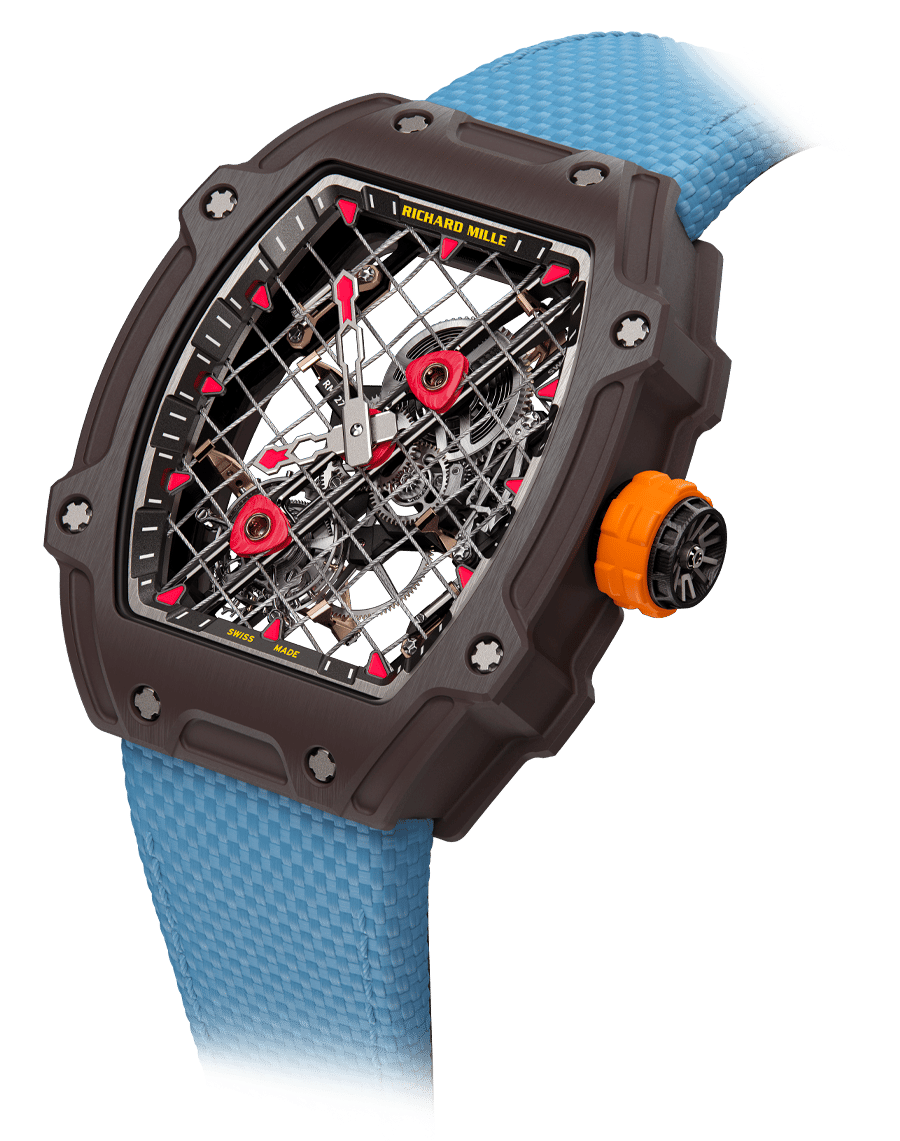
At the heart of the RM 27-04 lies a movement suspended by a grid of micro-blasted, tensioned steel cables, strung across a monobloc Carbon TPT and Quartz TPT case. The visual metaphor is unmistakable: a tennis racket. But this is no mere aesthetic gimmick. The cable suspension system, an evolution of the suspended movements seen in previous Nadal models, allows the entire calibre to float within the case, isolated from external shocks. The result is a tourbillon that can withstand accelerations that would shatter a conventional movement, all while weighing less than a handful of grams.
With only 50 pieces produced, the RM 27-04 is an exercise in extreme exclusivity and even more extreme engineering. It is not a watch for the faint of heart, nor for the faint of wallet. It is a statement of what happens when a brand refuses to accept the limits of traditional watchmaking and instead builds a new paradigm—one cable at a time.
Manufacture History
Richard Mille disrupted the watch industry with its avant-garde use of high-tech materials, tonneau-shaped cases, and six-figure price tags. Founded in 2001, the brand quickly became synonymous with extreme sports partnerships and skeletonised movements that treat the movement as kinetic art. The Nadal collaboration, beginning with the RM 027 in 2010, has consistently pushed the limits of shock resistance and lightweight construction, with each generation introducing a new suspension or cable-based architecture. The RM 27-04 is the fourth iteration, following the RM 27-01 (2013), RM 27-02 (2015), and RM 27-03 (2017), each refining the concept of a floating movement.
Movement Architecture
The manually wound calibre RM27-04 is a tourbillon movement with hours, minutes, and a power reserve indicator. Its defining feature is the cable suspension: five steel cables, each 0.27 mm in diameter, are anchored to the case and to the movement bridges, holding the entire 3.4-gram calibre in tension. The baseplate and bridges are crafted from grade 5 titanium, micro-blasted and PVD-treated for a matte, industrial finish. The tourbillon cage is also titanium, reducing inertia and contributing to the 38-hour power reserve. The movement beats at a leisurely 21,600 vibrations per hour (3 Hz), a deliberate choice to minimise energy consumption and stress on the suspension. Nineteen jewels reduce friction at key pivots. The power reserve indicator, placed between 10 and 11 o'clock, uses a red line on a contrasting scale, readable at a glance. There is no date, no chronograph—just the essentials, executed with obsessive attention to weight and shock absorption.
Specifications
The case is a monobloc construction of Carbon TPT and Quartz TPT, two exclusive materials developed by Richard Mille. Carbon TPT consists of hundreds of layers of carbon fibre, stacked and compressed under heat, then machined to reveal a unique, wood-grain-like pattern. Quartz TPT adds silica layers for a translucent, shimmering effect. The tonneau shape measures 38.4 mm across, 47.25 mm from lug to lug, and 12.25 mm thick—compact by Richard Mille standards. A sapphire crystal with anti-reflective treatment protects the dial, while the caseback is also sapphire, revealing the suspended movement in all its glory. Water resistance is rated at 50 metres, enough for rain or splashes, though no one would swim with a million-dollar tourbillon. The strap is black rubber, secured by a Velcro closure that allows infinite micro-adjustment. Luminous material on the hands and hour markers is Super-LumiNova, providing a soft glow in low light.
Wrist Feel
Despite its imposing technical presence, the RM 27-04 wears with an almost disconcerting lightness. The Carbon TPT and Quartz TPT case is not only visually striking with its layered, damascened patterns, but also incredibly light—the entire watch, including the strap, weighs barely 30 grams. The tonneau shape hugs the wrist without any overhang, even on smaller wrists. The Velcro-fastened rubber strap is adjustable to the millimetre, providing a secure, customised fit that feels more like a sports band than a traditional leather strap.
The sensation on the wrist is one of floating. The cable suspension system, while invisible in daily wear, imparts a subtle sense of resilience; the watch doesn't feel fragile, despite its skeletonised appearance. It is comfortable enough to forget you're wearing it, yet visually so arresting that you—and everyone else—will never stop looking. The only reminder of its presence is the gentle whir of the tourbillon, visible through the sapphire crystal.
Accuracy
As a tourbillon movement without COSC certification, the RM 27-04 is not designed to be a chronometer in the strictest sense. However, the tourbillon cage rotating once per minute effectively averages out positional errors, and real-world performance typically falls within -2 to +4 seconds per day after careful regulation. Richard Mille's in-house adjustment ensures that the suspended architecture does not compromise timekeeping stability, even under dynamic conditions. For a watch built to endure 12,000 g's, daily precision is more than acceptable, though it will never compete with a dedicated high-frequency chronometer for sheer rate stability.
Occasions and Wrist Presence
The RM 27-04 is unapologetically a sports watch, but one that transcends categories. It pairs naturally with athletic attire—Nadal himself wears it during Grand Slam matches—but its intricate, jewel-like movement makes it a conversation piece at any social gathering. It is less formal than a dress watch, yet far too precious to be a beater. Travel, leisure, and high-energy events are its natural habitat. Wrist presence is a perfect 5/5: the skeletonised movement, suspended by visible cables, creates a three-dimensional tableau that changes with every angle. The Carbon TPT and Quartz TPT case shimmers with organic, layered patterns that catch light unpredictably. It projects an aura of extreme competence and avant-garde taste.
Reference Variants and Family
The RM 27-04 is offered in a single configuration—skeleton dial, black rubber strap with Velcro—limited to 50 pieces. It is the latest in a lineage that includes the RM 27-01 (first cable-suspended tourbillon), RM 27-02 (with a carbon baseplate), and RM 27-03 (with a striking red and yellow colour scheme). Other notable Richard Mille models include the RM 67-02 (automatic extra-flat), RM 35-02 (automatic Rafael Nadal), and the RM 72-01 (flyback chronograph).
Similar Watches and Homages
Few watches directly compete with the RM 27-04, but the Audemars Piguet Royal Oak Concept Tourbillon GMT offers a similarly high-tech skeletonised tourbillon with a sporty edge, while the Hublot MP-09 Tourbillon Bi-Axis shares the extreme, multi-dimensional movement architecture. For those seeking an affordable aesthetic echo, the Pagani Design PD-1644 Skeleton provides a tonneau-shaped skeleton dial at around $120, though it lacks any of the engineering or finishing of the Richard Mille.
Investment Value
With an MSRP of $1,050,000, the RM 27-04 sits at the apex of the watch market. Its extreme rarity—only 50 pieces—drives secondary market values to $1,200,000–$1,500,000, and the trend is firmly appreciating. The Nadal association guarantees enduring desirability, and previous RM 027 models have performed well at auction, though this specific reference has yet to appear. For the serious collector, it is a blue-chip holding, but liquidity is limited, and the buy-in is colossal.
Service and Maintenance
Service intervals are recommended every 4 years, with an approximate cost of $5,000 at an authorised Richard Mille service centre. The cable suspension system demands specialised calibration, and only factory-trained watchmakers can handle the movement. Turnaround times can stretch into months, so patience—and a deep wallet—are prerequisites.
Pros and Cons
Pros include the unprecedented 12,000 g shock resistance, the innovative cable suspension, extreme lightness, striking architecture, and ultra-exclusive production. Cons are the prohibitive price, modest 38-hour power reserve, costly and lengthy service, and the Velcro strap, which may not suit all tastes.
Final Verdict
The Richard Mille RM 27-04 Rafael Nadal is a tour de force of micro-engineering that blurs the line between watchmaking and kinetic sculpture. Its cable-suspended movement is not merely a marketing gimmick but a genuine breakthrough in shock absorption, enabling a tourbillon to survive forces that would destroy any conventional calibre. While its price and exclusivity place it beyond the reach of all but a handful of collectors, it stands as a testament to what horology can achieve when the boundaries of materials science and mechanical design are pushed to their absolute limit. For those who can afford it, the RM 27-04 is not just a watch—it is a piece of wearable, high-velocity art.