Rolex Submariner Date Ref. 1680: The Original Date-Equipped Diver
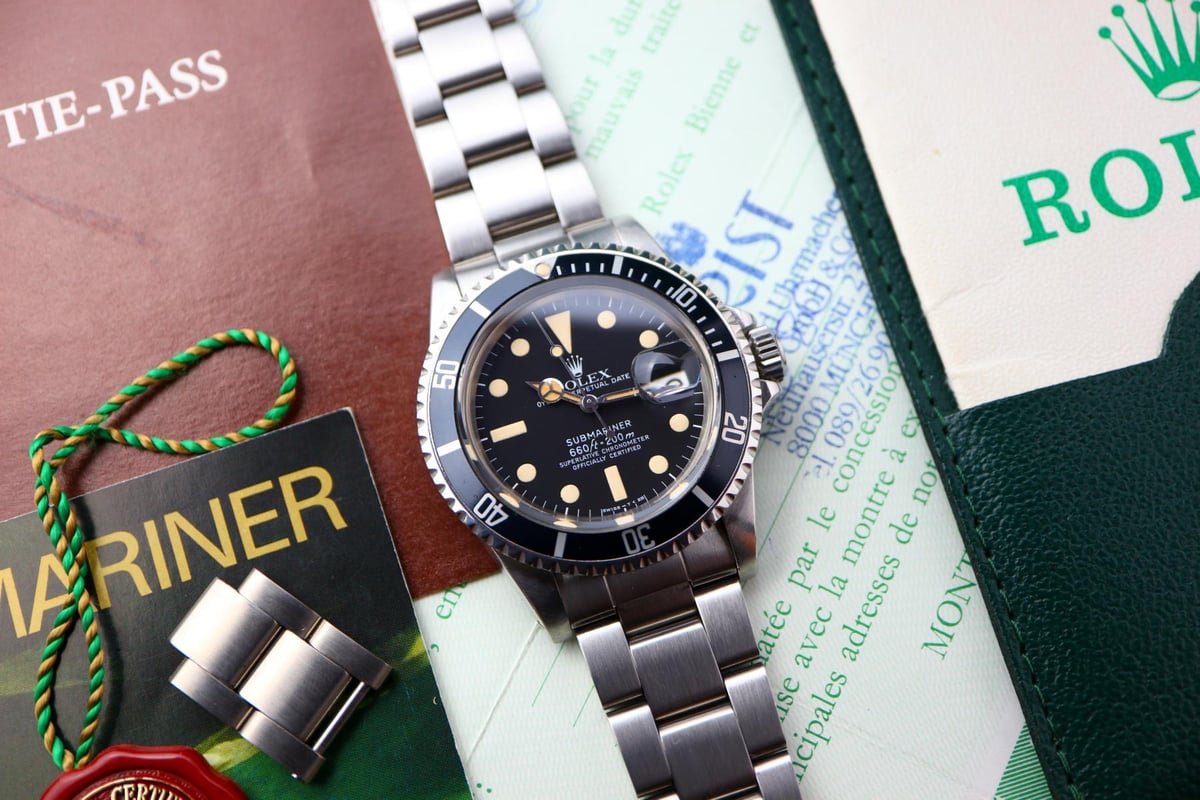
The Rolex Submariner is, without question, the archetypal dive watch, and the Ref. 1680 holds a particularly revered place within its storied lineage. Introduced in 1969, it marked a significant evolution for the Submariner, being the first reference to incorporate a date complication, viewed through the now-iconic Cyclops lens. This addition signaled Rolex’s intent to broaden the Submariner’s appeal beyond pure professional diving, transforming it into a versatile daily wear instrument.
Historical Context and Evolution
Before the 1680, Submariners were no-date affairs, epitomized by references like the 5513. The integration of the date, powered by the robust Caliber 1575, was a practical enhancement that resonated with a wider audience. Early 1680s, produced until approximately 1975, are famously known as "Red Submariners" due to the red 'SUBMARINER' text on their matte black dials. These early examples are further categorized by their depth ratings – 'meters first' (e.g., 200m = 660ft) and later 'feet first' (e.g., 660ft = 200m) – a subtle detail that significantly impacts collector desirability and value. Following the Red Subs, Rolex transitioned to "White Submariners," featuring all white text on the dial, produced until the reference was discontinued around 1980.
Movement: The Enduring Caliber 1570/1575
At the heart of the 1680 beats the Rolex Caliber 1570 (the base movement) or 1575 (the date version). This automatic, self-winding movement is a testament to Rolex's engineering philosophy: robustness, reliability, and precision. Operating at a frequency of 19,800 vibrations per hour (vph) and featuring 26 jewels, it delivers a power reserve of approximately 48 hours. The Caliber 1570/1575 is a COSC-certified chronometer, ensuring exceptional accuracy in daily wear. Its architecture is characterized by its simplicity and efficiency, with a large, free-sprung balance wheel and Rolex's signature red reverser gears for bi-directional winding. While not adorned with the elaborate finishing found in haute horlogerie, its industrial-grade decoration is executed to ensure longevity and consistent performance, reflecting its tool-watch ethos.
Case and Aesthetics: A Purposeful Design
The 1680 retains the iconic 40mm Oyster case, crafted from 904L stainless steel, known for its exceptional corrosion resistance. The case features the Trip-lock crown, ensuring its impressive 200-meter (660 feet) water resistance, a standard for professional diving at the time. A defining characteristic of the 1680 is its domed acrylic crystal, which, while more susceptible to scratches than sapphire, imparts a warm, vintage charm and minimizes glare underwater. The unidirectional rotating bezel, with its aluminum insert, provides a clear and reliable means of tracking elapsed dive time. The matte black dial, with its tritium-lumed hour markers and Mercedes hands, offers superb legibility in all conditions. The subtle variations in dial text, patina, and bezel fade are what make each vintage 1680 unique and highly sought after by collectors.
On the Wrist: Unassuming Utility
The 40mm diameter of the 1680 is perfectly proportioned for a wide range of wrists, offering a balanced and comfortable fit. Its relatively slim profile (around 14.5mm including the domed crystal) allows it to slip under most cuffs, making it surprisingly versatile for a dive watch. The Oyster bracelet, typically a Ref. 93150 with a Fliplock clasp, ensures a secure and robust attachment. The tactile experience of the acrylic crystal, the gentle play in the bezel, and the subtle warmth of tritium lume all contribute to a distinct vintage character that is deeply appealing. It wears as a confident, capable instrument, a testament to its original design brief.
Patek Philippe Perpetual Calendar Chronograph Ref. 3970: The Pinnacle of Complication
Moving from robust utility to exquisite artistry, we turn our attention to the Patek Philippe Ref. 3970. Introduced in 1986, the 3970 had the monumental task of succeeding the legendary Ref. 2499, a watch now considered one of the most important and valuable Patek Philippe references ever made. The 3970 not only lived up to this challenge but also solidified Patek Philippe's reputation as the undisputed master of grand complications, particularly the perpetual calendar chronograph.
Historical Context and Lineage
The 3970's introduction marked a new era for Patek Philippe's flagship complication. While the 2499 was larger and bolder, the 3970 returned to a more classically proportioned 36mm (later 36.5mm) case, aligning with Patek's timeless aesthetic. Produced for nearly two decades across four distinct series, the 3970 saw subtle evolutions in dial design, case proportions, and pushers. It was available in yellow gold, rose gold, white gold, and platinum, with platinum examples often featuring diamond hour markers or rare Breguet numerals, adding to their exclusivity. The 3970 cemented the perpetual calendar chronograph as a cornerstone of Patek Philippe's offerings, paving the way for its successors like the 5970 and 5270.
Movement: The Magnificent Caliber 27-70 Q
The true heart of the 3970 is its manual-winding Caliber 27-70 Q. This movement is a masterclass in horological engineering and finishing. While its base ébauche is derived from the Lemania 2310 (a movement also used by other prestigious brands like Omega in the Speedmaster), Patek Philippe's modifications are so extensive that it is rightfully considered an in-house caliber. Patek re-engineered virtually every component, replacing parts with their own designs, enhancing the finishing, and integrating their perpetual calendar module. The result is a movement that operates at a traditional 18,000 vph, offering a generous 60-hour power reserve. The finishing of the Caliber 27-70 Q is breathtaking. Visible through the sapphire exhibition caseback (an option on many 3970s, and standard on platinum models, often with an interchangeable solid caseback), one can admire the exquisite Geneva stripes, polished anglage on every bridge, perlage on the mainplate, and meticulously blued screws. The chronograph mechanism features a column wheel, ensuring crisp and precise pusher actuation, while the perpetual calendar module is a marvel of miniaturization and mechanical logic, accurately tracking day, date, month, leap year, moon phase, and a 24-hour indicator without manual adjustment until the year 2100. For models produced before 2009, the movement bore the esteemed Geneva Seal; later models carried the equally stringent Patek Philippe Seal.
Case and Aesthetics: Understated Grandeur
The 3970's case, typically 36mm or 36.5mm, embodies Patek Philippe's philosophy of understated elegance. Crafted in precious metals, its proportions are harmonious, with gracefully sculpted lugs and a refined bezel. The dial layout is a study in legibility despite the wealth of information it conveys. The chronograph registers (30-minute counter at 3 o'clock, 24-hour indicator at 9 o'clock) are perfectly balanced with the moon phase aperture and date display at 6 o'clock. Day and month windows are positioned just below 12 o'clock, while the leap year cycle is subtly integrated into one of the subdials. Applied baton markers, or occasionally applied Breguet numerals, provide a classic aesthetic. The sapphire crystal (front and often display back) offers a clear view into the mechanical artistry within and protects the intricate dial.
On the Wrist: Pure Sophistication
Wearing the Patek Philippe 3970 is an experience of pure sophistication. Its modest dimensions allow it to sit discreetly and comfortably on the wrist, making it an ideal companion for formal occasions or daily wear where discretion is valued. The weight of the precious metal is reassuring, a tangible reminder of the quality of materials and craftsmanship. The smooth actuation of the chronograph pushers and the subtle click of the perpetual calendar advancing are tactile pleasures that only a grand complication can offer. It is a watch that whispers its excellence rather than shouts it, a true connoisseur's choice.
A Collector's Duo: Complementary Icons
For the sophisticated young collector, the Rolex 1680 and Patek Philippe 3970 represent a compelling, almost essential, pairing. They are two sides of the same horological coin, showcasing the breadth and depth of Swiss watchmaking excellence. The Rolex 1680 offers a connection to adventure, robust engineering, and timeless design. It is a watch that can be worn without fuss, a reliable companion that carries the weight of history and countless stories. Its vintage charm, the warmth of its acrylic crystal, and the evolving patina of its dial and bezel make it a deeply personal object. It is the perfect daily wearer for those who appreciate heritage and understated cool. The Patek Philippe 3970, on the other hand, is a celebration of mechanical genius and artistic refinement. It is a watch for contemplation, for appreciating the intricate dance of gears and springs that track not just time, but the very rhythm of the cosmos. Its precious metal case and complex dial speak of elegance and a profound respect for tradition. It is the ultimate dress watch, a statement of serious horological appreciation. Together, these two references tell a complete story of horology. The 1680 represents the mastery of the tool watch, designed for purpose and built to last. The 3970 embodies the pinnacle of high complication, a testament to human ingenuity and dedication to craft. Owning both allows a collector to experience the best of both worlds: the rugged, iconic charm of a vintage Rolex and the exquisite, understated grandeur of a Patek Philippe grand complication. Both are not just watches; they are enduring legacies, destined to be cherished and passed down through generations.