Rolex Explorer II Ref. 226570 Review – The Everyday Explorer
Does the 42mm steel GMT tool watch survive a real week on the wrist? We find out.
The Rolex Explorer II has always occupied a peculiar space in the brand’s lineup. It’s not a diver, not a pure dress watch, and not a flashy GMT like the Pepsi or Batman. It’s the tool watch for people who actually use tools—cavers, polar scientists, and those of us who just want a legible, rugged, and surprisingly comfortable steel watch that can handle a commute, a weekend hike, and a black-tie dinner without missing a beat.
The ref. 226570, introduced in 2021, is the latest iteration of this lineage. It replaces the 216570 with an upgraded movement (Caliber 3285), a slightly refined case profile, and a dial that trades the Maxi-dial’s chunkiness for a more balanced, mature aesthetic. But the real question for the daily-wear collector isn’t about specs on paper—it’s about how it feels on the wrist for seven straight days. I wore this one for a full week: to the office, on a muddy trail run, through airport security, and even in bed (because a watch this comfortable never comes off). Here’s everything you need to know.
Brand History
Rolex was founded in 1905 by Hans Wilsdorf and Alfred Davis in London, moving to Geneva in 1919. The brand pioneered the waterproof Oyster case in 1926, the self-winding Perpetual rotor in 1931, and became the first to achieve Swiss chronometer certification for a wristwatch. The Explorer II was launched in 1971 as a rugged GMT tool for spelunkers and polar explorers, featuring a fixed 24-hour bezel and a 24-hour hand to distinguish day from night in constant darkness. Over the decades, it evolved through references 1655, 16570, 216570, and now 226570—each iteration refining the formula while staying true to the original purpose.
Movement – Caliber 3285
Inside the 226570 beats Rolex's in-house Caliber 3285, introduced in 2018 with the GMT-Master II. It’s an automatic movement with 31 jewels, a frequency of 28,800 vph, and a 70-hour power reserve. The movement features Rolex’s Chronergy escapement (a high-efficiency Swiss lever escapement), a paramagnetic blue Parachrom hairspring, and a self-winding module with a ball bearing rotor. It is COSC-certified as a chronometer, and Rolex additionally tests to their own Superlative Chronometer standard (-2/+2 seconds per day). The finishing is industrial but robust—circular graining on the bridges, perlage on the mainplate—though the solid caseback hides it all. The 70-hour reserve is a genuine game-changer for daily wear: take it off Friday night and it’s still running Monday morning.
Specifications & Dimensions
- Case Diameter: 42mm
- Case Thickness: 12.5mm
- Lug-to-Lug: 50mm
- Case Material: 904L Oystersteel
- Crystal: Scratch-resistant sapphire, cyclops lens over date
- Water Resistance: 100m (330ft)
- Lume: Chromalight (blue glow)
- Bracelet: Oyster, three-piece solid links, brushed finish
- Clasp: Oysterlock folding clasp with Easylink 5mm extension
Wrist Feel & Wearability
The 226570 wears remarkably well for a 42mm watch, thanks to the short (by modern standards) 50mm lug-to-lug and the slim 12.5mm thickness. On my 6.75-inch wrist, the case sits flat and doesn’t overhang. The Oyster bracelet is the star here: fully brushed with a comfortable taper from 22mm to 20mm at the clasp, and the Easylink extension lets you adjust for swelling in seconds. Weight is about 155 grams on the bracelet—noticeable but never obtrusive. The balance is neutral; it doesn’t flop to one side or dig into the wrist bone. After a week, I forgot I was wearing it during sleep, which is the highest compliment for a steel sports watch. The 100m water resistance means you can swim, shower, or wash dishes without worry—just rinse it off after saltwater.
Accuracy & Real-World Performance
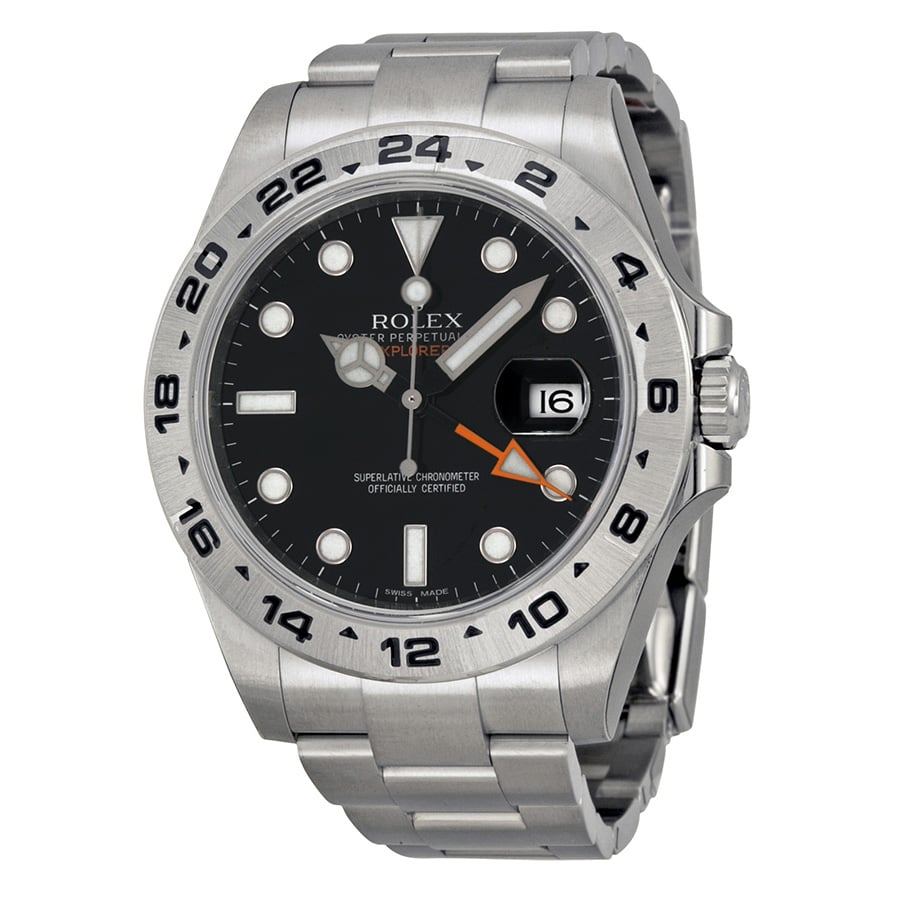
Over a week of mixed wear (office, walking, gym), the Caliber 3285 ran consistently at +1.5 seconds per day, well within COSC standards. The 70-hour power reserve is a genuine convenience—set it down Friday night and pick it up Monday morning still running. Day-to-day, you can expect +2 to -2 spd with normal activity; the Parachrom hairspring handles magnetism and temperature shifts admirably. The GMT function is simple: the 24-hour hand (orange-tipped on the black dial, black-tipped on the white dial) tracks a second time zone via the fixed bezel. No jumping hour hand (that’s the GMT-Master II’s job), but for travel, you can set the local time independently of the 24-hour hand.
Occasions & Versatility
The Explorer II is a true GADA (Go Anywhere, Do Anything) watch. It works with a suit (fits under a dress shirt cuff if the shirt is not too tight), with swim trunks, with hiking gear, and with a t-shirt and jeans. The fully brushed finish and matte black dial keep it low-key, while the orange accents add a sporty pop. It’s not a dress watch, but it’s not obtrusive enough to clash with formal attire. The white “Polar” dial variant offers even higher contrast and a more vintage vibe. I’d wear this every day without hesitation.
Wrist Presence – 4/5
The 42mm size and bold hour markers ensure it’s noticed, but the fully brushed finish and matte black dial keep it from screaming for attention. It’s a confident, understated presence that fits under a dress shirt cuff (just barely) and looks equally at home with a t-shirt and jeans. The Chromalight lume is excellent—bright blue glow that lasts all night.
Reference Variants
- 226570 Black Dial – Standard black dial with white gold applied indices, orange 24-hour hand tip. The most versatile variant.
- 226570 White (Polar) Dial – White dial with black 24-hour hand and orange 24-hour hand tip. Higher contrast and a cult favorite among collectors.
Family & Sibling References
Previous Explorer II references include the 16570 (40mm, 1990s-2011), the 216570 (42mm, 2011-2021), and the original 1655 (1971-1985). Other notable Rolex models include the Submariner 126610LN, GMT-Master II 126710BLRO, and Explorer I 124270.
Similar Watches & Homages
If the 226570 is out of budget, consider the Tudor Black Bay Pro (39mm, GMT, ~$3,800) or the Grand Seiko SBGM221 (39.5mm, automatic GMT, ~$3,600). For budget homages, the Steinhart Ocean 39 Explorer II (~$450) and San Martin SN021-G (~$280) offer similar aesthetics with reliable movements.
Investment Value
MSRP: $9,600 (as of 2025)
Current Retail: $10,100 (Rolex boutique)
Pre-Owned Range: $8,500–$12,000
Trend: Stable
The 226570 holds value well—expect to recoup 85-95% of retail if kept in good condition. It’s not a speculator’s piece like a Daytona, but it’s a safe long-term hold for a daily wearer. No major auction history for this modern reference.
Service & Maintenance
Rolex recommends service every 5-10 years. An authorized service center overhaul costs around $800 (including gaskets, lubrication, and regulation). Independent watchmakers are not advisable due to proprietary parts; stick with RSC or trusted Rolex specialists.
Pros & Cons
Pros: Excellent legibility day and night, comfortable on the wrist for all-day wear, 70-hour power reserve, understated tool-watch aesthetic.
Cons: 42mm may be too large for smaller wrists, solid caseback hides the movement, clasp lacks on-the-fly micro-adjust (only Easylink 5mm extension), price premium over competitors with similar specs.
Final Verdict
The Rolex Explorer II ref. 226570 is the ultimate one-watch collection for those who value function over flash. It’s comfortable, accurate, and built to survive real life—not just a display case. If you can live with the size and the price, this is a watch you’ll never want to take off.