The Evolution of a Gateway Drug
In the hierarchy of horological milestones, the Tissot Visodate occupies a sacred space. For many young collectors, it represents the first foray into the world of Swiss mechanical movements. It’s the watch you buy when you’ve graduated from your first job, or when you finally decide that your wrist deserves more than a battery-powered fashion accessory. The Visodate has always been a love letter to the 1950s—an era of optimism, sharp tailoring, and the birth of the modern automatic watch. But the world has changed since 1954, and so has the Visodate. The reference T118.430.16.051.00 is Tissot’s answer to the modern demand for larger, more robust timepieces, and after a week of testing, the results are as nuanced as the faceted indices on its dial.
Case Architecture and the 42mm Question
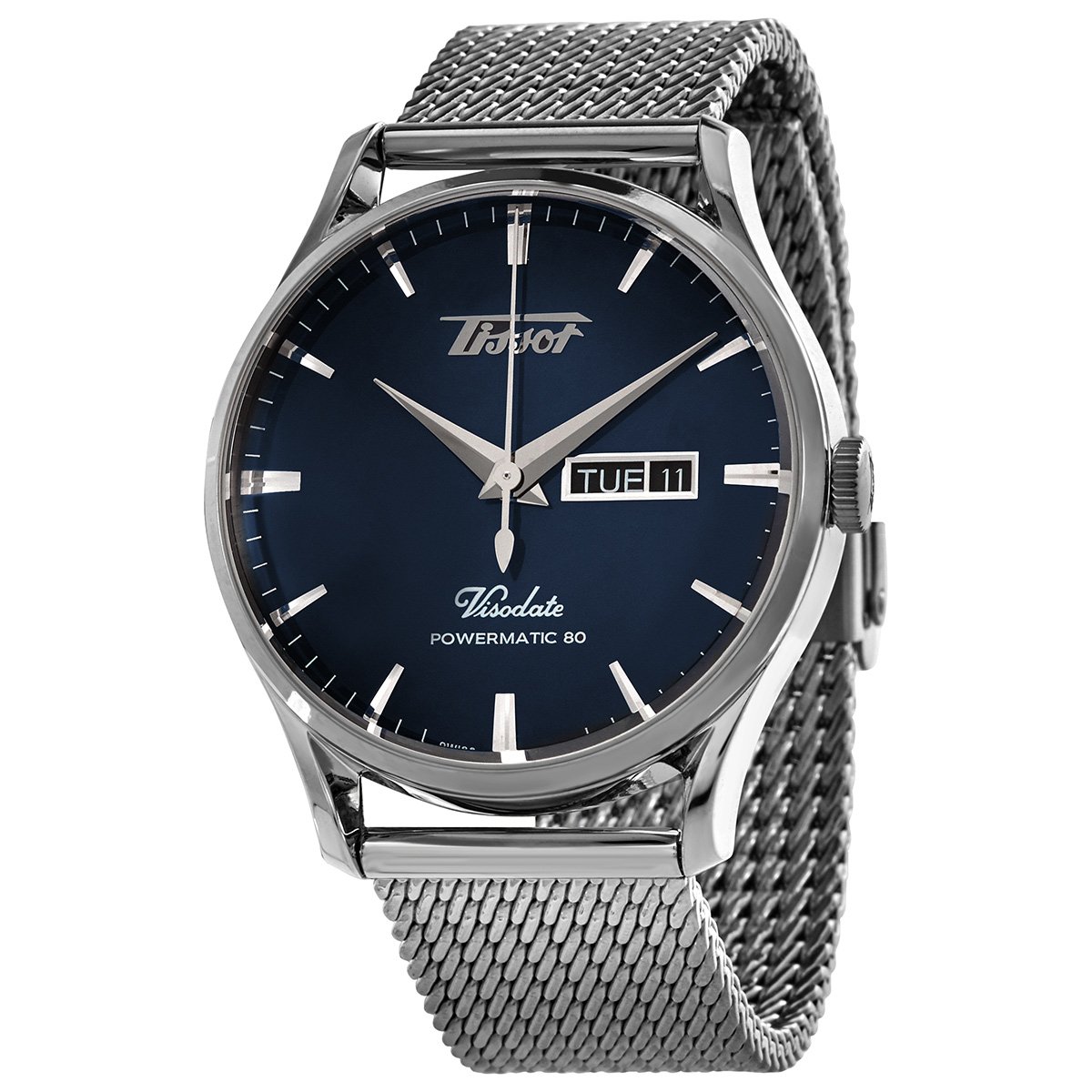
Let’s address the elephant in the room: the size. The previous iteration of the Visodate was a tidy 40mm, a size often cited as the 'Goldilocks' zone for dress watches. Moving to 42mm was a bold choice by Tissot. On paper, it sounds like a betrayal of the vintage aesthetic. However, when you hold the T118.430.16.051.00 in your hand, you realize the design language has shifted. This is no longer just a dress watch; it’s a 'daily-wear' watch. The case is constructed from 316L stainless steel with a high-polish finish that is remarkably well-executed for this price bracket.
The real magic lies in the case profile. Tissot has utilized a 'V' shape, where the bezel is wider than the caseback. This creates a floating effect on the wrist. When you look down at it, you see the full 42mm dial, but the part actually touching your skin is significantly smaller. This taper, combined with the curved lugs, allows the watch to sit comfortably on a variety of wrist sizes, though I would caution anyone with a wrist smaller than 6.5 inches to try it on in person first. The lug-to-lug measurement of nearly 50mm is the true limiter here. It’s a long watch, and on a smaller wrist, you might experience the dreaded 'overhang' where the lugs appear to hover over empty air.
The Dial: A Study in Mid-Century Minimalism
The black dial of the T118.430.16.051.00 is a masterclass in restraint. It isn't a matte black, nor is it a distracting sunray; it’s a deep, inky gloss that serves as the perfect backdrop for the polished elements. The most striking feature is the vintage Tissot logo. This isn't the modern, blocky T-plus logo we see on the PRX; this is the cursive, scripted logo from the 1950s. It adds an immediate sense of gravitas and history to the piece.
The indices are faceted and applied, catching the light with every movement of the wrist. One of my favorite details is the date window at 3 o'clock. Unlike the previous version which featured a day-date complication, the Powermatic 80 version opts for a cleaner date-only display. This choice improves the symmetry of the dial significantly. The dauphine hands are sharp and correctly proportioned, with the minute hand reaching all the way to the outer track—a detail often missed by lesser brands. There is no lume on this watch, which is appropriate for its heritage. If you find yourself in a dark cinema or a dimly lit bar, you’ll have to rely on the way the polished facets catch whatever ambient light is available. It’s a trade-off for elegance, and it’s one I’m happy to make.
The Powermatic 80: Utility Over Everything
Inside beats the Powermatic 80.121 movement. This is a movement that has revolutionized the entry-level Swiss market. By reducing the frequency from 28,800 vph (4Hz) to 21,600 vph (3Hz) and optimizing the barrel and escapement, Tissot has managed to squeeze 80 hours of power reserve out of a single mainspring. In practical terms, this means you can take the watch off on Friday evening, leave it on your dresser all weekend, and strap it back on Monday morning without having to reset the time. For the young professional with a rotating collection, this is a game-changer.
Purists might argue that the lower beat rate results in a 'stuttery' second hand compared to the smooth sweep of a 4Hz movement. While technically true, the difference is negligible in daily use. What you lose in sweep, you gain in magnetic resistance and reliability. This version features the Nivachron hairspring, which is a titanium-based alloy that makes the watch significantly less susceptible to the magnetic fields generated by our laptops, phones, and tablets. In a modern office environment, this is far more valuable than a slightly smoother second hand.
The Seven-Day Wear Test
Monday: The first day is always about the strap. The Visodate comes on a black leather strap with an alligator-style embossing and a butterfly deployant clasp. Out of the box, the leather is quite stiff. It took about four hours of wear before it began to conform to my wrist. The deployant clasp is signed with the vintage logo, which is a nice touch, but it adds a bit of bulk to the underside of the wrist. By 5 PM, I was conscious of the clasp pressing against my desk while typing.
Tuesday: Legibility is the theme of the day. The domed sapphire crystal is gorgeous, but it is a magnet for reflections. Without a heavy application of anti-reflective coating, the dome can sometimes act like a mirror in direct overhead office lighting. However, the distortion you get when looking at the dial from an angle is pure vintage joy. It gives the watch a depth that flat crystals simply cannot match.
Wednesday: I wore the Visodate with a casual sweater and jeans today. This is where the 42mm size actually helps. While a 34mm or 36mm vintage watch might feel too dainty for a casual outfit, the 42mm Visodate has enough 'presence' to work with a denim jacket. It bridges the gap between dressy and casual better than its 40mm predecessor did.
Thursday: A rainy commute tested the 30m water resistance. This is the Visodate’s Achilles' heel. 30 meters essentially means 'splash resistant.' You cannot swim with this watch, and you should be careful even when washing your hands. In a world where many 'dress' watches are moving toward 50m or 100m of resistance, the Visodate feels a bit fragile in this department. I found myself tucking it deep under my sleeve as I ran for the train.
Friday: The 'Friday Night Test.' Transitioning from the office to a cocktail bar, the Visodate shines. Under the warm, dim lights of a lounge, the polished case and indices come alive. It looks like a watch that costs three times its MSRP. This is the environment where the Visodate is most at home.
Saturday & Sunday: I left the watch on the nightstand to test the power reserve. When I picked it up on Monday morning, it was still ticking, losing only a few seconds over the 60+ hours it sat idle. That is the Powermatic 80 promise delivered.
The Strap Situation
We need to talk about the 21mm lug width. For those who love to swap straps, 21mm is a frustrating 'in-between' size. Most standard straps are 20mm or 22mm. While you can squeeze a 22mm leather strap in there, or live with the gap of a 20mm, it’s never quite right. Tissot’s choice of 21mm is clearly an aesthetic one—it keeps the proportions of the 42mm case balanced—but it limits your aftermarket options. If you plan on keeping this watch for the long haul, I recommend investing in a high-quality custom 21mm shell cordovan strap to truly elevate the look.
Final Thoughts
The Tissot Heritage Visodate Powermatic 80 (ref. T118.430.16.051.00) is not a perfect watch, but it is a perfect *first* watch. It has its quirks—the low water resistance, the odd lug width, and the polarizing 42mm diameter. But these are overshadowed by its strengths. You are getting a legitimate piece of Swiss history, a movement that outperforms almost everything in its price bracket, and a design that manages to be both nostalgic and modern.
For the sophisticated young collector, the Visodate is a reminder that you don't need to spend five figures to own a watch with soul. It survives the week because it was designed for the week. It’s a tool for the modern professional who still appreciates the romance of a mechanical heartbeat. If you have the wrist to pull off the 42mm case, there is very little in the sub-$1,000 market that can compete with the sheer charisma of the Visodate.