The Jurisdictional Heritage of Le Locle
To understand the Tissot Le Locle Powermatic 80, one must first understand the geography of Swiss watchmaking. Le Locle, a town nestled in the Neuchâtel mountains, is more than just a location; it is a UNESCO World Heritage site recognized for its watchmaking urbanism. Tissot has occupied this space since 1853, and the Le Locle collection is the brand's tribute to this lineage. The reference T006.407.11.033.00 is not merely a product; it is a physical manifestation of a town's identity.
For the modern collector, particularly the young enthusiast beginning their journey, the Le Locle offers a sense of permanence. In an era of rapidly shifting trends and 'hype' watches, Tissot remains anchored to a classical design language. This specific reference, with its silvered dial and stainless steel bracelet, represents the most versatile iteration of the line, capable of transitioning from the boardroom to a formal evening gala without missing a beat.
Technical Deep-Dive: The Powermatic 80 Caliber
The heart of this timepiece is the Powermatic 80.111 caliber. To the uninitiated, it may seem like just another automatic movement, but to the horologist, it represents a significant shift in movement engineering. Based on the venerable ETA 2824-2, the Powermatic 80 is the result of a collaborative effort between Tissot and ETA to optimize efficiency. The primary modification is the reduction of the vibration frequency from the standard 4Hz (28,800 vph) to 3Hz (21,600 vph).
This reduction in frequency, while resulting in a slightly less 'smooth' sweep of the seconds hand, allows for a massive increase in power reserve—extending it to a full 80 hours. This means a collector can set the watch down on a Friday evening and find it still ticking accurately on Monday morning. Furthermore, the movement utilizes a high-tech synthetic escapement material, which reduces friction and wear over time, potentially extending the service intervals. The movement is also decorated with a custom rotor featuring the Tissot crest and waves of 'perlage' on the plates, visible through the ornate exhibition caseback.
Dial Architecture and Aesthetics
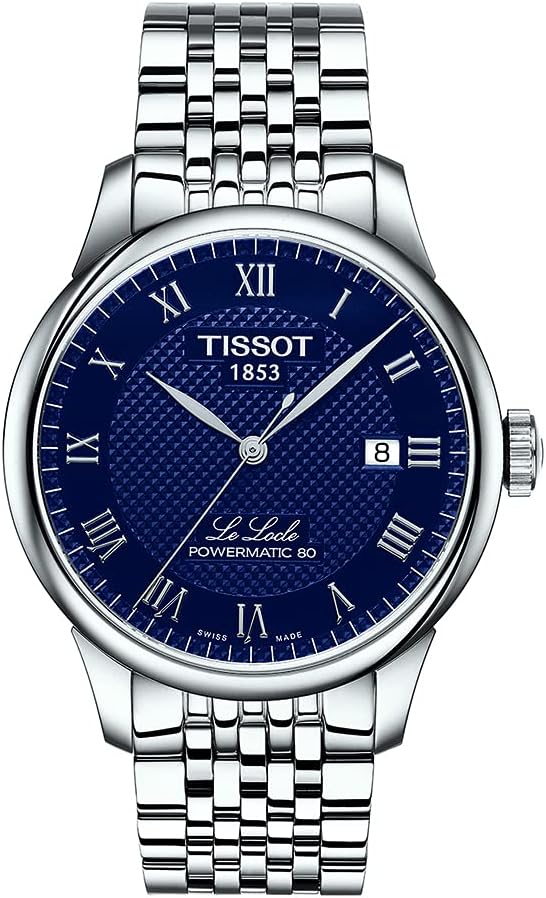
The dial of the T006.407.11.033.00 is a masterclass in texture. The central portion of the dial features a 'Clous de Paris' or hobnail pattern, which provides a tactile depth that is rarely found at this price point. This guilloché-style finish is contrasted by a smooth outer ring that houses the painted Roman numeral indices. The use of Roman numerals reinforces the watch's traditionalist ethos, evoking the aesthetics of 19th-century pocket watches.
The leaf-shaped hands (feuille hands) are polished to a high sheen, providing excellent legibility against the silvered background. A subtle date window is positioned at 3 o'clock, integrated with enough restraint that it does not disrupt the symmetry of the dial. The 'Le Locle' signature, written in an elegant cursive script, serves as a final flourish, reminding the wearer of the watch's prestigious origin.
Case Construction and Ergonomics
The case is executed in 316L stainless steel, the industry standard for high-quality horology due to its corrosion resistance and ability to take a high polish. At 39.3mm, the diameter is perfectly judged for the modern wrist. It avoids the 'dinner plate' look of oversized dress watches while maintaining enough presence to feel contemporary. The thickness of 9.8mm is particularly noteworthy; achieving a sub-10mm profile with an automatic movement and a date complication is a feat of packaging that many brands struggle to replicate.
The caseback is perhaps one of the most ornate in the industry. Rather than a simple glass window, Tissot has opted for a split exhibition back with an engraved bridge that spans the center. This bridge features the Tissot heritage logo and traditional Swiss motifs, framing the balance wheel and rotor in a way that feels intentional and artistic. It is a detail that speaks to the 'reverent' nature of the Le Locle line.
The Bracelet: A Study in Articulation
The stainless steel bracelet of the T006.407.11.033.00 is composed of seven rows of small links. This high link count allows the bracelet to be incredibly flexible, almost mimicking the feel of a leather strap. Each link is polished, which does make the watch a bit of a 'scratch magnet,' but the visual payoff is a shimmering, jewelry-like quality that elevates the watch's status. The butterfly clasp is a dual-push-button design that hides the mechanism entirely, creating a seamless loop of steel around the wrist.
Market Positioning and Value Proposition
In the world of luxury horology, 'value' is often a relative term. However, in the case of the Tissot Le Locle, the value is absolute. To find another Swiss-made automatic with an 80-hour power reserve, a sapphire crystal, and this level of dial finishing, one would typically have to spend upwards of $1,500. Tissot’s ability to offer this package for under $700 is a testament to the manufacturing power of the Swatch Group.
For the young collector, this watch serves as the perfect 'first serious watch.' It teaches the wearer to appreciate movement architecture, the history of Swiss manufacturing, and the nuances of dial design. It is a watch that commands respect from seasoned collectors not because of its price, but because of its integrity.
Final Thoughts
The Tissot Le Locle Powermatic 80 (Ref. T006.407.11.033.00) is a triumph of democratic horology. It does not pretend to be a Patek Philippe or a Vacheron Constantin, yet it honors the same traditions that those houses were built upon. It is precise, technically advanced, and aesthetically timeless. Whether you are adding it to a growing collection or purchasing it as a singular daily companion, the Le Locle is a timepiece that proves elegance and engineering are not the exclusive domain of the ultra-wealthy.