When we discuss the 'Big Three' of German watchmaking, Glashütte Original often occupies a unique space. It lacks the austere, mathematical rigidity of A. Lange & Söhne, yet it possesses a depth of manufacturing capability that few brands at its price point can match. The Sixties Chronograph is perhaps the purest expression of this identity. It is a watch that looks back at the GDR-era Spezimatic with affection, but builds it with the precision of 21st-century Saxon engineering.
The Dial: A Pforzheim Masterpiece
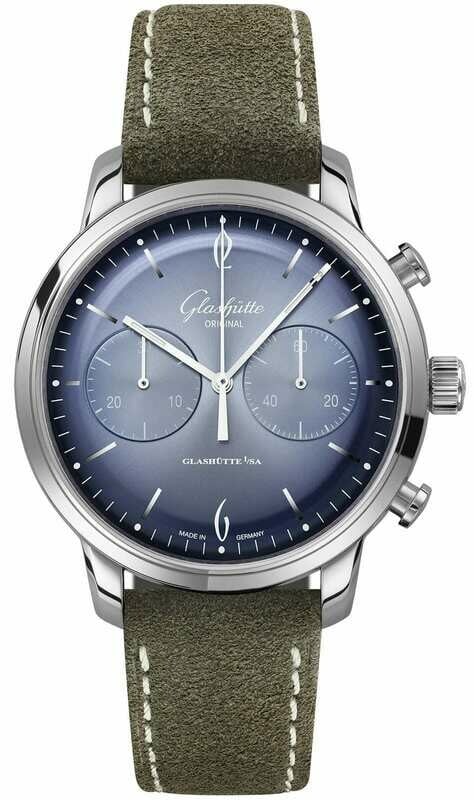
One cannot discuss the Sixties Chronograph without starting at the dial. Glashütte Original owns its dial manufactory in Pforzheim, a rarity in an industry where most brands outsource this critical component. The dial of the Sixties Chronograph is domed—not just at the edges, but across its entire surface. This creates a canvas for light to play across the galvanized silver or the vibrant dégradé finishes of the annual editions.
The typography is the star here. The stylized numerals at 12 and 6 are an exact replica of the fonts used in the 1960s, providing a quirky, mid-century modern flair that distinguishes the watch from the more conservative Senator line. The sub-dials for the small seconds and the 30-minute counter are slightly recessed, adding a layer of dimensionality that is often lost on flat-dial chronographs. During my week of wear, I found the legibility to be superb, even in direct sunlight, thanks to the anti-reflective coating on the box-shaped sapphire crystal.
Case Architecture and Ergonomics
On paper, 42mm might sound daunting for a dress-adjacent chronograph. However, the Sixties Chronograph is a lesson in how geometry affects wearability. The case is essentially a slim disc, with the lugs emerging from the bottom of the mid-case and curving sharply downward. This design allows the watch to 'hug' the wrist. On my 6.75-inch wrist, the watch felt no larger than a standard 40mm piece.
The thickness of 12.4mm is notable. While not 'ultra-thin' by any means, a significant portion of that height is accounted for by the highly arched sapphire crystal. The actual metal sidewall of the case is quite slim, which visually reduces the bulk. The mushroom pushers are another highlight—they are easy to operate even with gloves on, and they provide a tactile connection to the mechanical heart of the watch that modern rectangular pushers often lack.
The Calibre 39-34: Reliable Soul
Inside beats the Calibre 39-34. This is an automatic movement with a modular chronograph construction. While some purists prefer integrated chronographs, the modular approach allows Glashütte Original to maintain a slimmer profile for the base movement while offering the complexity of a stopwatch. The finishing is visible through the sapphire caseback and it is undeniably German: Glashütte stripes, beveled edges, and the iconic swan-neck fine adjustment.
The power reserve stands at 40 hours. In a world where 70-hour reserves are becoming the standard, this is one area where the Sixties shows its age. However, as a daily wearer, this is rarely an issue. The winding rotor is heavy and efficient; a few hours on the wrist is enough to keep it topped up for the night.
Daily Life and Versatility
Throughout the week, I wore the Sixties Chronograph in various settings. On Tuesday, it was paired with a navy suit for a series of meetings. Its elegance was undeniable—it looked every bit the professional's tool. By the weekend, I had swapped the suit for a cashmere sweater and dark denim. The watch transitioned seamlessly. It has a 'cool factor' that transcends formal wear; it feels like something a creative director or an architect would wear.
One caveat for the daily wearer: the water resistance is rated at 3 bar (30 meters). This is a 'splash-resistant' watch, not a 'swim-resistant' one. While it survived a rainy afternoon in the city without issue, this is not the piece you take to the poolside. It is a watch for the urban landscape, designed for the boardroom, the bistro, and the gallery.
Final Thoughts
The Glashütte Original Sixties Chronograph is a rare bird. It manages to be nostalgic without being a caricature. It is large enough to be modern but shaped well enough to be elegant. For the collector who is tired of the standard Swiss offerings and wants something with a bit of soul, a bit of color, and a world-class dial, there is very little that can compete with this Saxon gem. It is a reminder that the 1960s weren't just about the moon—they were about style, and this watch has it in spades.