A. Lange & Söhne Cabaret Tourbillon Honeygold: The Rectangular Exception
The Cabaret is the quiet outlier in A. Lange & Söhne's catalogue. While the Lange 1, Datograph, and Zeitwerk occupy the center of collector conversation, the rectangular Cabaret has always been a connoisseur's shape. The Cabaret Tourbillon Honeygold, a Handwerkskunst limited edition of 30 pieces, takes that outlier status and turns it into a statement. It is not a watch that shouts. It is a watch that asks you to lean in.
Rectangular tourbillons are rare for good reason. A tourbillon is a three-dimensional complication, and a rectangular movement demands a different architecture from the ground up. Lange solved that problem in the Cabaret Tourbillon with the L042.1, a manually wound rectangular calibre with a stop-seconds mechanism for the tourbillon. The Honeygold edition wraps that movement in Lange's proprietary gold alloy and finishes it to Handwerkskunst standards. The result is a watch that feels less like a product and more like a small, wearable piece of Glashütte craft.
Manufacture History
A. Lange & Söhne was founded in 1845 in Glashütte, Saxony, by Ferdinand Adolph Lange. The brand's modern chapter began in 1990, when Walter Lange revived the name after decades of state ownership. That revival was built on a simple promise: movements designed, finished, and assembled in Glashütte, with a level of hand-finishing that could compete with the best of Switzerland. The Cabaret joined the collection in 1997, giving Lange a rectangular dress watch with a distinctively German interpretation of Art Deco proportions.
The Cabaret Tourbillon arrived in 2008, and it was not a cosmetic exercise. It introduced a rectangular tourbillon movement with a patented stop-seconds mechanism, a feature that had long been considered difficult to implement in a tourbillon. The Handwerkskunst edition in honey gold is the most elaborate expression of that idea. Handwerkskunst is Lange's label for pieces that showcase rare crafts, and it is applied sparingly. The Cabaret Tourbillon Honeygold is one of those rare pieces.
The Honey Gold Difference
Honey gold is not a marketing name for yellow gold. It is a proprietary 18k alloy that Lange developed in-house. Its colour is warmer and slightly more muted than conventional yellow gold, and it is harder than traditional gold alloys. That hardness matters in a watch that will be worn and handled. It means the case is more resistant to the small scratches and dings that accumulate over time, and it holds a polish with a slightly different character. The alloy is exclusive to Lange, which adds a layer of distinction that is not visible at a glance but is understood by collectors.
The case is cut from honey gold and finished with the same discipline Lange applies to its round watches: broad polished surfaces, tight bevels, and a restrained presence. It does not try to be a sports watch. It is a dress watch with a complication that happens to be a tourbillon. The rectangular shape is classic, but the execution is modern in its precision. The lugs are shaped to follow the wrist, and the case sits flat without feeling thin. It is a case that rewards handling, not just looking.
Case and Dial
The dial is where the Handwerkskunst treatment becomes obvious. The black surface is hand-finished, and the details are executed with a level of care that rewards magnification. The large date sits at the top of the dial, a Lange signature, and the tourbillon occupies the lower half. The hands are honey gold, and the applied markers are polished and faceted. The dial is legible, but it is not simple. There is a lot happening in a small rectangular space, and Lange has managed to keep it balanced. The tourbillon aperture is framed with a polished bezel, and the cage itself is finished by hand. This is not a dial that relies on colour or texture alone; it relies on geometry and finish.
The large date is a classic Lange detail. It is not a simple date window; it is a mechanism with two discs that are precisely aligned. The font is clean, and the aperture is framed with a polished surround. The tourbillon is the other focal point. It sits at the bottom of the dial, and its cage is visible through the aperture. The stop-seconds mechanism means the tourbillon can be stopped, which is a useful feature when setting the watch precisely. The dial is a study in restraint, but it is not austere. The hand-finishing gives it warmth, and the honey gold hands and markers catch the light in a way that is subtle rather than flashy.
Movement Architecture
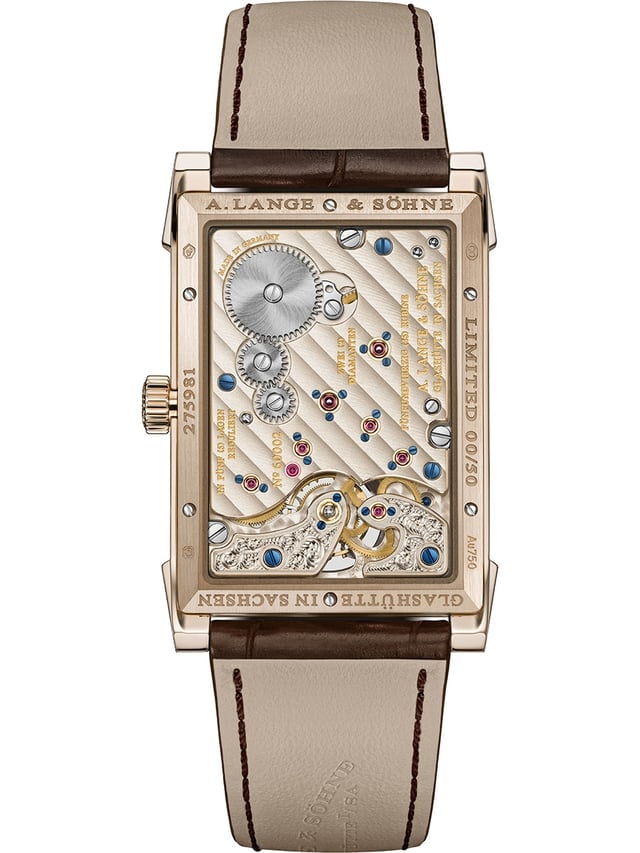
The calibre L042.1 is the heart of the watch. It is a manually wound rectangular movement with a tourbillon, a large date, and a stop-seconds mechanism. The power reserve is 84 hours, which is generous for a manually wound tourbillon and means the watch can be wound every few days without anxiety. The frequency is 21,600 vph, a traditional beat rate that suits the classical character of the piece. The movement has 29 jewels.
The architecture is worth studying. A rectangular movement cannot simply be a round movement squeezed into a different case. The bridges, the gear train, and the tourbillon cage all have to be arranged around the shape. Lange's solution is elegant: the tourbillon sits at one end, the date mechanism at the other, and the mainspring barrel and gear train fill the space between. The stop-seconds mechanism is patented, and it allows the tourbillon to be stopped for precise time setting. That is a small detail in daily use, but it is a significant technical achievement in a tourbillon.
The finishing is what separates this movement from a merely competent one. The bridges are decorated with Glashütte ribbing, the bevels are polished by hand, and the balance cock is engraved. The tourbillon cage is finished with the same attention. Gold chatons and blued screws are present, and the overall effect is one of density and refinement. This is not a movement that looks empty. It looks engineered, and it looks hand-finished. The Handwerkskunst designation is not marketing fluff here; it is a description of the labour involved.
The Tourbillon and Stop-Seconds
The tourbillon is often described as a solution to a problem that no longer exists. In a pocket watch, the tourbillon averaged out the effects of gravity on the balance wheel. In a wristwatch, the wearer's movements do much of that work. But the tourbillon remains a symbol of horological ambition, and in the Cabaret Tourbillon it is more than a symbol. The stop-seconds mechanism is the practical innovation. It allows the tourbillon to be stopped when the crown is pulled out, which means the watch can be set to the second. That is a feature that many tourbillons lack, and it makes the watch easier to live with.
The tourbillon cage itself is a small sculpture. It is finished by hand, and the bridge that holds it is polished and beveled. The aperture in the dial frames it like a stage. It is not a large tourbillon, but it is proportionate to the rectangular case. The effect is intimate rather than spectacular. You have to look closely to appreciate it, and that is part of the appeal. This is a watch for someone who enjoys the act of looking.
On the Wrist
The Cabaret Tourbillon Honeygold wears like a rectangular dress watch should. The case is long enough to sit properly on the wrist, but it is not oversized. The honey gold gives it a pleasant weight, and the leather strap keeps it close to the skin. The rectangular shape means the watch sits flat, and the lugs are shaped to follow the wrist. It is comfortable for a full evening, and it does not feel fragile, even though it is clearly not a watch for rough work.
The balance is good. The tourbillon adds visual weight to the lower half of the dial, but the large date at the top keeps the composition from feeling bottom-heavy. On the wrist, the watch reads as formal, but the tourbillon gives it a quiet drama. It is the kind of watch that catches the light when you move your wrist, not when you wave your arm. The strap is hand-stitched leather, and the pin buckle is honey gold. The whole package feels considered.
Accuracy and Ownership
Lange does not submit this watch for COSC certification, and that is not the point. The movement is adjusted and finished to Lange's own standards, and in real-world use you can expect stable performance within a few seconds per day. The tourbillon is a chronometric device, but it is also a piece of theatre. The stop-seconds mechanism makes setting the watch precise, and the 84-hour power reserve means you can take it off for a weekend and pick it up again without resetting.
Ownership is a ritual. The watch is manually wound, so you interact with it every few days. The winding action is smooth, and the power reserve gives you flexibility. The large date is easy to read, and the hands are legible against the black dial. It is not a watch that demands attention, but it does reward routine. You wind it, set it, and wear it. The simplicity of that interaction is part of the pleasure.
Service and Long-Term Care
Service should be handled by A. Lange & Söhne. The tourbillon and the Handwerkskunst finishing require specialist care, and you should not entrust this watch to a general watchmaker. The service interval is not a fixed number in the way it is for a simple three-hand watch, but you should expect to send it to the manufacture when the amplitude drops or the rate becomes inconsistent. The cost is significant, as it is for any high-complication Lange, but the watch is built to be serviced and passed on.
Long-term care is about more than servicing. The honey gold case is harder than traditional gold, but it is still gold. It will pick up marks if you wear it carelessly. The sapphire crystal is scratch-resistant, but the dial and hands should be kept away from moisture and impact. This is a watch for formal occasions, not for the beach or the workshop. Treated with respect, it will last for generations.
Collecting and Value
The Cabaret Tourbillon Honeygold is limited to 30 pieces, and that scarcity matters. It is a Handwerkskunst piece, which means it sits at the top of Lange's craft hierarchy. The honey gold case and the hand-finished dial make it distinct from the standard Cabaret Tourbillon. For a collector, the appeal is not just the tourbillon; it is the combination of a rectangular movement, a patented stop-seconds mechanism, and a level of finishing that is rarely applied to a rectangular watch.
Value is difficult to pin down because so few pieces trade publicly. Limited Lange tourbillons tend to hold their value, and Handwerkskunst pieces are sought after by collectors who understand the labour involved. This is not a watch to buy for short-term speculation. It is a watch to buy because you want a rectangular tourbillon that is finished to a standard you will not find elsewhere. The price is on request, and the secondary market is private. If you find one, you should expect to pay a premium for the scarcity and the craft.
The Competition
The rectangular tourbillon is a small field. Patek Philippe's Gondolo 10-Day Tourbillon is the closest rival in spirit, with a rectangular case and a long power reserve. Vacheron Constantin's Malte Tourbillon is tonneau-shaped rather than rectangular, but it shares the dressy, hand-finished ethos. Jaeger-LeCoultre's Reverso Tribute Tourbillon offers a rectangular case and a reversible design, but it is a different kind of object. The Lange is distinct because of its movement architecture and its Handwerkskunst finishing. It is not the most obvious choice, and that is precisely the point.
Final Verdict
The Cabaret Tourbillon Honeygold is a rare thing: a rectangular tourbillon that does not feel like a compromise. It is technically serious, visually restrained, and finished to a level that rewards close inspection. It is not for everyone. It is not a daily beater, and it is not a watch for someone who wants to be noticed from across the room. But for the collector who understands movement architecture and hand-finishing, it is a compelling piece. It is Lange at its most deliberate.