Brand context: Akrivia and the independent atelier
Akrivia was founded in Geneva in 2012 by Rexhep Rexhepi, a watchmaker trained in the classical tradition and known for small-series, hand-finished watches. The brand's output is deliberately limited, and its reputation rests on traditional finishing, unusual complications, and the personal involvement of its founder. The Chronographe à Sonnerie sits at the more experimental end of that output, combining a chronograph with a striking mechanism in a package aimed at experienced collectors.
That context matters for buyers. Akrivia is not a mainstream brand with a global service network and a published catalogue of every variant. It is an atelier brand, and the watch should be evaluated as much by the conversation with the maker as by the spec sheet. The Chronographe à Sonnerie is a statement of intent: it says that the brand can combine a practical complication with a poetic one, and that it can do so in a case that is meant to be worn rather than locked away.
Movement: hand-wound, complicated, and deliberately opaque
The movement is hand-wound and in-house, with a chronograph and a sonnerie. Akrivia does not publicly disclose the caliber designation, power reserve, frequency, or jewel count for this reference, so I am not going to fill those gaps with guesses. What can be said is that the architecture is intended to be seen: the finishing, the bridges, and the interplay of levers and springs are part of the appeal. A sonnerie adds a striking mechanism to an already complex chronograph, and that means more parts, more adjustment, and more service specialization.
In use, the movement feels mechanical in the best sense. Winding is deliberate, the chronograph pushers have a positive action, and the sonnerie is best appreciated in a quiet room. This is not a movement that hides its complexity behind a sealed caseback; it is a movement that asks you to pay attention. Buyers should request the movement dossier from Akrivia, including service history, timing information, and any specific operating instructions for the sonnerie.
Case, crystal, and strap: what the spec sheet does not say
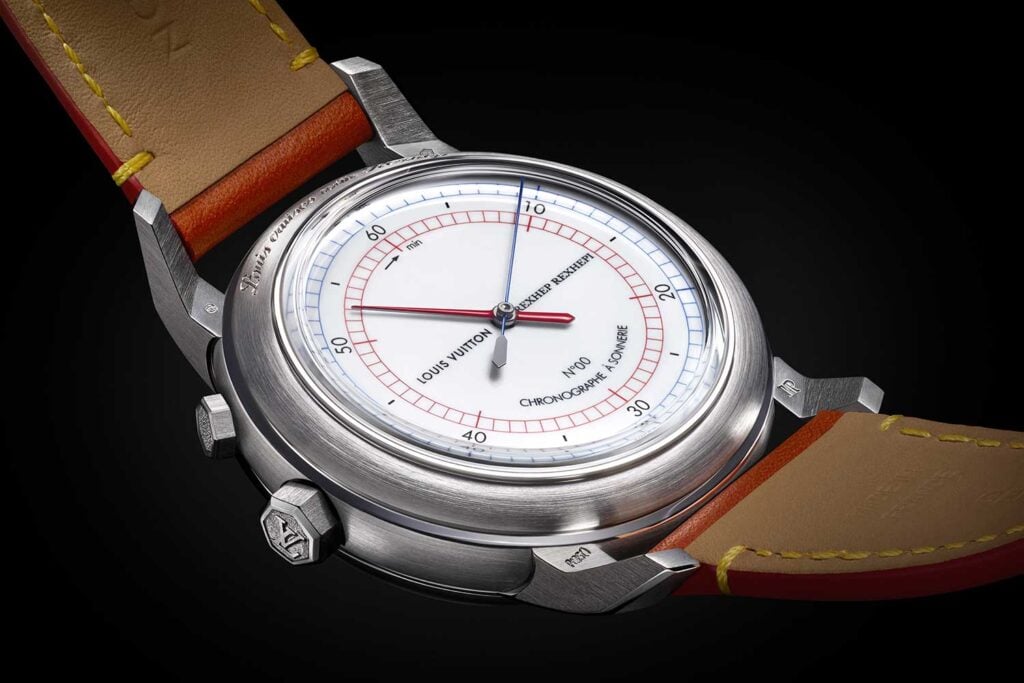
Akrivia has not published a full set of case dimensions for this reference, so I have left the diameter, thickness, and lug-to-lug measurements unstated rather than invent them. The same applies to case material and water resistance. What I can describe is the experience: the case is finely finished, with a restrained profile that sits close to the wrist. The crystal is sapphire, the lume is absent, and the watch is supplied on a leather strap with a pin buckle. This is a formal watch, not a sports watch, and it should be treated accordingly.
The case finishing is the kind that rewards a loupe, but it also works at arm's length. The surfaces are clean, the transitions are crisp, and the watch does not rely on size to make an impression. The strap is supple and breaks in quickly, which matters for a watch that you might wear for a full day at a desk. The pin buckle is traditional and keeps the profile low, though buyers who prefer a deployant clasp should ask the atelier about options.
On the wrist: comfort, balance, and presence
On the wrist, the Chronographe à Sonnerie behaves like a formal watch first and a complication piece second. It does not flop or rotate on the wrist; the lugs curve in a way that keeps the case centered, and the leather strap is supple enough to break in quickly. The weight is present but not distracting, and the case sits close enough to slide under a shirt cuff. The chronograph pushers are reachable without shifting the watch, and the crown is easy to grip when you need to wind it.
The sonnerie changes the experience only when you ask it to. In a quiet room, it is a reminder that this is not a conventional chronograph; in a busy day, it recedes into the background. The watch does not feel fragile, but it does feel special, which is a different kind of daily-wear challenge. I would wear it for office days, dinners, and travel where a jacket is part of the plan, rather than for weekends that involve tools or water.
Wrist presence is a four out of five. It has the quiet confidence of an independent dress watch, with a sonnerie that draws attention only when you want it to. It is not a watch for someone who wants to be noticed across a room; it is a watch for someone who wants to be noticed by the person sitting next to them.
Legibility and daily usability
Legibility is good for a formal watch. The dial is not cluttered by sports-watch graphics, and the chronograph is easy to read when you need it. The absence of lume is not a problem for the intended use, but it does mean that the watch is not a nighttime tool. The sonnerie is not a substitute for an alarm in a noisy environment; it is a mechanical flourish, not a practical reminder.
The chronograph is usable in daily life, but it is not the reason to buy this watch. The reason is the combination: a chronograph that you can operate, a sonnerie that you can enjoy, and a case that you can wear. The watch is at its best when you are not in a hurry. It is not a grab-and-go sports chronograph, and it does not pretend to be.
Accuracy and real-world timing
Akrivia's reputation is built on traditional finishing and regulation, but the exact rate tolerance for this reference is not publicly stated. In real-world use, I would expect a well-adjusted hand-wound movement to hold a stable rate, with the usual caveat that a sonnerie and chronograph can affect amplitude depending on how often they are used. Ask the atelier for a timing sheet and check the rate over a full week, including a day with the chronograph running and a day with the sonnerie exercised. That is more useful than a single bench reading.
If you are a collector who checks a watch against a reference clock every morning, you will want to establish a baseline. If you are a wearer who sets the watch once a week and enjoys the ritual of winding, the exact rate will matter less than the consistency. Either way, the movement should be treated as a precision instrument that benefits from regular service and careful handling.
Variants, family, and alternatives
No other publicly documented variants of ref. LVRR-01 were confirmed at the time of writing. The reference under review is the one to use as a starting point, and buyers should ask Akrivia directly about dial options, strap configurations, and any unique-piece variations. The Chronographe à Sonnerie does not have a long public family tree, so the market is more about individual pieces than a catalogue of references.
Within Akrivia, the Chronomètre Contemporain and Chronomètre Contemporain II are the better-known siblings. They are time-only or time-focused pieces with the same independent-atelier ethos, but they do not offer the chronograph-plus-sonnerie combination. If you are comparing this watch to other independent striking watches, the F.P. Journe Sonnerie Souveraine is the obvious reference point, though it lacks the chronograph. The Patek Philippe 5078 is a formal minute repeater with a similar collector brief, and the Audemars Piguet Royal Oak Concept Supersonnerie shows how modern striking technology can be packaged in a sportier case.
There is no meaningful homage market for a sonnerie chronograph. The combination is too specialized, and the finishing is too specific to the atelier. If you want an affordable dress chronograph, there are many good options, but they will not deliver the same mechanical voice. This is a watch that exists at the top of the independent market, and it should be compared with other independent pieces rather than with mass-produced chronographs.
Investment value and ownership
Akrivia does not publish a public MSRP for this reference, and the pre-owned market is not publicly indexed. That makes precise investment commentary impossible. What can be said is that Akrivia's small production and collector following support demand, but a sonnerie chronograph is a niche object with limited liquidity. Buy it because you want the object and the experience, not because you need to sell it quickly.
The auction history for ref. LVRR-01 is not established. Akrivia pieces rarely appear at public auction, and when they do, the results depend on provenance, condition, and the specific configuration. If you are buying on the secondary market, insist on a full service history and a movement dossier. The cost of servicing a sonnerie chronograph can be significant, and it is not a watch that should be bought without a conversation with the atelier.
Service and ownership realities
Akrivia does not publish a fixed service interval or approximate service cost for this reference. Service should go through Akrivia or an approved specialist, because sonnerie and chronograph work is highly specialized. The watch is not a candidate for a local watchmaker who has never worked on a striking mechanism. Owners should budget for careful handling, insurance, and a service relationship that may involve shipping the watch to Geneva.
That is part of the ownership experience. An independent atelier watch is not a commodity, and the service relationship is part of the value. If you want a watch that can be serviced at any mall, this is not it. If you want a watch that comes with a direct connection to the maker, the trade-off may be worth it.
Pros and cons
Pros: the combination of chronograph and sonnerie is rare and emotionally compelling; the finishing is hand-finished and independent; the wrist presence is restrained and comfortable; and the collector appeal is strong. Cons: key specifications and service costs are not publicly documented; the service network is specialized; resale liquidity is limited; and the watch is not a sports watch, so water and shock resistance should be treated conservatively.
Final verdict
The Akrivia Chronographe à Sonnerie is a watch for collectors who value mechanical voice and hand finishing over published specifications. On the wrist, it is more comfortable and more discreet than its complication count suggests, but it demands the care of a formal independent piece. If you can verify the movement dossier and accept the service realities, it is a compelling and deeply personal alternative to a mainstream grand complication.