The bar is the point
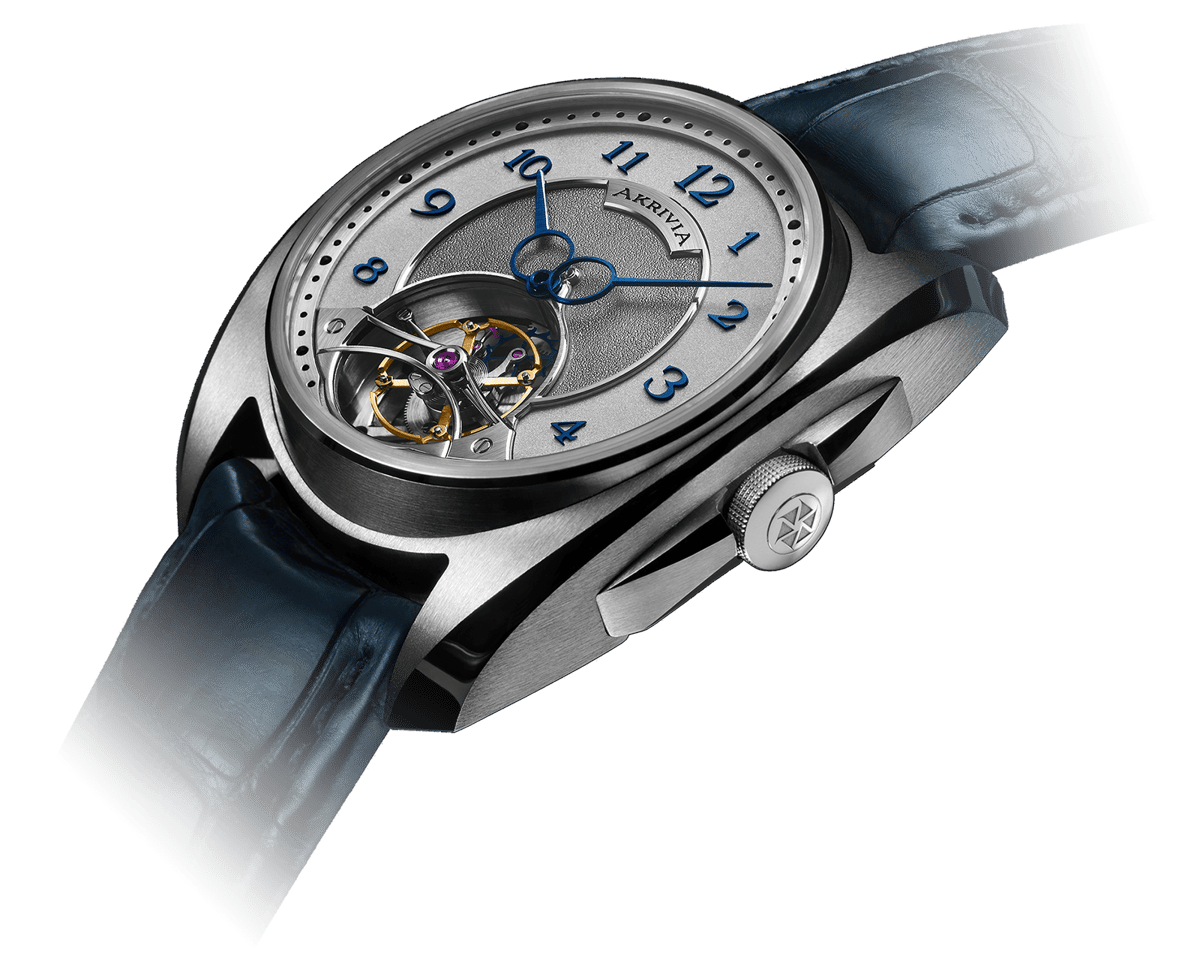
Every serious collection has a hinge moment — the day the dial stops being the whole story and the architecture underneath starts doing the talking. For a lot of young collectors that moment arrives in front of an independent, not a dive watch. The Akrivia Tourbillon Barrette Miroir, reference AK-05, is that moment cast in precious metal and sapphire: a hand-wound tourbillon whose entire argument is a single, mirror-polished bar.
The name is a set of instructions. Barrette — bar. Miroir — mirror. Look through the crystal and you find a bridge shaped like a blade, polished until it stops behaving like metal and starts behaving like a black mirror, holding the tourbillon cage in place. Everything else — the plates, the bridges, the screws — is arranged around that one gesture. It is the horological equivalent of a designer who builds an entire collection around a single seam.
This is not a watch you will see in a mall. Akrivia makes very few pieces a year, sells most of them before they are finished, and does essentially no marketing. Which is exactly why the Barrette Miroir has become a signal among the people who do know: the collector who wears one to a Phillips preview, the founder who wears one to a board meeting and never mentions it.
Akrivia, Rexhep Rexhepi, and the Geneva problem
Akrivia was founded in Geneva in 2012 by Rexhep Rexhepi, who was born in Kosovo in 1987, moved to Switzerland as a child, and was in a watchmaking apprenticeship at Patek Philippe by fourteen. From there: F.P. Journe, then a stretch in complications development, then his own bench. The résumé matters because it explains the watch. Patek taught him finishing discipline; Journe taught him that a movement can be a piece of design rather than a parts bin.
What Rexhepi built is a small atelier in Geneva — a handful of watchmakers, no industrial scale, no celebrity ambassadors, no boutique strategy. The output is deliberately tiny. In 2018 the Chronomètre Contemporain won the Men's Watch Prize at the Grand Prix d'Horlogerie de Genève, which is the point at which the wider market noticed. Since then, Rexhep Rexhepi pieces have become some of the hardest watches in the world to buy at retail and among the most discussed lots at auction.
The Barrette Miroir sits earlier in that arc, closer to the pure craft end. It is a tourbillon built by a workshop that was still introducing itself — which is precisely why it reads as more personal than product. There is no marketing department in the room. There is a man at a bench who decided the bridge should be perfect.
What you are actually looking at
The dial side is organised around the tourbillon and the bar that bridges it. There is no date, no chronograph, no GMT hand competing for attention. It is a one-idea watch, and the idea is finishing. That is a rarer proposition than it sounds. Most high-end watches are designed to be legible in a photograph — big markers, strong contrast, a recognisable silhouette. The Barrette Miroir is designed to be legible in the hand, at an angle, in low light, when the bar catches a window and turns into a hard white line.
This is the difference between a watch that photographs well and a watch that lives well. The former is a social media asset. The latter is the reason people who own forty watches still reach for the same one.
Finishing as the actual complication
Black polish — the technique that turns steel into a mirror which only reveals itself at an angle — is the hardest finishing in watchmaking and the cheapest to fake in a photograph. On the Barrette Miroir it is the headline rather than a supporting detail. The bar itself, the cage, the steelwork: all of it is about angles and light.
Hold the watch at arm's length and it looks like a clean, quiet object. Tilt it fifteen degrees and the bar goes from invisible to a hard line of white. That is the trick of black polishing. It is a party trick that takes dozens of hours per component, and it cannot be machined, stamped or automated. Every one of those mirror surfaces is a human being pressing steel against a tin lap and checking the result under a loupe.
The interior angles are the tell. Anyone can polish a flat surface. Polishing the inside corner where two surfaces meet, without rounding it over, is where a workshop reveals whether it is serious. Akrivia is serious. Look at the cage arms under magnification and you will see a crispness that industrial brands simply do not produce, because the labour cost makes it commercially irrational.
The movement
Hand-wound, in-house, tourbillon. Akrivia does not publish a full technical dossier on this reference, and I am not going to invent one — no caliber number, no frequency, no power reserve figure that I cannot stand behind. What can be said is what the architecture tells you.
This is a movement built outward from the tourbillon rather than a base caliber with a cage bolted on. The bar exists to hold the cage and to be looked at, and everything else is subordinated to that. Hand-winding is the correct choice here: a rotor would obscure the very thing you bought the watch for, and the daily wind keeps the owner in physical contact with the mechanism. On a piece like this, that contact is the product.
The finishing language is consistent front and back — anglage on the bridges, polished steelwork, a cage that is finished to the same standard as the visible plates rather than being left raw because nobody was supposed to see it. In independent watchmaking, that consistency is the difference between a good watch and a piece that ends up in a museum case.
On the wrist
This is a watch that announces itself through weight and angle rather than size. The precious-metal case gives it a dense, settled feeling, and because there is no bezel-heavy mass or chunky crown guard to throw the balance off, it sits close and stays put under a shirt cuff. The leather strap and pin buckle keep the whole thing traditional — no deployant hardware cluttering the underside, no micro-adjust theatre. It wears like a dress watch that happens to have a hole in it.
The winding ritual is half the ownership experience. A hand-wound tourbillon asks to be wound daily, and Akrivia's crown feel is part of the charm — you feel the mainspring load rather than spin a rotor and hope. If you are used to automatics, the first week feels like a chore and the second week feels like a ceremony. By the third week you will find yourself winding it at your desk for no reason at all.
One honest caveat: a tourbillon aperture is a hole in a watch, and holes let in dust, moisture and the consequences of a careless Saturday. Treat it like the dress watch it is. This is not a piece for the pool, the gym or the airport shower.
Accuracy and ownership
There is no published chronometer certification for this reference, and it would be a mistake to buy a hand-finished independent tourbillon as a timing instrument. Expect a well-regulated example to hold within a few seconds a day in normal wear, with the usual caveats: hand-wound movements are sensitive to how consistently you wind them, and a tourbillon cage is a delicate assembly that rewards gentle handling.
The tourbillon's job here is optical and philosophical. It is the reason the bar exists, not the reason the watch keeps time. Anyone who tells you a wrist-borne tourbillon is a meaningful accuracy advantage is selling you something. Anyone who tells you it is the most beautiful thing to watch through a caseback is telling the truth.
Service means a return to Geneva. There is no independent network for a hand-finished tourbillon of this type, and any watchmaker who is not the maker is a risk you should not take. Budget for the round trip, the wait and the insurance — and factor it in before you buy, not after.
The market
Akrivia is one of the clearest examples of a structural scarcity story in modern watchmaking. The workshop's capacity is fixed by the number of trained hands in the room, and that number grows slowly. Demand, meanwhile, has been pulled upward by the 2018 GPHG win and by the broader migration of collector capital toward independents — the same shift that has turned F.P. Journe and Kari Voutilainen into auction fixtures and pushed waiting lists into the years.
Akrivia and Rexhep Rexhepi pieces appear with some regularity at Phillips and Christie's Geneva sales, generally at strong premiums to original retail. No major public auction result is specifically attributable to the Tourbillon Barrette Miroir, so treat this model's secondary market as private treaty rather than benchmarked. Prices are negotiated between collectors, not printed in a catalogue.
The trend, though, is clear. When supply cannot respond to demand and the maker's reputation is still compounding rather than plateauing, the direction of travel is one way. This is not a flip. It is a piece you keep and let the market come to.
The alternatives
If you want the same philosophy with less spectacle, the Rexhep Rexhepi Chronomètre Contemporain II is the obvious answer: same bench, same finishing discipline, a closed dial and a more restrained brief. If you want the tourbillon conversation at the highest level, the F.P. Journe Tourbillon Souverain is the historical reference point and the watch Rexhepi grew up around. Kari Voutilainen makes the other great independent argument that finishing is the complication. Greubel Forsey and De Bethune offer far more architectural, far more extroverted takes on the same mechanism.
At the other end of the market, the Chinese tourbillon has become genuinely interesting. Sugess and Seagull both produce working tourbillons for four figures, and Frederique Constant builds a manufacture tourbillon at a fraction of independent pricing. None of them are in the same conversation as the Akrivia — the finishing gap is not a matter of degree, it is a matter of category — but they are legitimate ways to live with the visual drama of an open cage while you wait for an allocation that may never come.
Verdict
The Tourbillon Barrette Miroir is the purest statement of what Akrivia is: a workshop that treats finishing as the complication and refuses to dress it up with specifications. It is not the watch you buy to tick boxes — it is the watch you buy because you have stopped needing to. If you can get one, get one. The market has already decided the rest.