Akrivia Tourbillon Regulator AK04: The Regulator You Can Actually Wear
There is a particular kind of watch that exists to be admired under a loupe and then returned to a safe. The Akrivia Tourbillon Regulator is not that watch — or at least, it does not have to be. Over a week of ordinary wear, what struck me was not the tourbillon's spectacle (though it is spectacular) but how naturally the regulator layout settles into daily use. You glance down, you read the minutes, you find the hours where they belong, and you get on with your day.
Akrivia is the Geneva workshop of Rexhep Rexhepi, and the Tourbillon Regulator is one of its core expressions: a hand-wound tourbillon arranged on a regulator dial. Reference AK04 is the subject here. It is a small-series object, made in numbers that barely register against the output of the big houses, and it is priced accordingly. But the question I set out to answer was simpler: what is it like to live with?
The short answer is that it is easier than you might expect, and more rewarding than most watches at any price. The longer answer involves the dial, the finishing, the strap, and the quiet compromises that come with any tourbillon.
A young house with old hands
Akrivia was founded in Geneva in 2012 by Rexhep Rexhepi, a watchmaker born in Kosovo who trained at Patek Philippe and spent time at F.P. Journe before setting up on his own. That pedigree matters, because it explains the house's priorities: classical finishing, traditional architecture, and a refusal to chase volume. The workshop's output is tiny, and each piece is finished by hand to a standard that is increasingly rare.
The Tourbillon Regulator belongs to that tradition. It is not a sports watch, not a travel watch, and not a complication-flexing exercise. It is a tourbillon watch with a regulator dial — a layout borrowed from observatory clocks, where the minutes are central and dominant, the hours sit in their own subdial, and the seconds are read from the tourbillon cage itself. In Akrivia's hands, that layout becomes both a technical statement and a daily instrument.
It is worth pausing on what 'independent' means here. Akrivia is not a brand that outsources its identity. The movements are conceived and finished in-house, the cases are made in small batches, and production is deliberately limited. That has two consequences for an owner: you are buying something genuinely rare, and you are buying into a service relationship with a small workshop rather than a global network. Both are worth understanding before you commit.
The regulator layout, explained
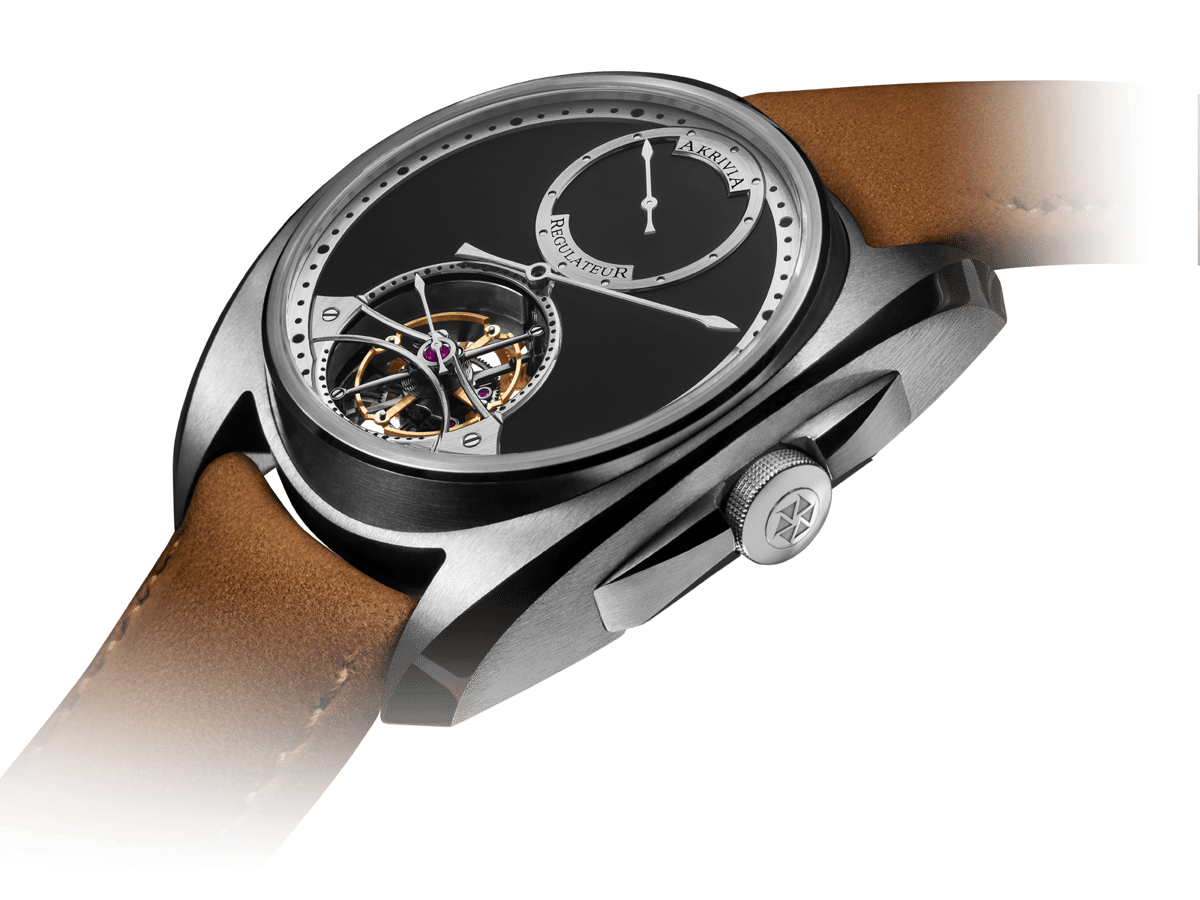
A regulator dial separates the indications so that each can be read at a glance without interference. On the AK04, the minutes hand is the longest and most prominent, sweeping around the outer track. The hours are relegated to a subdial, and the tourbillon at six o'clock doubles as the running seconds. It is a layout that sounds fussy on paper and feels obvious on the wrist.
What makes it work is the hierarchy. You read minutes first because minutes are what you need most of the time. The hours subdial is there when you need to anchor yourself. And the tourbillon, rotating once a minute, gives you a constant, hypnotic confirmation that the watch is running. In a week of wear, I never once found myself hunting for the time.
Dial and hands: the instrument aesthetic
The dial is where a regulator lives or dies, and Akrivia has got the proportions right. The minutes track is clear and unobstructed, the hour subdial is small enough to recede but large enough to read, and the tourbillon aperture at six is framed rather than gaping. The hands are slender and finely finished, with enough contrast against the dial to remain legible without shouting. There is no lume, no date, no text beyond the essentials — just the architecture of time.
What I appreciate most is the restraint. A regulator dial can easily become a diagram, all lines and labels. This one feels like a watch. The finishing on the hands catches the light in a way that draws the eye without distracting, and the dial surface has a subtle depth that rewards a second look. Under a loupe, the printing is crisp; at arm's length, it disappears into a clean, readable whole.
Movement and finishing
The AK04 is powered by an in-house, hand-wound tourbillon movement. Akrivia does not publish every specification, and I would rather leave a number blank than invent one, but the essentials are clear: the movement is conceived, finished and assembled in Geneva, and it is finished to a standard that rewards close inspection. Bridges carry Geneva stripes; steel components are black-polished; the tourbillon cage is bevelled and finished by hand.
Winding it is part of the ritual. A hand-wound tourbillon asks for a few turns each morning, and the feel of the crown — the slight resistance, the sense of engagement — is one of the small pleasures of ownership. There is no rotor to obscure the view, and the caseback (sapphire, naturally) gives you the full architecture. If you are the kind of person who turns a watch over on the desk, this is a watch that rewards the habit.
The tourbillon itself is the centrepiece, and it is worth looking at closely. The cage is light, the finishing is clean, and the rotation is smooth and quiet. A tourbillon in a wristwatch is, strictly speaking, a solution to a problem that no longer exists — positional error in pocket watches — but that is beside the point. What matters is that the execution is honest: the cage is not there to hide mediocre finishing, it is there because the watchmaker wanted to make it.
What I cannot tell you is the exact power reserve or frequency, because Akrivia does not publish those figures for this reference in a way I can verify. What I can tell you is that the movement behaves like a well-sorted independent: it is regulated by hand, it is not chronometer-certified, and it asks to be treated as a precision object rather than a tool.
Case, strap and the details that matter
The case is gold — warm, solid, and finished with the kind of restrained geometry that photographs poorly and feels wonderful in person. The lugs are sculpted rather than slab-sided, and the transition from case to strap is clean. There is no unnecessary bulk, no aggressive bevel, no attempt to look sporty. It is a dress watch, and it knows it.
The case finishing deserves a closer look. The surfaces are polished and brushed in the right places, and the lugs have a sculpted quality that is hard to capture in photographs. It is the kind of case that looks simple until you compare it with a lesser one, at which point the differences — the crispness of the bevels, the evenness of the brushing, the way the strap fits between the lugs — become obvious.
The crystal is sapphire, front and back, which is what you would expect at this level. The strap is leather, supple and well-judged in thickness, and the clasp is a pin buckle — a detail I appreciate, because a deployant can add bulk and complexity to a watch that is trying to stay elegant. The buckle is finished to the same standard as the case, which is the kind of thing you notice only when it is missing.
Water resistance is not the point of this watch, and Akrivia does not position it as anything other than a dress piece. Treat it accordingly: no swimming, no showering, no gardening. That is not a criticism; it is a category distinction. A tourbillon regulator is not a G-Shock, and it should not pretend to be.
On the wrist
Here is where the AK04 surprised me. Tourbillons have a reputation for being fragile, top-heavy and awkward — watches that sit on the wrist like a Fabergé egg. The Akrivia does not. The gold case has a warmth and a solidity that feel reassuring rather than ostentatious, and the strap is supple enough that the watch settles quickly. There is no sense of the case fighting the wrist.
The balance is the thing. A regulator dial puts visual weight in the centre, and the tourbillon at six adds a focal point low on the dial. On the wrist, that translates into a watch that feels centred and calm. It does not slide, it does not rotate, and it does not demand constant adjustment. I wore it with a shirt cuff, with a knit, and with a jacket, and it never felt like an event.
Is it a daily watch? For me, yes — with caveats. It is a dress watch in temperament, and it does not pretend to be water-resistant or shock-proof. But as a watch to wear to the office, to dinner, to a meeting, it is entirely at home. The regulator layout is legible in low light (there is no lume, but the contrast is good), and the tourbillon gives you something to look at when the conversation lags.
One thing I noticed over the week: the watch encourages a slower relationship with time. Because you wind it, because you read the minutes first, because the tourbillon is always moving, you look at it more often than you look at a quartz watch. That is either the point or a distraction, depending on your temperament. For me, it was the point.
A week on the wrist
I wore the AK04 for seven days, rotating it with nothing else. Monday: office, shirt cuff, the watch slipped under the cuff without complaint. Tuesday: dinner, jacket, the gold case warmed up under the lights. Wednesday: a long train journey, plenty of time to watch the tourbillon. Thursday: a day of writing, the regulator layout proving its worth every time I glanced down. Friday: a gallery opening, where the watch drew a couple of quiet compliments. Saturday: a market, a coffee, a walk — the watch felt slightly overdressed but never wrong. Sunday: a day off, and the watch stayed on.
What I learned is that the AK04 is not a watch that demands a special occasion. It is a watch that improves ordinary ones. That is a rare quality, and it is the strongest argument for buying one.
Legibility and daily use
Legibility is the regulator's party trick. Because the minutes hand is long and the hour subdial is small, you can read the time at a glance from an awkward angle — the classic test of a real-world watch. The dial furniture is clean, the typography is restrained, and there is no date window to break the symmetry. If you need a date, this is not your watch. If you do not, the purity is a pleasure.
The lack of lume is worth noting. This is a dress tourbillon, not a field watch, and Akrivia has not pretended otherwise. In a dark restaurant, you will rely on ambient light. In a week of wear, I did not miss the lume, but I did notice its absence when I checked the time in a cinema.
The strap deserves a second mention. A watch like this lives or dies by its strap, and the leather supplied is comfortable from the first wear — no break-in period, no stiffness. The pin buckle is easy to use and sits flat on the wrist. If you are between sizes, the strap holes are well spaced, which is a small thing that makes a big difference over time.
Accuracy
A hand-finished independent tourbillon is not a quartz watch, and it is not a COSC-certified chronometer either. Akrivia regulates each movement by hand, and the realistic expectation is a small handful of seconds a day, with variation depending on how the watch is worn and rested. The regulator layout makes it easy to check against a reference time: set the minutes, note the deviation, and adjust once a week if you are particular.
What matters more than the number is the consistency. In my time with the watch, it behaved predictably — no sudden jumps, no drama. That is what you want from a tourbillon: not a laboratory result, but a dependable companion.
Occasions
This is a formal and dress watch first. It pairs with a suit, a tuxedo, and a good knit. It is not a sports watch, not a travel watch (no GMT, no date), and not a beater. Within those limits, it is remarkably versatile: the gold case and leather strap read as elegant without being flashy, and the regulator dial gives it an intellectual edge that works in professional settings.
If you are looking for one watch to do everything, this is not it. If you are looking for a watch that makes the ordinary moments of a day feel a little more considered, it is exactly right.
Value and ownership
Akrivia does not publish a list price in the way the big houses do; pieces are typically price-on-request, and the secondary market is thin and private. What I can say is that you are paying for hand-finishing, scarcity, and the Rexhepi name — all of which have held up well among collectors. This is not a watch to buy as a financial instrument, but it is a watch that has tended to find willing buyers when it comes to market.
Service is a consideration. The movement is low-volume and the parts are not in general circulation, so servicing means returning the watch to Geneva. That is normal for independent horology, but it is worth factoring into the ownership calculation. If you are the kind of owner who likes a local watchmaker to open the case, this is not the watch for you.
Insurance is another practical point. A watch of this value should be scheduled on a specialist policy, and you should keep the paperwork — the certificate, the service records, the original box — because provenance matters in the private market. None of that is glamorous, but it is part of owning an independent.
Alternatives
If you want a tourbillon from an independent, the obvious comparisons are F.P. Journe's Tourbillon Souverain, Laurent Ferrier's Galet Tourbillon, and the work of Kari Voutilainen. Each has a different temperament: the Journe is more architectural, the Ferrier softer, the Voutilainen more decorative. The Akrivia sits between them, with a regulator dial that is more instrument-like than any of the three.
If you want the regulator look without the tourbillon, Chronoswiss has been making regulator dials for decades. If you want the tourbillon drama at a fraction of the price, there are Chinese tourbillons that will give you the visual effect — though not the finishing, and not the same sense of occasion.
Verdict
The Akrivia Tourbillon Regulator AK04 is a watch that asks you to slow down, wind it, and look. It is not cheap, it is not practical in the utilitarian sense, and it is not for everyone. But as a daily-wear dress watch for someone who cares about hand-finishing and independent watchmaking, it is hard to beat. It wears beautifully, reads clearly, and reminds you — every time you check the time — why mechanical watches still matter.
If you are in the market for a small-series tourbillon and you want something you can actually wear, put this on your list. If you want a watch to throw in a bag and forget about, buy something else. The AK04 is not that watch, and it never pretended to be.