A hand-wound corrective
There is a version of watch collecting in which everything gets bigger, thicker, and more aggressively engineered until the object on your wrist resembles a piece of safety equipment. Alpina, quietly and without much fanfare, has spent the last several years offering the opposite argument. The Tropic-Proof Handwinding — reference AL-480S2H6 — is that argument in steel.
This is not a limited-edition hype drop. It is not a collaboration with a streetwear label. It is a small Swiss brand with a real archive reaching back to the middle of the last century, pulling out a name it actually owns, and building a watch around a movement you have to wind yourself. In 2025, that counts as a statement.
Alpina, briefly
Alpina was founded in Winterthur in 1883 by Gottlieb Hauser, originally as a cooperative of Swiss watchmakers banding together against the bigger houses. That cooperative spirit shaped the brand: practical, well-made, legible watches sold at prices working professionals could justify. The company's defining moment came in 1938 with the Alpiner 4, a sports watch that combined antimagnetic protection, shock resistance, water resistance, and a stainless-steel case — four qualities that were not commonly bundled together at the time.
The Tropic-Proof name belongs to the same lineage. Mid-century Alpina marketed watches designed to survive heat, humidity, and the specific wear-and-tear of tropical climates — a very real concern for anyone wearing a mechanical watch in equatorial heat, where seals, lubricants, and dial finishes all had to hold up. The modern Tropic-Proof revives that idea, but the emphasis has shifted. This is less a survival instrument and more a piece of wearable nostalgia, built for people who like the look of a 1950s tool watch and the ritual of a manual movement.
That is worth stating plainly, because it sets expectations. Alpina today is a heritage brand operating in the mid-market, not a manufacture chasing chronometer certificates. What it does well is memory — and this reference is a good example of memory done with restraint.
The case and the dial
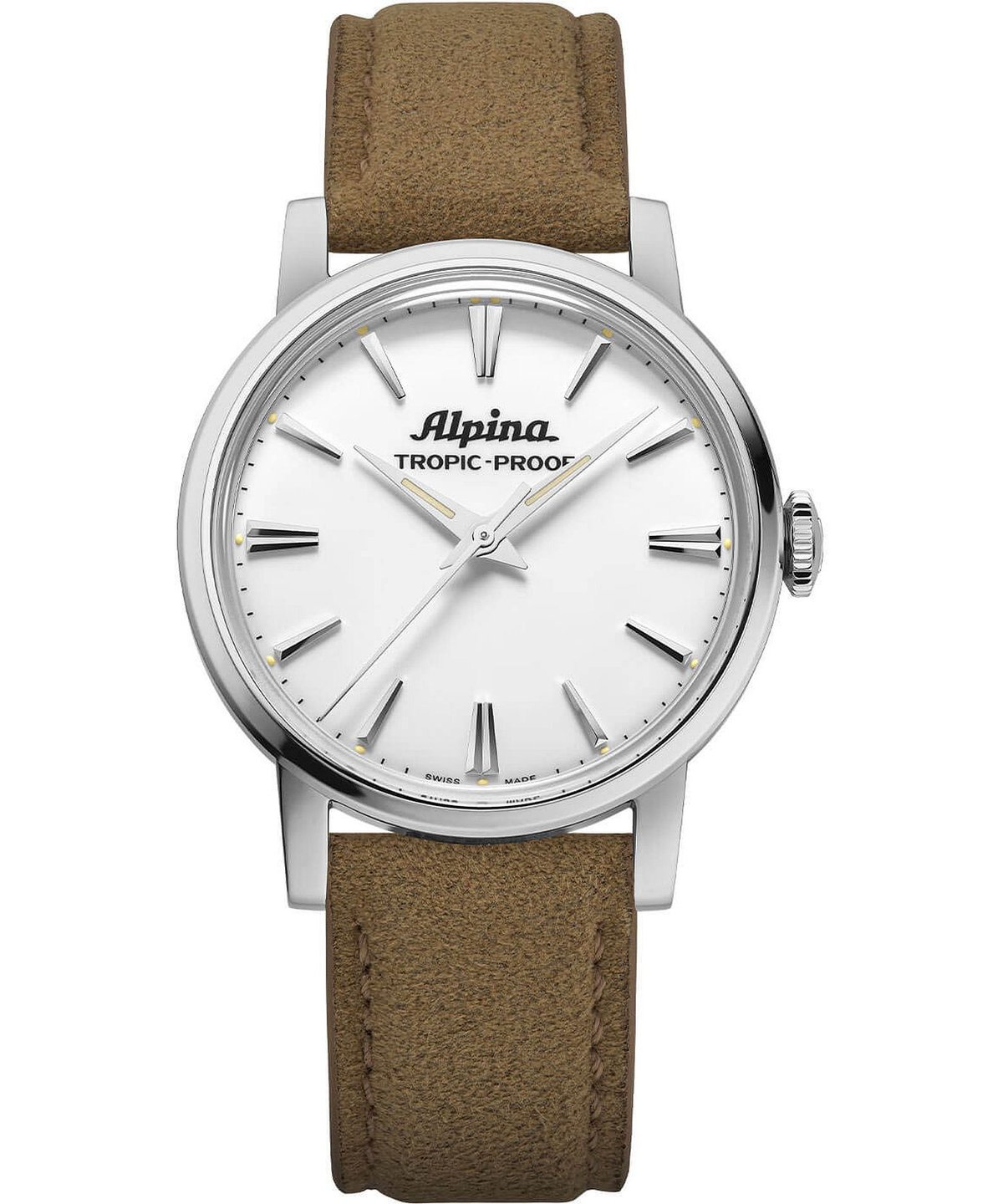
The first thing you notice in the metal is proportion. The Tropic-Proof Handwinding wears like a watch from another era: polished stainless steel, a slim profile, and a case that sits low and close rather than perching on top of the wrist. Alpina has not published detailed case dimensions for this reference, and rather than invent numbers, it is more useful to describe the effect. This is a watch that slides under a shirt cuff without a fight. It looks correct on a leather strap and it does not dominate a wrist.
The dial is the reason to buy it. The tropical treatment — warm, slightly sun-faded tones with period-appropriate printing — reads as patina rather than pastiche. Vintage watch collectors pay enormous premiums for dials that have aged into this kind of warmth, and here it arrives new, without the fragility or the servicing anxiety of an actual sixty-year-old watch.
Printing is clean and restrained, and the layout is time-only, which is the right call. There is no date window interrupting the balance, no sub-dial complicating an already busy surface. There is also no lume, which is consistent with the heritage brief: this is a design object, not a night-shift tool. The crystal is sapphire, a sensible modern concession that keeps the watch wearable without the scratch anxiety that comes with an acrylic box crystal. Owners on forums have made the usual case for acrylic and its warm distortion; they are not wrong aesthetically, but sapphire is the pragmatic answer for a watch people will actually wear.
The movement
Alpina's specification for this reference is intentionally thin. The brand describes a hand-winding mechanical movement and declines to publish a caliber designation, a power reserve figure, or a frequency. That is frustrating for the kind of buyer who reads spec sheets the way other people read box scores, and it is worth being honest about rather than filling the gap with assumed numbers.
What can be said is that this is a manual-wind Swiss three-hander, which is a well-trodden category. Manual movements of this type are typically simpler than their automatic equivalents — fewer components, no rotor, no oscillating weight — and that simplicity pays off in two ways. First, the case can be slimmer, because there is nothing swinging around inside demanding vertical clearance. Second, the movement is straightforward to service, which keeps long-term ownership costs in a sane place.
The experience of winding it is the point. A manual watch creates a small, tactile relationship with its owner: a few turns in the morning, a feel for the tension as the mainspring fills, a sense of the mechanism as a mechanism. In a hobby increasingly dominated by watches that are worn as objects and never touched, that is not a small thing. It is the whole thing.
How it wears
The Tropic-Proof Handwinding is a watch that disappears into a cuff. Because there is no rotor moving around inside, the whole object feels denser and more solid than automatic watches of a similar footprint — you can feel the mass of the movement rather than the emptiness around it. It settles low against the wrist and stays there. If you are accustomed to chunky sports watches, the first ten minutes may feel underpowered. By day three, everything else in the box starts to feel loud.
On the wrist, most of the personality lives in the dial, and the leather strap the watch ships on is soft from the start. The pin buckle is a small, honest detail — no micro-adjust ratchet, no signed deployant, no over-engineering. It looks particularly good under an oxford cuff, but it also reads well with technical outerwear, which is a strange sentence to write about a heritage piece and an accurate one nonetheless. Owners should expect to swap the strap; the case is a generous collaborator with almost any leather, and a grey or olive NATO completely changes its character.
Accuracy and daily life
Alpina does not submit this reference for chronometer certification, and nobody should buy a hand-wound heritage watch expecting quartz discipline. A well-regulated Swiss manual-wind three-hander of this type typically settles into a rate measurable in a few seconds to a quarter of a minute per day, and that is the correct expectation to carry into ownership. What matters more than the raw number is consistency: a hand-wound movement that gets wound at roughly the same time every morning tends to hold a steady rate rather than wandering.
The practical consequence is that this is not a set-and-forget daily driver. It rewards attention. If you travel with it, you will be resetting it. If you leave it in a drawer for a week, it will stop. For some buyers that is a dealbreaker; for others it is precisely the point. The watch asks something of you every morning, and the asking is the relationship.
Water resistance is not specified in the published material for this reference, which is worth flagging honestly. A watch carrying the Tropic-Proof name suggests some measure of moisture protection, but without a stated rating it should be treated as a fair-weather companion: rain, hand-washing, and daily life yes; swimming and showers, no. Anyone who needs a watch for the pool should look at Alpina's Seastrong line instead.
Occasions
This is a genuinely versatile watch, in the way that mid-century tool watches always were. It works as a daily wearer for office life, reads dressy enough under a jacket, handles weekends and travel without complaint, and carries enough visual interest to be a conversation piece without ever becoming the loudest thing in the room. It is not a formal watch in the black-tie sense, and it is not a sports watch in the pool sense. Everything in between is fair game.
Value, and the honest word on investment
Alpina's heritage pieces have generally retailed in the region of two thousand dollars, and this reference sits comfortably in that territory. On the secondary market, expect the usual first-owner depreciation that afflicts most mid-market Swiss watches; pre-owned examples typically trade meaningfully below retail, which makes the used market the smarter entry point for anyone patient enough to wait.
It bears saying without hedging: this is not an investment. Alpina is a brand with authentic heritage but limited auction gravity, and no one is fighting over allocations. There is no meaningful auction history to point to. The value proposition here is entirely experiential — a well-made, characterful, hand-wound Swiss watch at a price that does not require a justification speech. Buyers who need their watches to hold value should look elsewhere. Buyers who want a watch they will actually wind every morning are getting a very good deal.
Alternatives worth considering
The obvious cross-shop is the Oris Divers Sixty-Five, which delivers vintage dive-watch styling with an automatic movement and a stronger secondary market — more watch, more money, more conventional. The Longines Heritage Classic offers a dressier, more formal reading of mid-century design and a name with broader recognition. The Hamilton Khaki Field Mechanical is the other great affordable hand-wound heritage piece, though its military bearing is a different mood entirely. And for buyers drawn to small independents, the Serica 4512 delivers hand-wound, vintage-proportioned everyday watchmaking with sharper finishing per dollar.
At the entry end, the Timex Marlin Hand-Wound proves the formula scales down remarkably well for a fraction of the price, while the Vario 1945 and the Baltic MR01 show how far microbrands have pushed archive-inspired design. None of them carry Alpina's specific history, and that history is part of what you are paying for.
The verdict
The Alpina Tropic-Proof Handwinding is not trying to win a specification fight, and that is exactly its appeal. It is a handsome, honest, hand-wound heritage watch with a dial that does most of the emotional work and a price that does not demand an explanation. It has real limitations — no published movement detail, a soft resale curve, an unspecified water rating — and none of them matter much if you are buying it for the right reasons.
Buy it if you want a mechanical object that asks something of you every morning. Skip it if you need your watch to hold value or survive a pool. In a market that keeps shouting, this is a watch that knows how to speak at conversational volume — and increasingly, that is the rarer thing.