There are two kinds of watch reviews. The first is a spec-sheet audit — movement, case, water resistance, done. The second is the one that matters: what the thing does to you when you look down at your wrist in a meeting and lose the thread of the conversation. The anOrdain Model 3 Method belongs firmly to the second category, and it's a better watch for it.
Glasgow doesn't get mentioned in the same breath as Geneva, and that's precisely the point. anOrdain's workshop sits in a city better known for shipyards, murals and miserable weather than for grand feu enamel — and yet, since 2015, a small team there has been doing something the Swiss largely stopped bothering with: firing dials in a kiln, one at a time, and accepting that a meaningful percentage will crack and go in the bin.
The Model 3 Method is the clearest expression of that stubbornness. It's not the most complicated watch you can buy at the price. It might be the most human.
The Glasgow Problem
anOrdain was founded in Glasgow in 2015 by a small team led by designer Lewis Heath, and the founding premise was almost perverse: build a watch brand around vitreous enamel at a moment when the entire industry had decided enamel was too slow, too expensive and too fragile. The Swiss hadn't lost the skill. They'd done the maths and walked away.
What anOrdain did instead was build its own kiln operation in Scotland and treat the failure rate as a cost of doing business rather than a reason not to. Vitreous enamel is powdered glass fused to a metal blank at around 800°C. It's fired repeatedly, each pass risking a crack, a bubble or a colour shift. The dials that survive have a depth and translucency that no printed or lacquered dial can fake — a quality that photographs badly and reads beautifully in person.
That's the context you need before you judge the Model 3 Method. This is not a brand buying a dial from a supplier and slapping a logo on it. The dial is the product. Everything else is packaging.
The Dial Is the Watch
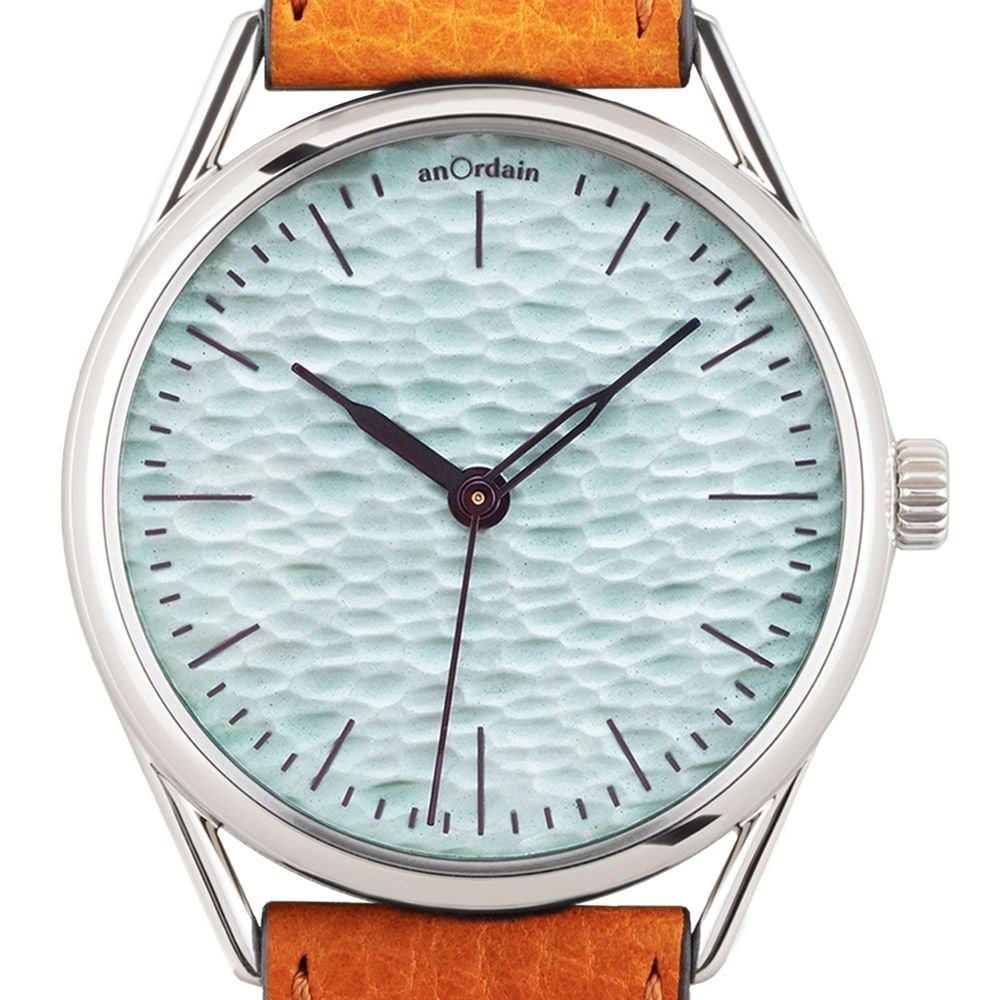
Strip away the marketing and the Model 3 Method is a three-hander with no date, no lume and no bezel furniture. What's left is a dial, and it's the reason the watch exists.
Enamel has a trick that no other dial finish quite manages: at arm's length it reads as a single, flat, quiet tone, and up close it opens up into something with actual physical depth. It shifts as the light moves across it. It doesn't sparkle. It doesn't sunburst. It just sits there, looking like a material rather than a treatment.
The layout is deliberately typographic — clean indices, no clutter, nothing competing with the surface. The absence of a date window matters more than most buyers realise: it keeps symmetry, it keeps the enamel uninterrupted, and it removes the single most common visual compromise in modern watch design. anOrdain could have added a date and sold more watches to people who think they need one. They didn't.
That restraint is the entire personality of the piece. There's no lume, which tells you exactly what kind of watch this is: not a tool, not a travel companion for a night flight, not something you wear into water. A dress watch that doesn't insist you dress for it.
Case, Crystal and the Absence of Noise
The case is stainless steel with a brushed finish that reads matte rather than shiny, and a sapphire crystal over the dial. The overall design language is restrained to the point of anonymity — and that's a compliment. There's no chamfered lug drama, no crown guards, no bezel taper designed to catch a camera flash. It's a case built to hold a dial and disappear.
That restraint pays off in versatility. The Model 3 Method doesn't look out of place under a shirt cuff at a board meeting or with a knit and jeans on a Saturday. It doesn't announce a category, which means it doesn't fight your wardrobe.
One thing worth being clear about: this is not a watch built for abuse. No lume, no meaningful water resistance, no shock-resistant architecture. Treat it as a dress piece. Keep it out of the pool. Don't wear it to change a tyre. It will reward that care for decades.
The Movement Nobody Brags About
Inside is a Swiss automatic running at 28,800 vph with roughly 40 hours of power reserve. It's built on a Sellita ébauche, it isn't COSC-certified, and it isn't in-house. anOrdain is entirely upfront about this, and they're right to be.
Here's the thing about movement snobbery: it exists because movements are expensive, and expensive is easy to signal. But at this price point, every dollar spent on a decorated in-house movement is a dollar not spent on the dial. anOrdain made the call that the dial is what you look at forty times a day and the rotor is what you look at approximately never. That's the correct priority, and any collector who's honest with themselves knows it.
What you get is a competent, proven, easily serviced automatic with a clean industrial finish. It won't win a finishing contest against a Glashütte three-quarter plate. It will also never be the reason the watch disappoints you.
On the Wrist
The Model 3 Method is a watch that disappears into a cuff and then surprises you when you look down. The lugs drop rather than flare, the case sits flat, and because there's no bezel clutter or date aperture, the whole thing reads quieter and more compact than you'd expect from the numbers on paper.
Balance is the standout. There's no top-heaviness, no rotational pull, no sense that the case is fighting the strap. On a smaller wrist it centres cleanly. On a larger wrist it reads as a deliberate, understated choice rather than something undersized.
The strap deserves its own paragraph. anOrdain ships the Model 3 Method on a leather strap with a pin buckle, and it's the kind of leather that's soft from day one rather than requiring a month of break-in. It tapers well, it doesn't crease badly, and it doesn't look like a placeholder the brand expected you to replace immediately. Plenty of watches at twice the price ship with worse.
Presence-wise, this is a four out of five. It doesn't shout across a room, but the enamel has a depth that catches eyes at a dinner table, and that's the more interesting kind of attention anyway.
Accuracy and Daily Life
This is a Swiss ébauche at 28,800 vph, not a chronometer. Expect a few seconds to roughly ten seconds a day of variance depending on position and how consistently you wear it. If you're the type who syncs to an atomic clock every morning, this will annoy you. If you set it once a week while you're winding it, you'll never think about it again.
There's no COSC certificate and no hacking-second theatre. What there is, is a watch that starts when you pick it up and doesn't ask anything of you. Power reserve of around 40 hours means it'll survive a weekend off the wrist and be running on Monday morning.
What It Costs, What It Holds
anOrdain sells direct, in small batches, with production rather than marketing as the bottleneck. That structure has a predictable effect on the secondary market: because the queue is long and the output is genuinely limited, pre-owned examples tend to trade at or slightly above retail rather than below it. Retail sits in the region of $2,950, and secondary pricing generally settles somewhere in the high two-thousands to mid three-thousands depending on condition and dial.
That's a stable picture, not a speculative one. Nobody is buying anOrdain to flip it at a Geneva auction — and there's no meaningful auction history to point to. But the waitlist premium means the downside is limited in a way it simply isn't for a mass-produced dress watch bought at full retail.
Service runs through anOrdain in Glasgow. That's excellent for the watch and mildly annoying for anyone outside the UK — budget for shipping and turnaround rather than dropping it at a local watchmaker.
The Competition
If you want genuine grand feu enamel and you have a serious budget, the Breguet Classique 5177 is the reference point, and it costs many multiples of this. If you want the closest thing to real enamel at an accessible price, Seiko's Presage enamel dials get you part of the way there — though the finishing, exclusivity and depth aren't comparable.
The more interesting comparison is Kurono Tokyo, which shares the same indie philosophy: a tiny studio betting everything on the dial, selling out before most people hear about it. And for anyone who wants the same quiet, design-led dress-watch energy without the enamel, the Nomos Tangente is a cleaner, more industrial German answer to the same question.
Where the Model 3 Method wins is in the combination. Nobody else at this price is firing enamel in-house, in small batches, and selling it direct without a dealer margin baked in.
Verdict
The Model 3 Method is not trying to win a specification argument, and if you force it into one, it will lose. What it does instead is put a genuinely hand-made dial — glass fired in a kiln, cracks and rejects and all — on a wrist at a price the Swiss stopped offering decades ago.
Buy it if you look at your watch more than you talk about it. Buy it if you like the idea of a dial that a machine couldn't make. Skip it if you need a certificate number to feel good about a purchase. The people who get this watch already know which side of that line they're on.