The Allure of the Understated: Why the Archimede 1950-1 Matters
In a world of oversized chronographs and ceramic bezels that scream for attention from across the boardroom, the Archimede 1950-1 (Ref. 1950-1) is a quiet revolution. It is a watch that understands the power of silence. As an analyst for Vivir, I spend my days looking at market trends, resale values, and the shifting tides of 'hype.' What I see increasingly is a fatigue among the young elite—a weariness toward the artificial scarcity of the major houses. We are looking for something real. We are looking for the 1950-1.
The Ickler Pedigree: More Than Just a Name
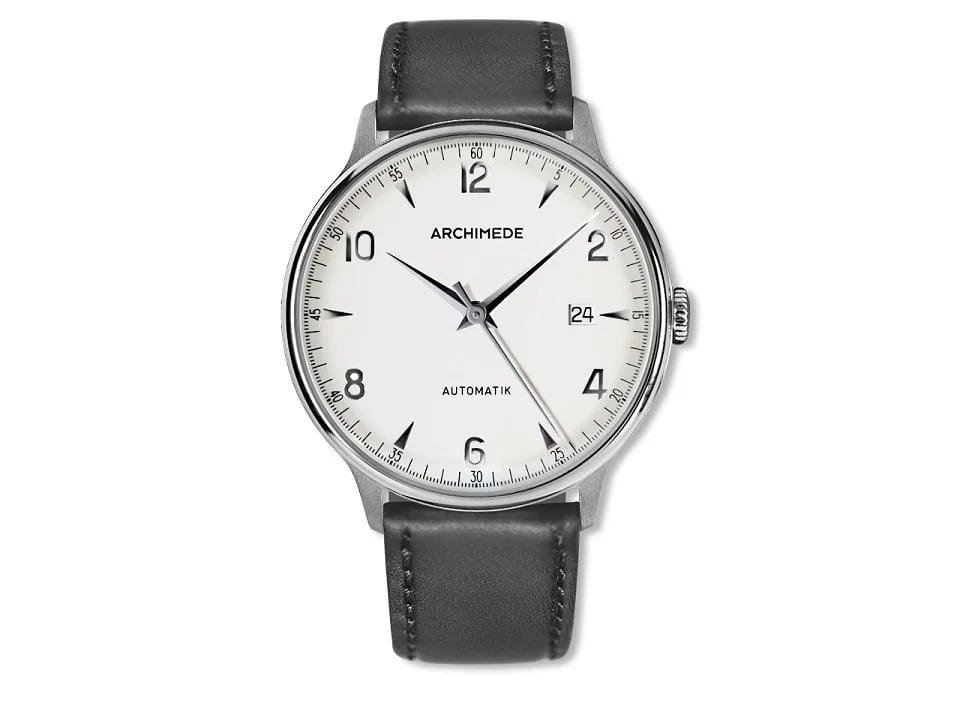
To understand Archimede, you must first understand Ickler. Since 1924, the Ickler family has been crafting watch cases in Pforzheim, Germany. They are the 'maker's maker.' While many Swiss brands outsource their cases to anonymous factories in the Far East, Archimede builds theirs in-house. When you run your thumb along the brushed flanks of the 1950-1, you aren't feeling the result of a cost-cutting measure; you are feeling nearly a century of metallurgical mastery. The transition from the polished bezel to the brushed mid-case is executed with a precision that puts many five-thousand-dollar watches to shame.
Design Language: A Mid-Century Love Letter
The design of the 1950-1 is, as the name suggests, a tribute to the golden era of horology. The 40mm stainless steel case is surprisingly contemporary in size but vintage in spirit. The dial is slightly domed, a detail that catches the light in a way that flat dials simply cannot. The hour markers are applied, adding a layer of depth that speaks to the watch's quality. The hands are curved at the tips to follow the contour of the dial—a hallmark of high-end watchmaking that is often omitted in this price bracket.
The Movement: Practicality Over Pretense
Under the hood, we find the Miyota 9015. Now, I can already hear the purists in the back of the room sighing. 'A Japanese movement in a German watch?' they ask. But let’s look at the data. The 9015 is a thin movement, measuring only 3.9mm in height. It is this specific dimension that allows the 1950-1 to maintain its incredible 9.8mm total thickness. If Archimede had opted for a standard Swiss ETA 2824, the watch would have gained a millimeter of 'bloat.' In the world of dress watches, a millimeter is a mile. The 9015 is reliable, hits 28,800 vibrations per hour, and is essentially bulletproof. For the young collector who wants a watch that works every time they pick it up, it’s a logical, market-driven choice.
Wrist Feel and Daily Utility
The 1950-1 is a 'ghost' on the wrist. It weighs so little and sits so low that you genuinely forget you are wearing it until you need to check the time. This is the ultimate 'daily' for the professional. It doesn't snag on a jacket lining, it doesn't bang against the edge of a MacBook, and it doesn't draw unwanted attention in a neighborhood where you'd rather keep your wealth private. The 44mm lug-to-lug means it fits perfectly on wrists ranging from 6 inches to 8 inches, making it a versatile asset in any portfolio.
The Investment Thesis: Hold vs. Flip
Let’s talk numbers. You are paying roughly $780 for this watch. In the pre-owned market, you’ll see them trade between $500 and $650. This is not a 'flip' watch. You aren't going to buy this on Monday and sell it for a profit on Friday. However, the value proposition lies in the *utility-per-dollar* ratio. Unlike a high-maintenance vintage piece that requires a $1,000 service every three years, the Archimede is a low-cost, high-reward hold. It is the 'blue chip' of the entry-level market—stable, reliable, and always in style.
The Competition: Where Does It Stand?
When compared to the Junghans Max Bill, the Archimede offers a superior case and a sapphire crystal (the Max Bill often uses plexiglass which scratches if you even look at it wrong). Compared to Nomos, the Archimede is a third of the price. While Nomos offers the prestige of an in-house Glashütte movement, the Archimede offers the Ickler case, which many would argue is actually the more impressive piece of engineering at this level.
Conclusion: The Final Verdict
The Archimede 1950-1 is not a watch you buy because you want to show off. It’s a watch you buy because you understand the mechanics of value. It is a testament to the idea that you don't need to spend ten thousand dollars to own a piece of horological integrity. For the wealthy collector who wants to prove they have more than just their father's bank account—that they have *taste*—the 1950-1 is the only choice. It is the smartest $800 you will ever spend on your wrist.