The Pforzheim Pedigree: Why the Case Matters
To understand the Archimede 1950-4, you first have to understand the Ickler family. In the watch world, many 'manufacturers' are actually assemblers, buying cases from one factory, dials from another, and movements from a third. Archimede is different. Because they are owned by Ickler—one of the few remaining high-end case makers in Germany—the 1950-4 benefits from a level of machining that is frankly unheard of at the sub-$1,000 price point.
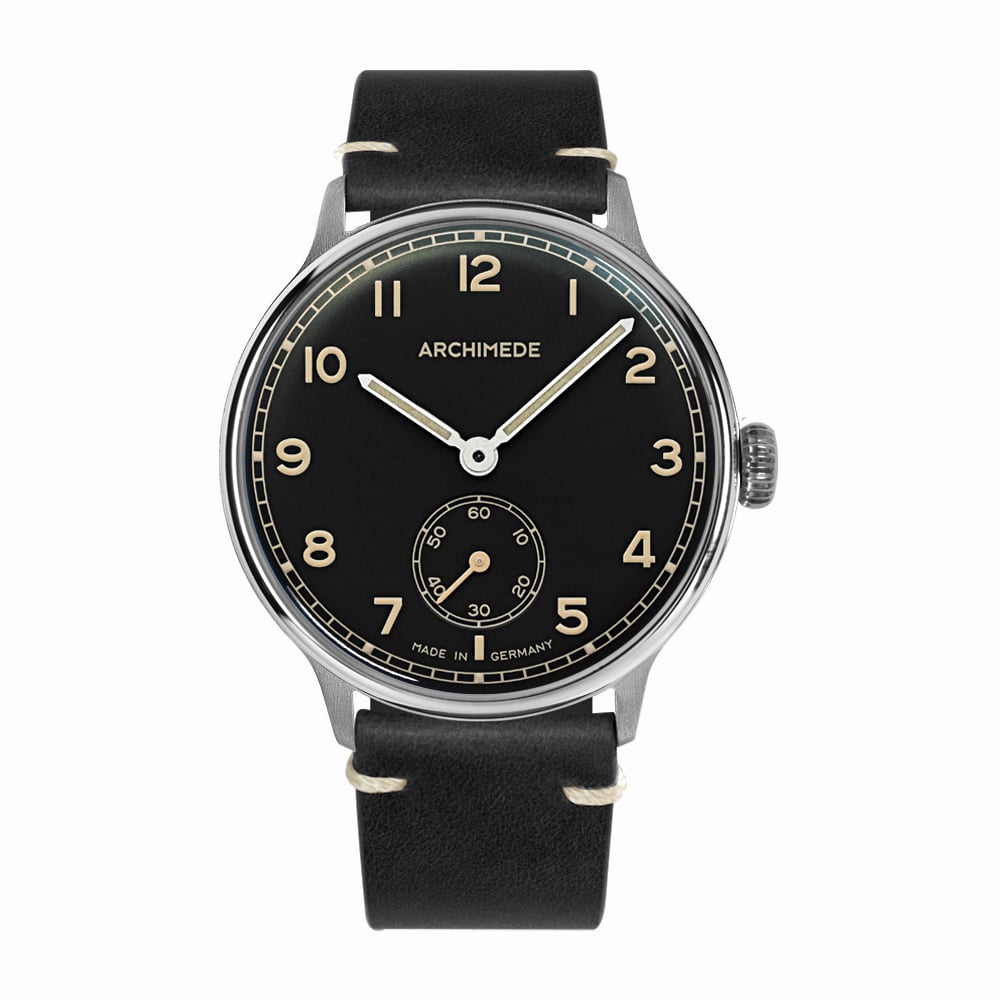
The case of the 1950-4 is a masterclass in subtlety. It features a brushed finish on the sides that contrasts beautifully with a polished bezel. This interplay of light gives the watch a three-dimensional quality that cheaper, stamped cases simply cannot replicate. When you run your finger along the lugs, there are no sharp edges or inconsistent gaps. It feels like a singular, purposeful object.
Design Language: A Love Letter to the Fifties
The dial of the 1950-4 is where the '1950' moniker truly earns its keep. It features a gentle dome, a hallmark of mid-century watchmaking that adds warmth and character. The markers are applied, not printed, giving the face a depth that catches the light as you move your wrist. The hands are slightly curved at the tips to follow the contour of the dial—a detail usually reserved for high-end horology like Grand Seiko or Vacheron Constantin.
In terms of cultural relevance, the 1950-4 taps into the 'New Vintage' movement. We are seeing a shift away from the oversized 'look-at-me' watches of the 2010s toward pieces that prioritize proportions and wearability. This watch looks just as at home with a vintage Porsche 356 as it does with a modern MacBook Pro. It bridges the gap between the analog past and the digital present.
The Movement: Slim, Reliable, and High-Beat
Purists might scoff at the Japanese Miyota 9015 movement inside a German watch, but that would be a mistake. The 9015 was a strategic choice. It is significantly thinner than the standard Swiss ETA 2824 or Sellita SW200. Without this movement, Archimede couldn't have achieved the 9.8mm case thickness that makes this watch so special.
From a performance standpoint, the 9015 is a beast. It beats at 28,800 vibrations per hour, providing a smooth second-hand sweep that feels premium. While the rotor can be a bit noisy—a common trait of the 9015—it’s a small price to pay for a watch that wears this comfortably. It’s a movement built for the long haul, requiring minimal maintenance and offering parts availability that ensures it can be serviced for decades to come.
The Vivir Verdict
The Archimede 1950-4 is a testament to the power of 'less is more.' In a market saturated with derivative designs and over-hyped collaborations, Archimede has stayed true to its roots: high-quality German engineering at a fair price. It is a watch for the collector who doesn't need to prove anything to anyone else. It’s a personal pleasure, a tactile joy, and a design icon in its own right.
If you are looking to start a collection or simply need a reliable, stylish daily driver that can transition from the office to a high-end dinner, the 1950-4 should be at the top of your list. It is, quite simply, one of the best-valued watches in the world today.